
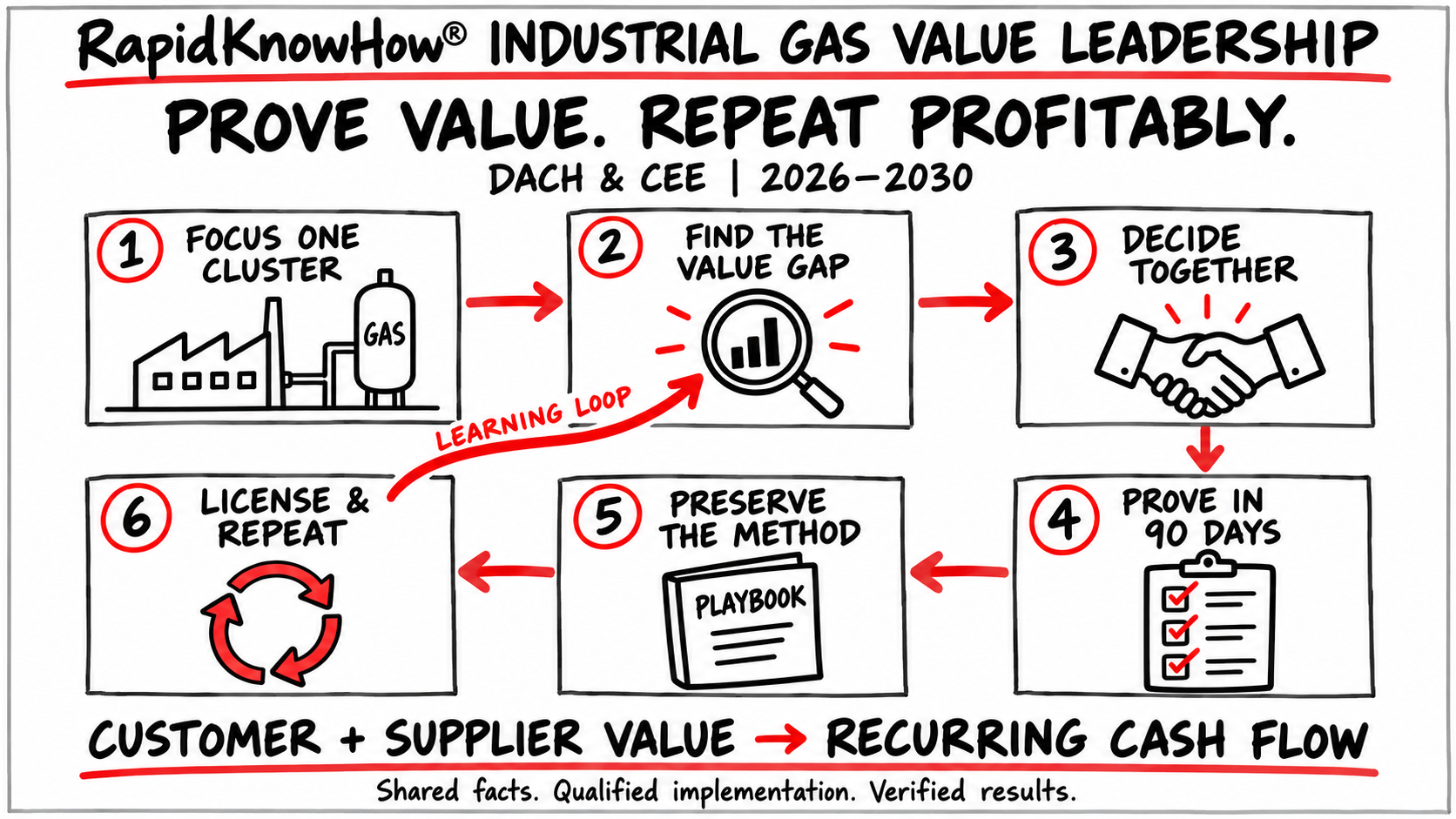
CONTROL THE CRITICAL FLOWS. PROVE TOTAL VALUE. REPEAT PROFITABLY.
Your opportunity: improve industrial gas reliability and economics by connecting consumption, replenishment, supplier performance and actual cash effects in one shared decision. RapidKnowHow® provides the decision structure; your team and qualified partners implement and verify.
Our 2030 ambition: become the leading independent supplier–customer decision and value-orchestration system in a defined DACH–CEE industrial gas segment. This is a proposed strategy, not an achieved market position or a guarantee.
01 — SIGNAL: Find your critical industrial gas flow
Begin with one site, one gas and one costly problem: emergency deliveries, excess inventory, process waste, disputed charges or supply-related interruptions. Establish the baseline with operations, procurement and finance.
Proposed initial focus: mid-sized manufacturers using bulk nitrogen or oxygen within the Brno–Bratislava–Vienna cluster. Extend into Bavaria, Silesia and further DACH–CEE markets when the method is repeatable.
02 — INTERPRET: Turn shared facts into value
Suppliers already offer gas management, telemetry and digital services. Our proposed differentiation is to connect those inputs to a jointly understood decision and verified customer–supplier economics. Local service availability must be checked.
| Critical flow | Baseline measure | Possible action |
|---|---|---|
| Consumption | Gas per unit of acceptable output | Investigate waste or process variation |
| Replenishment | Emergency deliveries and stockouts | Coordinate ordering and deliveries |
| Storage | Inventory, dwell time and relevant losses | Review stock and storage economics |
| Commercial | Total supply cost and invoice discrepancies | Clarify charges and contractual options |
| Supply model | Comparable lifecycle cost and reliability | Evaluate cylinders, bulk or on-site alternatives |
| Production | Supply-related interruptions | Review resilience and backup arrangements |
03 — DECIDE: One improvement with joint economic value
SELECT ONE FEASIBLE IMPROVEMENT. NAME ONE OWNER. AGREE ONE PROOF STANDARD.
Priority = expected net combined benefit × evidence confidence ÷ implementation effort. Use documented ratings and strictly positive effort. This heuristic supports prioritization; it is not a statistical forecast.
Evaluate customer and supplier benefit separately and remove double counting. A price reduction transfers value; fewer unnecessary deliveries can create combined value. Qualified engineers approve technical changes. Safety, purity and production requirements constrain every decision.
04 — ACTION: Choose your concrete RapidKnowHow® system
| Your next question | Self-guided PDF offer | Practical output |
|---|---|---|
| Where is our largest cash gap? | Find the Cash Gap™ | A baseline, prioritized gaps and three actions |
| Which option should we approve? | Make the Board Decision™ | A comparison, decision, accountable owner and mandate |
| How does our team prove the outcome? | Start the 90-Day Cash Proof™ | An implementation plan, reviews and evidence record |
These are existing self-guided PDF systems. Your team applies them. Consulting, technical engineering, implementation and independent verification services are not included. Check current product scope and checkout total. Dedicated industrial gas templates, training and license terms remain development requirements.
Who pays? The customer or supplier purchasing the system under an explicit agreement. Disclose compensation and commercial interests when comparing alternatives.
Smooth process: reader opportunity → relevant offer → purchase → automatic PDF delivery after confirmed payment → customer-led application. Explore the Shop.
TOP 3 ACTIONS NOW
- FOCUS: choose one bulk-gas customer segment and critical flow; name the strategy owner.
- CONNECT: operations, supplier representatives and finance establish shared facts, costs and a verification standard.
- PROVE: approve one qualified implementation, appoint the owner and schedule a 90-day review.
05 — VERIFY: Prove one result within 90 days
| Period | Task | Evidence |
|---|---|---|
| Days 1–15 | Agree baseline, scope, owner and proof standard | Shared data and approved plan |
| Days 16–60 | Implement and review weekly; confirm baseline and ownership at day 30 | Cost, reliability, quality and deviation records |
| Days 61–90 | Finance validates effects; decide whether to repeat | Actual benefit, implementation costs and delivery economics |
Customer net benefit = avoided expenditure + realized additional contribution margin − implementation and incremental operating costs. Measure supplier effects separately: delivery costs, service economics and realized capacity benefits.
Report one-time working-capital release separately. Released capacity and projected savings count as cash benefits only when economic effects are demonstrated. Contribution margin is not free cash flow.
Where licensing is appropriate, review the Decision Governance Licensing System and confirm product scope and permitted use. Existing GEO licensing must not be assumed to cover industrial gas.
06 — COMPOUND: Preserve and repeat verified value
BASELINE → DECISION → IMPLEMENTATION → VERIFIED CASE → REUSABLE METHOD → LICENSE → RENEWAL AND EXPANSION.
Preserve authorized, anonymized cases. Standardize decision templates, implementation playbooks and financial verification. Train qualified partners. Expand when customer benefit, delivery economics and repeatability are demonstrated.
Your 2026–2030 development path
These are proposed decision gates, not forecasts.
| Year | Task | Required proof |
|---|---|---|
| 2026 | Complete one paid application | Customer benefit and positive delivery economics |
| 2027 | Repeat with unrelated customers | Transferable method and repeat purchases |
| 2028 | Expand through qualified partners | Consistent results across sites |
| 2029 | Build renewal and multi-site adoption | Recurring revenue and reduced founder dependence |
| 2030 | Independently assess market position | Credible comparison within the defined category |
Track paying organizations, renewal, verified customer benefit, delivery margin and recurring cash flow. Claim market leadership only when a credible competitor comparison supports it.
Conclusion
CUSTOMER + SUPPLIER VALUE → RECURRING CASH FLOW.
FOCUS → CONNECT → DECIDE → ACT → PROVE → PRESERVE → LICENSE → COMPOUND.
ACTION CHECKLIST
- One customer segment, gas flow and accountable buyer.
- Shared baseline and finance-reviewed proof standard.
- One relevant paid system and clear next action.
- Qualified implementation protecting safety and quality.
- Day-30 baseline check and day-90 result review.
- Separate customer benefit, supplier benefit and actual cash effects.
- Protect confidential data and preserve authorized reusable learning.
- Scale only after customer value and profitable repeatability are demonstrated.
FINAL PASS: customers and suppliers gain demonstrable value, trained partners repeat delivery, and RapidKnowHow® earns profitable recurring cash flow. First review: remove the strongest chokepoint before adding functions.
Sources and evidence limits
Linde: gas management services; Linde: bulk supply and telemetry; Air Liquide: Industrial Merchant; Messer: e-monitoring.
Original RapidKnowHow® strategic framework, 4 October 2026. Proposed positioning, illustrative applications and milestones are not achieved results. Local supplier capabilities, customer data and contract economics require case-specific verification. Purchase and PDF delivery were not retested for this publication.
RapidKnowHow® — THE DECISION COMPANY™
Industrial Gas Leadership 2030
PROVE VALUE. THEN SCALE.
Watch the 60-second roadmap: 10 strategic actions for DACH and CEE, 2026–2030.
Start with ONE customer challenge. Use the Industrial Gas Action Guide to turn your first action into a measurable result.
RapidKnowHow® — Leading Industrial Gas Opportunity Signal Identifier in DACH & CEE