
The next leadership divide will not be between large and small companies. It will be between leaders who orchestrate AI into the operating system of their business and those who continue to treat AI as an optional add-on.
The first group will accelerate decision speed, customer relevance, and free cash flow.
The second group will become slower, more fragmented, and easier to outcompete.
This is why the AI-shift is not primarily a technology topic. It is a leadership topic.
AI does not create strategic advantage by its mere presence.
Strategic advantage emerges when leaders redesign how insight is created, how decisions are made, how teams execute, and how value is delivered.
In other words, the real question is not whether a company uses AI.
The real question is whether leadership has built a coherent AI-shift system.
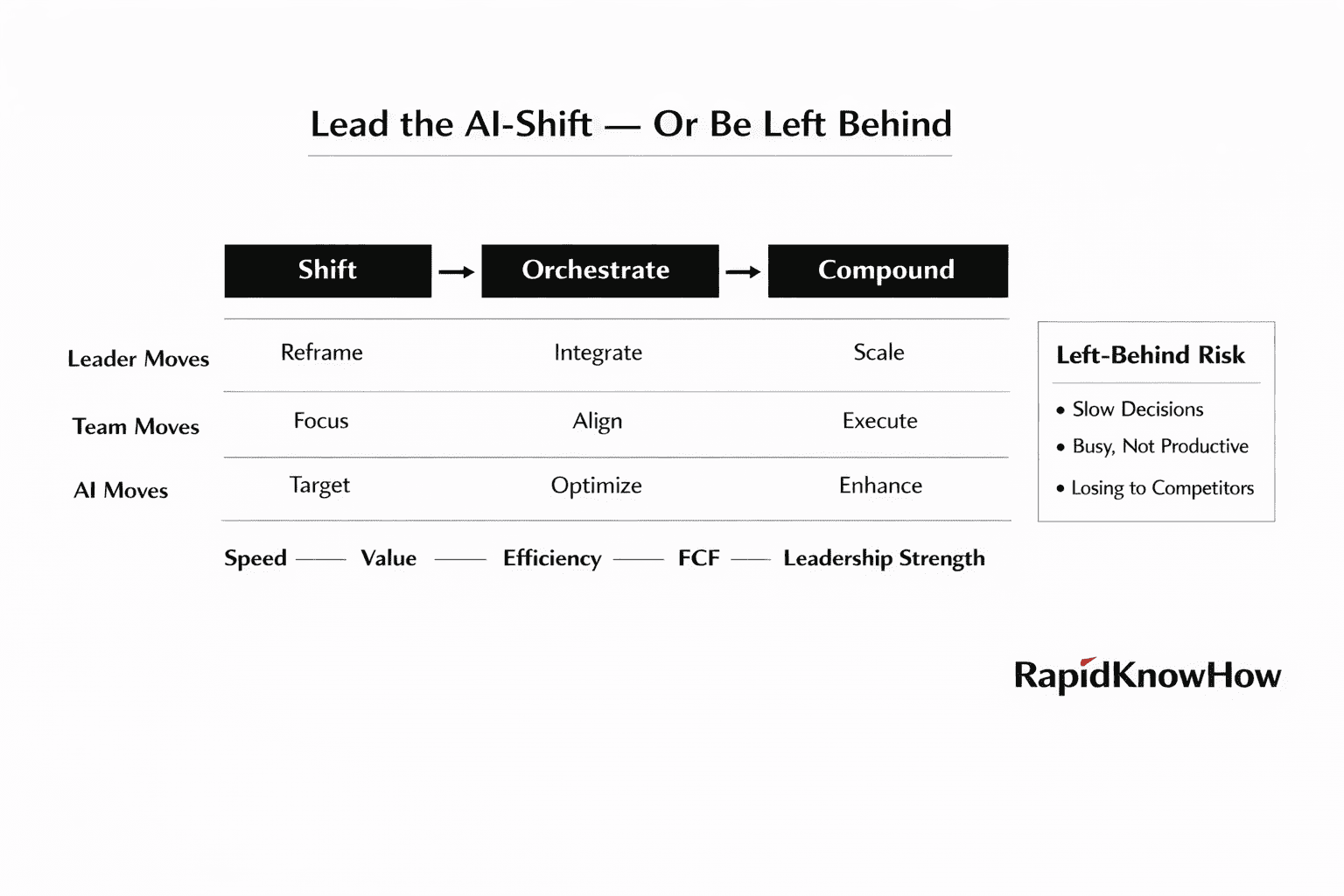
The RapidThrive view is simple. Leaders must move through three stages: Shift, Orchestrate, Compound.
First, leaders must Shift. This means changing the mental model. AI is not a gadget, and it is not a separate innovation lab. It is a new way to run the business.
The leader must define where AI can create the largest value gap between today’s reality and tomorrow’s opportunity.
That value gap may be faster customer response, shorter cycle times, better forecasting, lower operating friction, or more scalable know-how.
Without this first shift in thinking, AI remains noise. With it, AI becomes direction.
Second, leaders must Orchestrate. This is the decisive stage. Most organizations fail here because they scatter small pilots across departments.
One team tests prompts, another experiments with dashboards, and a third buys software. The result is activity without compounding value.
Orchestration means linking leaders, teams, workflows, customer needs, and AI capabilities into one operating logic. The aim is not more experimentation. The aim is fewer handoffs, faster decisions, better learning loops, and a visible connection between AI use and business outcomes.
This requires a discipline that many traditional organizations lack.
Leaders must decide what the top priorities are, who owns them, what metrics matter, and how progress is reviewed.
Weekly review rhythms matter.
Clear KPI logic matters.
A system perspective matters. AI only compounds when it is embedded into recurring decisions and recurring work.
Third, leaders must Compound. This is where the business effect becomes visible.
Time savings alone are not enough.
The real value comes when saved time is converted into faster throughput, better customer value, sharper pricing, lower friction, and stronger free cash flow.
AI-driven businesses create an advantage because they learn faster. They detect patterns earlier. They adapt sooner. They reduce waste while increasing relevance. Over time, this compounds into strategic resilience.
This compounding effect is why leadership matters so much.
A weak leader may buy AI tools yet still preserve slow structures.
A strong leader redesigns the system around outcomes.
That difference becomes visible very quickly.
In AI-lagging organizations, reporting remains slow, teams remain overloaded, and decisions still depend on manual rework.
In AI-shifting organizations, leaders gain live insight, teams work with greater clarity, and the business becomes more adaptive.
The risk of being left behind is therefore very real.
It is not just that competitors may use better tools. It is that they may build a superior operating rhythm.
They may answer customers faster, forecast more accurately, reduce internal drag, and improve execution quality at lower cost.
Traditional organizations then enter a dangerous pattern: slow decisions become lost margin, lost margin reduces strategic room, and reduced room makes future adaptation even harder.
Decline begins as operating friction long before it becomes visible in market value.
The solution is not complexity. It is disciplined simplicity.
A leader should define one AI-shift ambition for the next twelve months, select three priority use cases, assign ownership, redesign the relevant workflow, and review outcomes weekly. This creates movement.
Once one system works, it can be scaled across functions. The winning logic is not “do everything with AI.” The winning logic is “build one working AI-led system, then expand.”
RapidThrive therefore gives leaders a practical formula:
Leadership Intent + Workflow Redesign + AI Support + Review Discipline = Compounding Strategic Value
This formula helps leaders avoid the two common traps.
- The first trap is over-enthusiasm without operating structure.
- The second is skepticism that delays action until the market has already moved.
Strong leaders avoid both. They move early, but they move with system discipline.
In the end, the AI-shift changes the meaning of leadership itself.
Leaders are no longer only decision makers. They become orchestrators of intelligence, execution, and learning. Their role is to align people and AI around outcomes that matter.
They build the conditions under which speed, value, efficiency, and cash flow improve together.
That is the core message of the RapidThrive System for Leaders.
The future belongs neither to the most technical company nor to the most traditional one. It belongs to the company whose leaders can turn AI into a living operating system for better results.
One-line summary:
The leader of the next cycle will not be the company with the most AI tools, but the one that leads the most disciplined AI-shift system.
RapidKnowHow | RapidThrive System for Leaders
Lead the AI-Shift — Or Be Left Behind
Why this matters
The AI-shift is no longer a technology experiment. It is a leadership shift. Leaders who redesign decisions, workflows, and customer value around AI will gain speed, relevance, and free-cash-flow power. Leaders who delay will face slower execution, rising friction, and declining competitiveness.
Core insight
AI creates value only when it is orchestrated into the operating system of the business. The winning move is not “use more AI.” The winning move is “lead one coherent AI-shift system.”
1. Shift
- Reframe AI from tool to operating model.
- Define the value gap between current state and future state.
- Choose the few outcomes that matter most.
2. Orchestrate
- Connect leaders, teams, workflows, and AI routines.
- Replace isolated pilots with one integrated system.
- Review progress weekly with KPI discipline.
3. Compound
- Convert time savings into throughput and value.
- Translate better execution into free cash flow.
- Scale what works and stop what does not.
Left behind risk
- Slow decisions become lost margin.
- Teams stay busy but not productive.
- Competitors learn faster and capture customers.
Leadership action scorecard
One-line summary
The leader of the next cycle will not be the company with the most AI tools, but the one that leads the most disciplined AI-shift system.- Josef David
Leave a Reply