
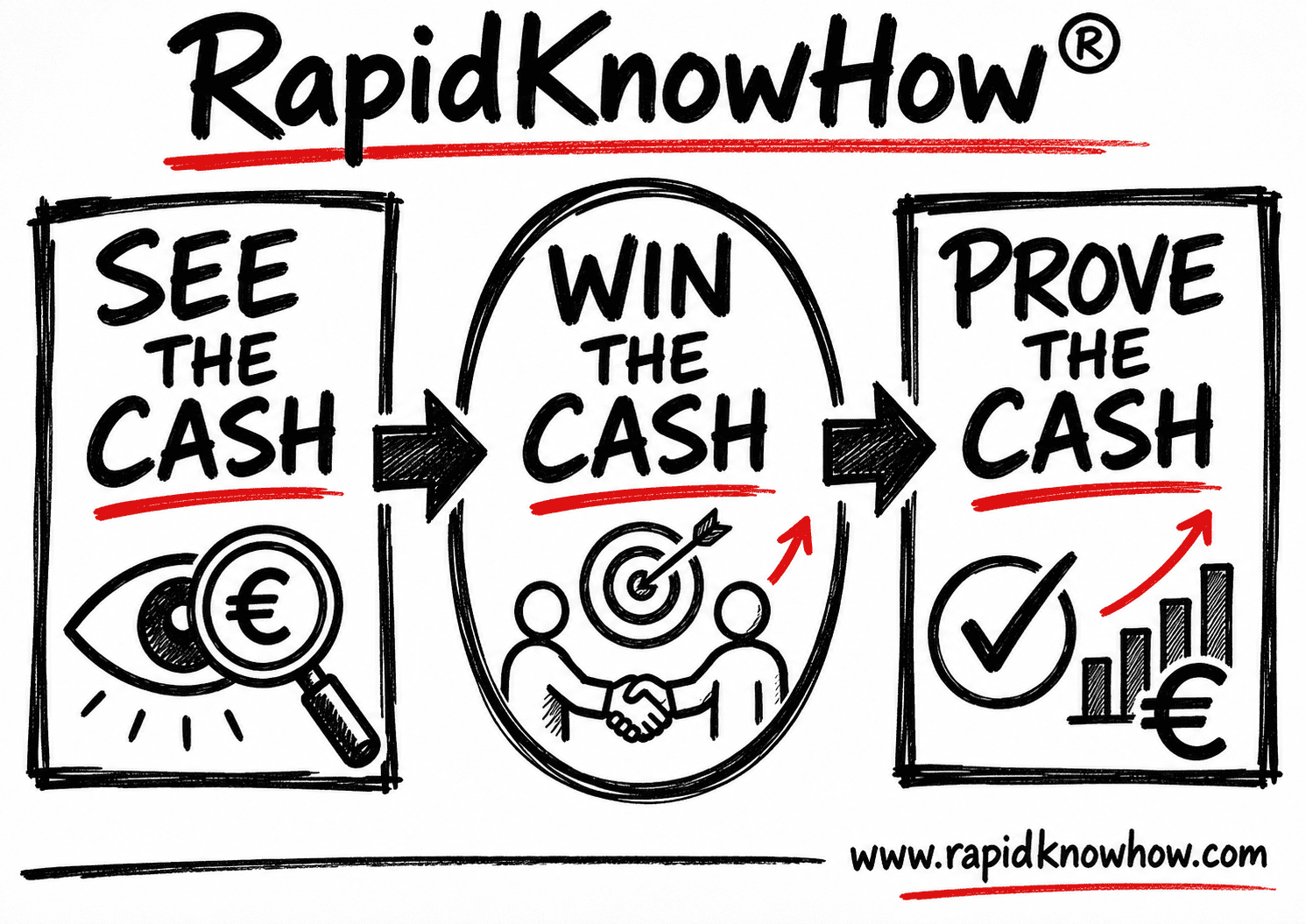
SEE THE CASH BEFORE THE MOVE
Detect Opportunity & Threat Early. Decide Before the Event.
PRODUCT PROMISE
Most companies recognize change after it has already affected:
- customers
- competitors
- margins
- supply chains
- technology
- regulation
- investment decisions.
RapidKnowHow® EARLY SYSTEM MOVE™ helps leaders identify the system behind the signals and decide what to do before the move becomes obvious.
SEE EARLIER → DECIDE EARLIER → POSITION EARLIER
THE PROBLEM
Leaders receive more information than ever.
But more information does not automatically create better decisions.
The real problem is:
CONNECTED SIGNALS ARE TREATED AS ISOLATED EVENTS.
A competitor reduces prices.
A customer changes buying behavior.
A new technology improves rapidly.
A regulation is announced.
A supplier becomes constrained.
Individually these may appear manageable.
Together they may indicate:
THE SYSTEM IS PREPARING A MOVE.
THE RAPIDKNOWHOW® SOLUTION
SIGNAL
What changed?
↓
SYSTEM
Which forces are connected?
↓
PRESSURE
Who is increasingly forced to act?
↓
BOTTLENECK
What controls the system?
↓
LIKELY MOVE
What becomes increasingly probable?
↓
OPPORTUNITY / THREAT
Where can value be gained or lost?
↓
ONE DECISION
What should we do now?
↓
TOP 3 ACTIONS
What must happen first?
↓
MEASURABLE RESULT
What changed because we acted early?
WHAT YOU GET
1. EARLY SIGNAL MAP™
Separate important signals from noise.
2. SYSTEM MOVE MAP™
Connect signals, drivers, pressures and dependencies.
3. OPPORTUNITY & THREAT ASSESSMENT™
Identify where business value is moving.
4. ONE DECISION™
Turn analysis into one clear executive choice.
5. TOP 3 ACTIONS™
Focus action on the highest-value moves.
6. EARLY MOVE SCOREBOARD™
Measure:
- cash protected
- cash created
- risk reduced
- time advantage
- strategic position strengthened.
ACTION GUIDE
STEP 1 — DEFINE THE QUESTION
Write one question:
WHAT MOVE MAY AFFECT OUR BUSINESS NEXT?
Examples:
- What will our main competitor do next?
- Where is AI moving our value chain?
- Which customer segment will change fastest?
- Which supply-chain dependency will become critical?
- Which market will become more attractive?
STEP 2 — IDENTIFY THE TOP SIGNALS
Select only the strongest signals.
For each signal ask:
- What changed?
- When?
- Why does it matter?
- Is it temporary or structural?
- What evidence supports it?
Do not collect everything.
Collect only what may change a decision.
STEP 3 — CONNECT THE SYSTEM
Ask:
- Which signals reinforce each other?
- Which party is under pressure?
- Which resource is scarce?
- Which capability becomes more valuable?
- Who has the strongest incentive to act?
The objective is not to predict perfectly.
The objective is to understand:
WHAT THE SYSTEM MAKES MORE LIKELY.
STEP 4 — DEFINE THE LIKELY MOVE
State the likely move in one sentence:
“Because [pressure] is increasing, [actor] is likely to [move] within [time].”
Then ask:
- What happens if we are right?
- What happens if we wait?
- What is reversible?
- What is difficult to recover later?
STEP 5 — MAKE ONE DECISION
State:
“We will secure [position] now because the system indicates [move].”
One decision.
Not ten priorities.
STEP 6 — TAKE THE TOP 3 ACTIONS
ACTION 1 — SECURE
Protect the critical position.
ACTION 2 — REDUCE
Reduce exposure to the main threat.
ACTION 3 — BUILD
Build the capability required for the next move.
STEP 7 — VERIFY THE RESULT
Measure:
CASH PROTECTED
What loss did we avoid?
CASH CREATED
What new value did we capture?
RISK REDUCED
What dependency or vulnerability improved?
TIME ADVANTAGE
How much earlier did we act?
POSITION
What strategic position improved?
30-DAY RESULT
Within 30 days the customer should have:
- one defined strategic question
- one verified signal set
- one system map
- one likely move
- one decision
- three actions
- one measurable scoreboard.
90-DAY RESULT
Within 90 days:
ONE EARLY MOVE → ONE ACTION → ONE VERIFIED BUSINESS RESULT
BEST FOR
- Boards
- CEOs
- Strategy leaders
- Business unit leaders
- Investors
- Industrial companies
- Competitive strategy
- AI transformation
- Market-entry decisions
- Supply-chain risk
- Geopolitical business exposure.
BUYER
CEO
CFO
CSO
Board Member
Business Unit Leader
Owner
Investor
CUSTOMER GETS
EARLIER SIGNAL → EARLIER DECISION → BETTER POSITION
LICENSE PATH
Once proven, EARLY SYSTEM MOVE™ becomes a recurring strategic operating system for:
- markets
- competitors
- customers
- technology
- investments
- supply chains
- strategic planning.
ONE DECISION
DO NOT WAIT FOR THE EVENT.
SEE THE SYSTEM EARLY ENOUGH TO CHANGE THE RESULT.
CALL TO ACTION
START MY EARLY SYSTEM MOVE™
Bring one strategic question.
Leave with:
ONE likely move
ONE decision
TOP 3 actions
ONE measurable result.
RapidKnowHow® EARLY SYSTEM MOVE™
SEE THE CASH.
RapidKnowHow® — THE DECISION COMPANY™