From product selling to AI-orchestrated Free-Cash-Flow growth: the 2026 industrial gas business model shift for leaders, challengers and asset-light innovators.
Strategic Call-to-Action Recommendation
Build the “Industrial Gas Game Changer Center 2026”: one board-ready cockpit that turns customer demand, cylinder flow, energy exposure, logistics cost and service value into weekly FCF, ROCE and customer-retention actions.
A) The Core Shift
From “Selling Gas” to “Orchestrating Industrial Gas Value”
The traditional industrial gas model is built around production, assets, cylinders, bulk tanks, transport, contracts and price increases. It is strong, asset-heavy and operationally proven. But in 2026, the winning model is no longer only about producing and delivering molecules.
The new model is:
Industrial Gas-as-a-Service + AI-Orchestrated Customer Value + Free-Cash-Flow Discipline
That means the company stops asking only:
“How much gas can we sell?”
And starts asking:
“How much measurable value can we create, capture and compound for each customer segment?”
The new Industrial Gas Leader 2026 manages four value flows:
- Gas Flow – product availability, purity, delivery reliability
- Asset Flow – cylinders, tanks, trailers, depots, filling capacity
- Data Flow – usage, forecasts, inventory, risk, customer behavior
- Cash Flow – margin, working capital, delivery cost, ROCE, retention
The business model changes when these four flows are orchestrated together.
B) The 2026 Industrial Gas Business Model Change
1. Old Model: Product-Selling Logic
The old model focuses on:
Selling oxygen, nitrogen, argon, hydrogen, helium, CO₂, acetylene and specialty gases.
Managing cylinders, bulk deliveries and contracts.
Passing through cost inflation when possible.
Optimizing production and logistics internally.
Competing on reliability, price, relationship and technical know-how.
This model works, but it has weaknesses:
High asset intensity.
High logistics cost.
Energy-cost exposure.
Complex cylinder tracking.
Working-capital pressure.
Slow customer insight.
Price pressure in commoditized segments.
Under-monetized service value.
The result: many companies generate revenue, but not enough strategic free cash flow.
2. New Model: AI-Orchestrated Value System
The new model focuses on:
Predicting demand before customers run out.
Optimizing delivery routes and refill cycles automatically.
Turning cylinder and tank data into cash-flow intelligence.
Segmenting customers by value, not only volume.
Selling uptime, safety, convenience and compliance, not only gas.
Creating recurring service subscriptions.
Using AI to improve pricing, asset use and customer retention.
The key change is this:
Industrial gases become a performance platform, not just a product portfolio.
C) The RapidKnowHow Industrial Gas System 2026
The 7-Step Business Model Transformation
Step 1: Segment the Market by Value
Do not treat all customers equally.
Segment customers into:
A-customers: high margin, recurring demand, strategic growth potential.
B-customers: stable but cost-sensitive.
C-customers: low margin, high service cost, weak loyalty.
Strategic niche customers: healthcare, food, labs, welding, electronics, hydrogen, helium, specialty gases.
The key question:
Which customers improve FCF and ROCE — and which customers destroy value?
Step 2: Build the Customer Value Map
For each segment, define the real value drivers:
For welders: availability, cylinder convenience, price clarity.
For hospitals: reliability, compliance, emergency readiness.
For laboratories: purity, documentation, traceability.
For food customers: safety, continuity, quality.
For hydrogen customers: infrastructure, uptime, future-readiness.
For helium users: scarcity management, allocation security, substitution strategy.
The new offer must be based on customer results, not internal product categories.
Step 3: Turn Supply Chain into a Cash-Flow Engine
The industrial gas supply chain is often the hidden profit lever.
AI can improve:
Cylinder rotation.
Depot stock levels.
Fill planning.
Route density.
Delivery frequency.
Tank telemetry.
Emergency orders.
Truck utilization.
Lost-cylinder reduction.
Working capital.
The target is clear:
Less idle asset. Less emergency delivery. Less working capital. More service reliability. More free cash flow.
Step 4: Create Industrial Gas-as-a-Service Offers
Replace one-dimensional product selling with service packages.
Example offers:
Oxygen Reliability-as-a-Service
For healthcare and homecare customers.
Welding Gas Productivity-as-a-Service
For workshops, construction, metalworking and repair businesses.
Laboratory Gas Compliance-as-a-Service
For labs, universities and research centers.
Helium Security-as-a-Service
For MRI, leak detection, aerospace and quantum technology users.
Hydrogen Readiness-as-a-Service
For fleets, industry, municipalities and energy-transition customers.
Each offer should include:
Gas supply.
Asset management.
Digital monitoring.
Usage analytics.
Service-level commitment.
Compliance support.
Monthly or annual recurring fee.
This shifts the model from transactional revenue to recurring value capture.
Step 5: Install the AI-Orchestrator Cockpit
The cockpit is the management system.
It should show weekly:
Revenue by segment.
Gross margin by customer cluster.
Delivery cost per customer.
Cylinder turns.
Asset utilization.
Working capital tied in cylinders and inventory.
Energy-cost exposure.
Pass-through effectiveness.
Customer risk.
Service failures.
FCF impact.
ROCE movement.
The board should not receive a static monthly report.
The board should see:
What changed this week? Why? What action improves FCF next week?
Step 6: Redesign Pricing Around Value and Risk
Pricing must move beyond list price plus surcharge.
Use four pricing layers:
Base gas price – molecule value.
Service price – delivery, emergency response, compliance.
Asset price – cylinder, tank, telemetry, installation.
Risk price – scarcity, volatility, energy exposure, special reliability requirement.
This allows better margin defense.
Example:
A customer needing guaranteed oxygen availability should not pay the same service logic as a customer buying occasional standard gas.
The model becomes fairer and more profitable:
High-value service gets high-value pricing.
Step 7: Scale Through Licensing, Partners and Regional Hubs
The future winner does not need to own every asset.
Build an asset-smart network:
Own critical assets.
Partner for regional reach.
License service models.
Use digital orchestration.
Connect depots, resellers and specialized partners.
Measure all partners through the same cockpit.
This creates a scalable model:
Central intelligence + local execution + measurable FCF impact.
D) The 2026 Industrial Gas Game Changer Formula
Strategic Formula
Industrial Gas Value 2026 = Customer Result × Supply Chain Intelligence × Asset Productivity × FCF Discipline
Or simpler:
Gas + Data + Service + AI = Compounding Industrial Gas Value
The industrial gas company becomes less of a product supplier and more of a mission-critical operating partner.
E) Top 10 Strategic Actions for 2026
- Build an AI-based customer segmentation by FCF and ROCE contribution.
- Identify the top 20% customers that create 80% of strategic value.
- Launch one Industrial Gas-as-a-Service offer in a focused niche.
- Install tank telemetry and cylinder tracking where ROI is strongest.
- Reduce emergency deliveries through predictive replenishment.
- Redesign pricing into gas, service, asset and risk components.
- Create a weekly FCF cockpit for management.
- Improve pass-through effectiveness for energy and logistics costs.
- Convert low-margin customers into digital self-service or partner-served accounts.
- Build a 2026–2030 roadmap: niche dominance first, then regional scaling.
F) Measurable Results
The Business Model Must Deliver
The new model is only valuable if it improves measurable outcomes.
Key metrics:
FCF: more cash generated after operating and capital needs.
ROCE: better return on assets and capital employed.
Asset utilization: higher cylinder turns, tank productivity and truck productivity.
Customer retention: stronger contracts through service integration.
Margin quality: less dependence on pure price increases.
Working capital: less capital trapped in inventory and cylinders.
Service quality: fewer run-outs, fewer emergency orders, higher reliability.
Market multiple: better valuation through recurring revenue and digital service capability.
The target for 2026 should be:
Improve FCF first. Improve ROCE second. Improve market multiple third. Improve market value through compounding.
G) The RapidKnowHow Industrial Gas MASTER Model
From Traditional Supplier to AI-Orchestrated Industrial Gas Leader
| Dimension | Traditional Model | 2026 Game Changer Model |
|---|---|---|
| Core offer | Gas product | Gas-as-a-Service |
| Main logic | Volume and contracts | Customer result and recurring value |
| Operations | Reactive delivery | Predictive replenishment |
| Pricing | Product price | Gas + service + asset + risk |
| Assets | Owned and managed internally | Orchestrated for productivity |
| Data | Reporting | Decision engine |
| Customer relation | Supplier | Performance partner |
| KPI | Revenue and margin | FCF, ROCE, retention, service value |
| Growth | More volume | Better value density |
| Advantage | Scale | Intelligence + execution speed |
H) Final Strategic Message
The Industrial Gas Business Model 2026 is not changed by adding AI as a tool. It is changed by redesigning the operating logic.
The winner will not simply be the company with the biggest plants, fleets or cylinder pools.
The winner will be the company that can answer every week:
Where is value created?
Where is cash trapped?
Which customers deserve priority?
Which assets are underused?
Which service can be monetized?
Which action improves FCF now?
That is the RapidKnowHow system:
See clearly. Act weekly. Measure results. Scale what works.
The 2026 Industrial Gas Game Changer is:
From molecule selling to AI-orchestrated, cash-flow-driven value leadership. – Josef David
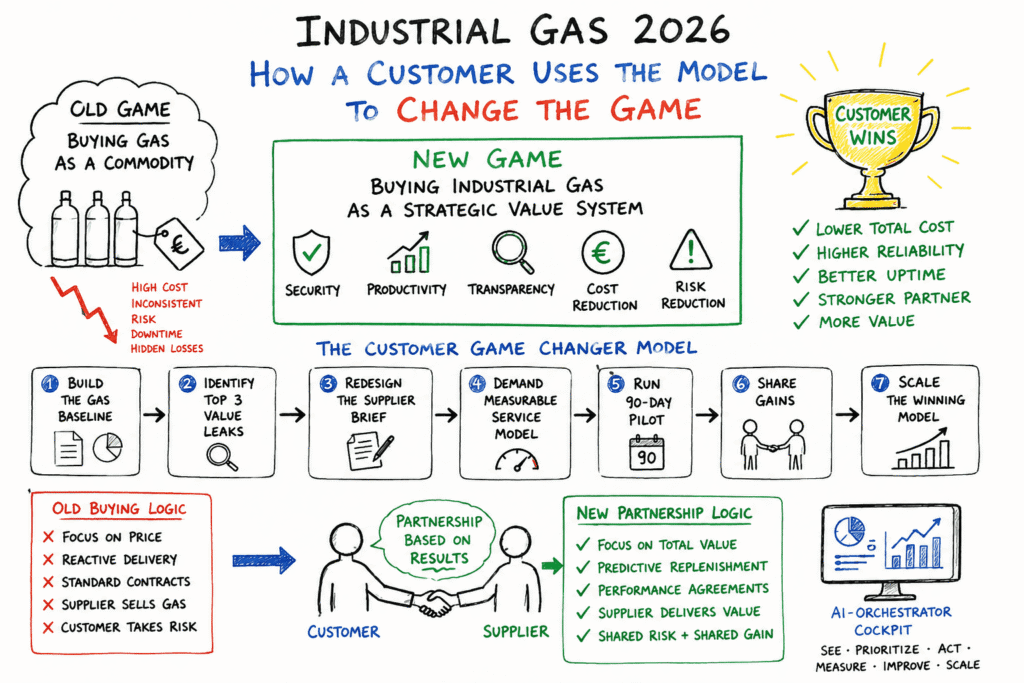
Industrial Gas 2026: How a Customer Can Use the RapidKnowHow Model to Change the Game
The real disruption starts when the customer stops buying gas as a commodity and starts managing gas as a strategic value system.
Strategic Call-to-Action Recommendation
Position the customer as the “Game Changer Buyer”: give them a 30-day Industrial Gas Value Sprint to reduce cost, secure supply, improve uptime and force suppliers to compete on measurable results.
A) The Key Insight
The customer can change the game faster than the supplier
Yes — this is the powerful point.
The Industrial Gas business model can be changed not only by the gas company, but also by the customer.
A customer who understands the RapidKnowHow model stops asking:
“What is your price per cylinder, per cubic meter, per ton?”
And starts asking:
“Which supplier helps me reduce total cost, secure supply, improve productivity, reduce risk and create measurable business value?”
That changes the entire negotiation.
The customer becomes the game changer because they shift the buying logic from:
Product Price → Total Value → Measurable Results
B) How the customer uses the model
1. The customer builds their own Gas Value Cockpit
The customer maps every industrial gas use case:
Oxygen, nitrogen, argon, hydrogen, helium, CO₂, acetylene, specialty gases.
Then they measure:
Gas consumption.
Delivery frequency.
Run-out risk.
Emergency deliveries.
Cylinder losses.
Rental cost.
Downtime cost.
Quality problems.
Safety issues.
Administrative workload.
Supplier responsiveness.
Total cost of ownership.
This gives the customer a strong fact base.
The result: the customer no longer negotiates blindly.
2. The customer redefines the supplier role
The customer tells suppliers:
“We are not buying gas only. We are buying uptime, reliability, safety, productivity and cash-flow improvement.”
That forces suppliers to offer more than standard contracts.
The supplier must now deliver:
Predictive replenishment.
Transparent pricing.
Service-level commitments.
Digital stock visibility.
Cylinder tracking.
Risk-sharing mechanisms.
Energy surcharge transparency.
Performance reporting.
Continuous improvement actions.
The customer changes the rules by changing the buying criteria.
3. The customer creates a supplier competition system
Instead of comparing suppliers only by price, the customer compares them by strategic value.
| Supplier Criterion | Old Buying Logic | Game Changer Buying Logic |
|---|---|---|
| Price | Lowest unit price | Lowest total cost and highest reliability |
| Delivery | Reactive delivery | Predictive replenishment |
| Contract | Standard terms | Performance-based agreement |
| Reporting | Invoice after delivery | Monthly value report |
| Risk | Customer carries risk | Shared risk model |
| Service | Problem response | Problem prevention |
| Value | Gas supply | Productivity, uptime, FCF impact |
This changes supplier behavior immediately.
C) The Customer Game Changer Model
Objective
Reduce total industrial gas cost while improving uptime, safety, reliability and strategic supplier performance.
Strategy
Use the RapidKnowHow AI-Orchestrator logic:
See → Prioritize → Act → Measure → Improve → Scale
Strategic Actions
Action 1: Create the gas baseline
Measure current consumption, cost, delivery frequency, service failures and hidden losses.
Action 2: Identify the top 3 value leaks
Typical leaks are emergency deliveries, excess cylinder rental, poor stock visibility, overconsumption, weak pricing transparency and downtime risk.
Action 3: Redesign the supplier brief
Ask suppliers for a value-based offer, not only a price quote.
Action 4: Demand a measurable service model
Define KPIs: availability, delivery reliability, cylinder turns, response time, cost reduction, safety performance and monthly improvement.
Action 5: Run a 90-day pilot
Start with one plant, one depot, one hospital, one laboratory, one welding network or one production line.
Action 6: Share gains
Create a gain-sharing model: when the supplier helps reduce total cost or improve uptime, both sides benefit.
Action 7: Scale the winning model
Roll out the best supplier model across sites, regions or business units.
D) The real disruption
The customer creates disruption by asking better questions.
Instead of:
“Can you reduce the price by 5%?”
The customer asks:
“Can you reduce our total gas-related cost by 15%, improve reliability by 20%, reduce emergency deliveries by 50% and show the impact every month?”
That is a different game.
It moves industrial gas purchasing from procurement pressure to strategic value creation.
E) Example: Customer Changes the Game
Case: Manufacturing customer using welding gases
Old situation
The customer buys argon, oxygen, acetylene and shielding gas from a supplier. Procurement negotiates annual price reductions. Production complains about stockouts. Finance sees rising rental and delivery costs. Nobody owns the total system.
RapidKnowHow intervention
The customer maps total gas usage and discovers:
Too many cylinders on site.
Low cylinder rotation.
Emergency deliveries every month.
No clear consumption forecast.
High rental charges.
No productivity link between gas usage and welding output.
New supplier demand
The customer asks the supplier for:
Automatic replenishment.
Digital cylinder tracking.
Monthly usage dashboard.
Fixed service-level agreement.
Reduction of emergency deliveries.
Shared savings model.
Training to reduce gas waste.
Result
The supplier either upgrades the offer — or loses the account to a smarter competitor.
The customer has changed the game.
F) The Customer Value Formula
Customer Industrial Gas Value = Supply Security + Productivity + Transparency + Cost Reduction + Risk Reduction
Or in RapidKnowHow language:
From Gas Buying → to Gas Performance Management
The customer becomes the orchestrator.
The supplier becomes the performance partner.
The contract becomes a value system.
G) Final Strategic Message
The strongest Industrial Gas Game Changer may not be the gas producer.
It may be the customer who says:
“I will no longer buy industrial gas as a commodity. I will buy measurable industrial gas performance.”
That customer forces the market to improve.
That customer attracts better suppliers.
That customer reduces hidden cost.
That customer builds resilience.
That customer changes the game.
AI-Orchestrator: The Total Cost of Ownership Optimizer – Case Industrial Gas
How industrial gas customers and suppliers can use AI to reduce hidden cost, secure supply, improve uptime and turn gas purchasing into measurable business value.
Strategic Call-to-Action Recommendation
Launch a 30-Day Industrial Gas TCO Sprint: map total gas cost, detect the top 3 value leaks, redesign supplier performance, and install an AI-Orchestrator Cockpit for monthly savings and reliability gains.
A) Core Idea
From Gas Price to Total Cost of Ownership
In industrial gas, many customers still manage purchasing through the visible price:
€/cylinder, €/m³, €/kg, €/ton, rental fee, delivery charge.
But the real cost is much larger.
The true cost includes:
Product cost + delivery cost + rental cost + emergency cost + downtime cost + stockholding cost + safety risk + administration + lost productivity + supplier failure.
That is the Total Cost of Ownership, or TCO.
The AI-Orchestrator changes the game because it does not only compare prices. It connects usage, logistics, inventory, service, risk and cash-flow impact into one decision system.
The shift is simple:
Old logic: Buy gas cheaper.
New logic: Use gas smarter, reduce hidden cost, secure uptime, improve value.
B) The AI-Orchestrator TCO Optimizer
Case: Industrial Gas
The AI-Orchestrator is a management cockpit that helps the customer and supplier see the full cost system.
1. It maps the current gas system
The system captures:
Gas type
Consumption by site
Delivery frequency
Cylinder stock
Tank level data
Emergency deliveries
Rental days
Lost cylinders
Supplier response time
Downtime events
Safety incidents
Invoice complexity
Contract terms
Energy and logistics surcharges
This creates the TCO baseline.
2. It detects the top value leaks
Typical industrial gas value leaks are:
Too many cylinders on site
Too many low-rotation cylinders
Unplanned emergency deliveries
Poor tank-level visibility
Wrong delivery frequency
High rental cost
Lost or unreturned cylinders
Overconsumption due to process inefficiency
Unclear surcharges
Supplier underperformance
Administrative workload
Production downtime caused by gas shortage
The AI-Orchestrator ranks these leaks by financial impact.
The key question becomes:
Which 3 leaks destroy the most cash this month?
3. It recommends strategic actions
The AI-Orchestrator does not stop at analysis. It recommends actions such as:
Move from manual ordering to predictive replenishment.
Reduce cylinder stock by site and usage pattern.
Shift low-volume users to reseller or digital self-service.
Install telemetry on high-risk tanks.
Bundle deliveries by route density.
Convert emergency deliveries into planned service.
Negotiate performance-based contracts.
Split gas price, service price, asset price and risk price.
Introduce gain-sharing between customer and supplier.
Use monthly value reports instead of only invoices.
The system turns data into decisions.
C) The TCO Optimizer Formula
Industrial Gas TCO
TCO = Gas Price + Delivery Cost + Asset Cost + Inventory Cost + Admin Cost + Risk Cost + Downtime Cost – Value Gains
The objective is not only to reduce the gas price. The objective is to reduce the total system cost.
Example
A customer may receive a 5% lower gas price from Supplier A, but Supplier A creates:
More emergency deliveries
More stockouts
More invoice corrections
More cylinder rental days
More downtime risk
A second supplier may have a slightly higher gas price but offers:
Predictive replenishment
Fewer deliveries
Lower rental exposure
Better reliability
Monthly performance reporting
Shared savings
The AI-Orchestrator can show that the second supplier is actually cheaper in total ownership terms.
That is the game changer.
D) The 7-Step Industrial Gas TCO Sprint
Step 1: Build the Gas Baseline
Collect all usage, cost, service and risk data for the last 12 months.
Step 2: Calculate Full TCO
Go beyond price. Include logistics, assets, admin, downtime and risk.
Step 3: Identify Top 3 Value Leaks
Focus only on the biggest cash and reliability problems.
Step 4: Redesign the Supplier Brief
Ask suppliers to solve measurable problems, not just quote lower prices.
Step 5: Install the AI-Orchestrator Cockpit
Track cost, usage, reliability, service, risk and savings monthly.
Step 6: Create a Performance Contract
Define KPIs: availability, delivery reliability, emergency reduction, cylinder rotation, downtime prevention and cost reduction.
Step 7: Scale the Winning Model
Start with one site, prove the result, then roll out across plants, regions or business units.
E) Strategic KPIs
The AI-Orchestrator should track:
Cost KPIs
Total gas cost
Cost per unit consumed
Delivery cost per delivery
Rental cost per cylinder
Emergency delivery cost
Invoice correction cost
Asset KPIs
Cylinder turns
Lost cylinders
Idle cylinders
Tank utilization
Stock coverage days
Service KPIs
On-time delivery
Run-out incidents
Supplier response time
Complaint rate
Service-level compliance
Risk KPIs
Downtime events
Safety incidents
Scarcity exposure
Single-supplier dependency
Energy surcharge exposure
Value KPIs
TCO reduction
Productivity gain
Working-capital reduction
Uptime improvement
FCF improvement
ROCE improvement
F) Customer-Supplier Game Changer
The AI-Orchestrator creates a new partnership logic.
Old relationship
Customer demands lower price.
Supplier defends margin.
Both sides negotiate annually.
Hidden costs remain untouched.
New relationship
Customer and supplier define the full TCO baseline.
AI detects value leaks.
Both sides agree on improvement actions.
Savings are measured monthly.
Gains are shared.
The supplier becomes a performance partner.
The conversation changes from:
“Give me 5% discount.”
to:
“Help me reduce total gas-related cost by 15%, reduce emergency deliveries by 50%, improve uptime and document the value every month.”
G) RapidKnowHow Positioning
The AI-Orchestrator as Industrial Gas TCO Optimizer
The RapidKnowHow system positions the AI-Orchestrator as the bridge between:
Customer pain and supplier value
Operational data and management decisions
Price negotiation and cash-flow improvement
Gas supply and business performance
The strongest selling message:
“We do not optimize the gas price only. We optimize the full cost and value system behind industrial gas usage.”
H) Final Strategic Message
Industrial gas customers do not win by buying the cheapest gas.
They win by controlling the total cost of ownership.
Suppliers do not win by defending old contracts.
They win by proving measurable value.
The AI-Orchestrator makes this visible, measurable and manageable.
Industrial Gas 2026 Game Changer:
From price-per-cylinder to total-cost-of-ownership optimization. – Josef David
Strategic Dialogue for Leaders: Turn Complexity into Cash-Flow, Action and Market Value
A focused RapidKnowHow dialogue helps leaders assess strategic events, business risks and growth opportunities in 15–30 minutes.
Strategic Call-to-Action:
Request a Strategic Dialogue and turn one leadership challenge into a clear action map.
RapidKnowHow® — THE DECISION COMPANY™
Industrial Gas Leadership 2030
PROVE VALUE. THEN SCALE.
Watch the 60-second roadmap: 10 strategic actions for DACH and CEE, 2026–2030.
Start with ONE customer challenge. Use the Industrial Gas Action Guide to turn your first action into a measurable result.
RapidKnowHow® — Leading Industrial Gas Opportunity Signal Identifier in DACH & CEE