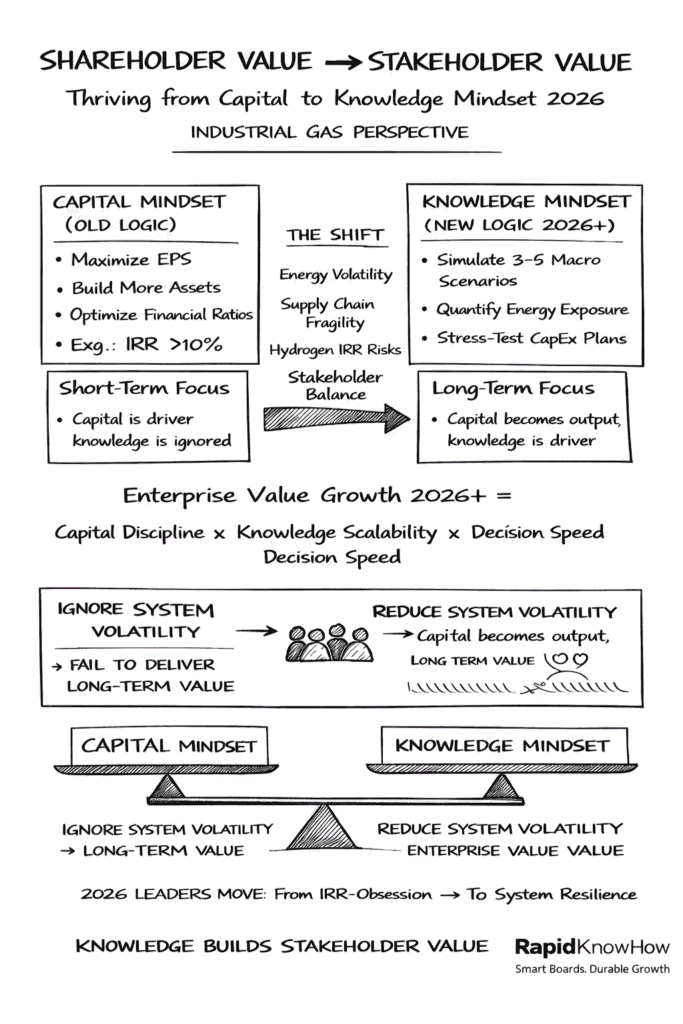
Thriving from Capital to Knowledge Mindset 2026
Industrial Gas Perspective
A) THE STRATEGIC SHIFT 2026
For decades, industrial capital markets rewarded:
• Asset growth
• EBITDA expansion
• Dividend stability
• ROCE optimization
This is the classic Shareholder Value Model.
But 2026 reality changes the architecture:
Energy volatility
Hydrogen capital risk
AI infrastructure demand
Regulatory acceleration
Supply chain fragility
The equation evolves from:
Maximize short-term capital return
to
Maximize long-term system resilience and cash-flow durability.
That is the shift toward Stakeholder Value.
But here is the critical insight:
Stakeholder value does not dilute shareholder value.
It stabilizes and compounds it.
B) CAPITAL MINDSET VS KNOWLEDGE MINDSET
1️⃣ CAPITAL MINDSET (OLD LOGIC)
• Build more assets
• Expand footprint
• Lock in long-term contracts
• Optimize financial ratios
Capital is treated as growth engine.
Risk:
Capital misallocation becomes structural.
2️⃣ KNOWLEDGE MINDSET (NEW LOGIC 2026+)
• Use AI to stress-test CapEx
• Simulate 3–5 macro scenarios
• Quantify energy exposure
• Model hydrogen IRR under subsidy shifts
• Re-rank portfolio quarterly
Capital becomes the output.
Knowledge becomes the driver.
C) SHAREHOLDER VALUE 1.0
Metric Focus:
• EPS
• EBITDA
• ROCE
• Dividends
Limitation:
Ignores systemic fragility.
D) STAKEHOLDER VALUE 2.0 (AI-Orchestrated)
Stakeholders include:
• Customers
• Employees
• Energy suppliers
• Regulators
• Capital markets
• Society
But here’s the deeper logic:
If you reduce system volatility →
you reduce capital risk →
you increase valuation multiple.
Stakeholder stability = Shareholder compounding.
E) INDUSTRIAL GAS EXAMPLE
Companies like
Linde plc
and
Air Liquide
are increasingly valued for:
• Stability
• Long-term contracts
• Pricing power
• Risk discipline
Why?
Because markets reward resilience.
F) THE NEW ENTERPRISE VALUE FORMULA
Enterprise Value Growth 2026+ =
Capital Discipline × Knowledge Scalability × Stakeholder Stability × Decision Speed
Where:
Stakeholder Stability =
Energy resilience + regulatory alignment + customer reliability + workforce competence.
G) WHY KNOWLEDGE CREATES STAKEHOLDER VALUE
Knowledge enables:
1️⃣ Predictive pricing → protects customers and margins
2️⃣ Energy stress testing → reduces volatility
3️⃣ CapEx simulation → protects shareholders
4️⃣ Hydrogen realism → protects capital
5️⃣ AI account prioritization → strengthens key clients
This is not soft governance.
This is hard cash-flow engineering.
H) THE 2026 BOARD QUESTION
Instead of asking:
“What is the IRR?”
Boards must ask:
• What is the system volatility impact?
• What is the exposure index shift?
• What stakeholder risk does this reduce?
• How does knowledge reduce capital intensity?
I) THE STRATEGIC CONCLUSION
2026 is not about abandoning shareholder value.
It is about upgrading it.
From:
Capital-heavy, asset-driven growth
To:
Knowledge-driven, system-stabilized compounding.
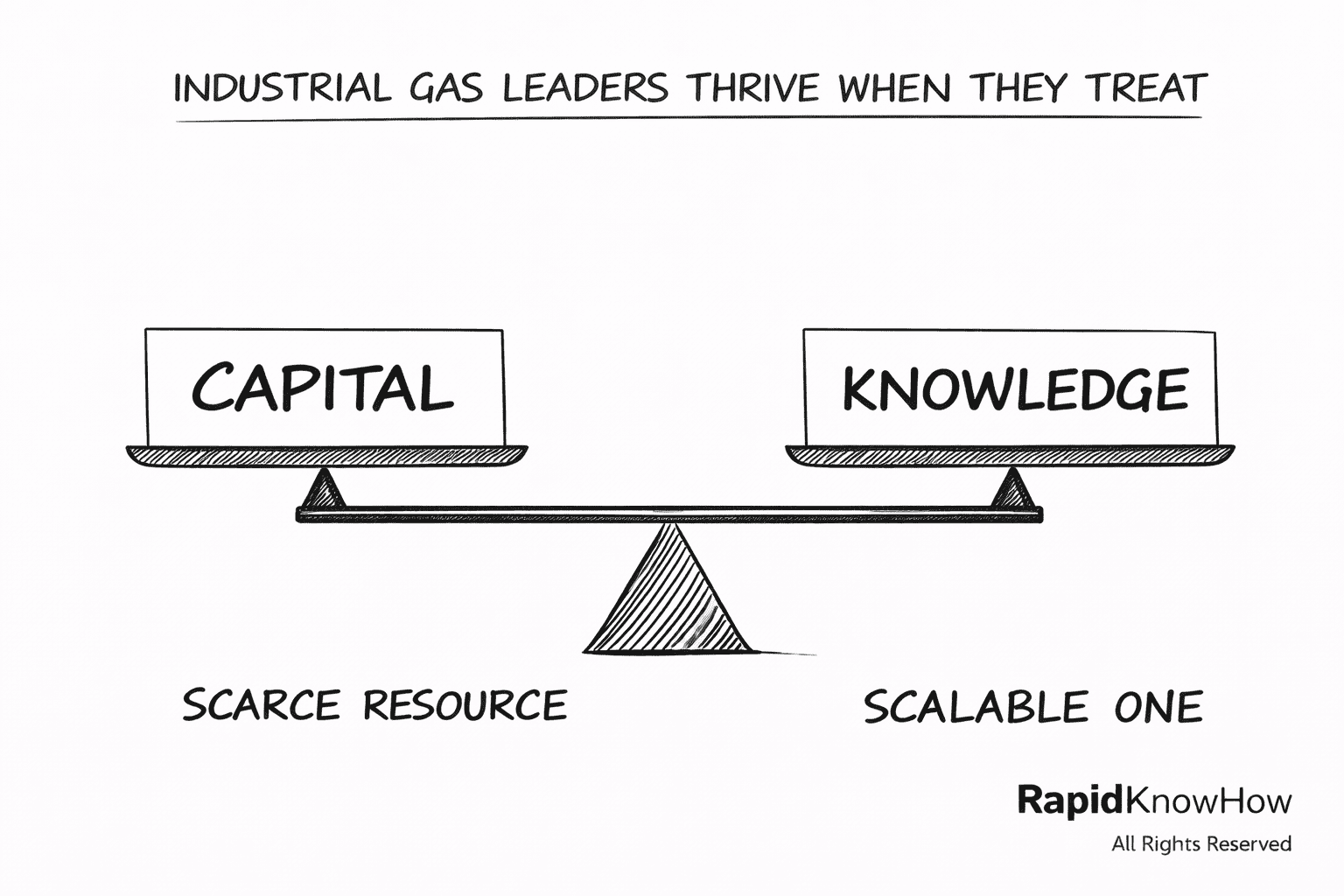
Industrial Gas leaders will thrive when they:
Treat capital as scarce
Treat knowledge as scalable
Treat stakeholders as risk buffers
Treat AI as orchestration engine
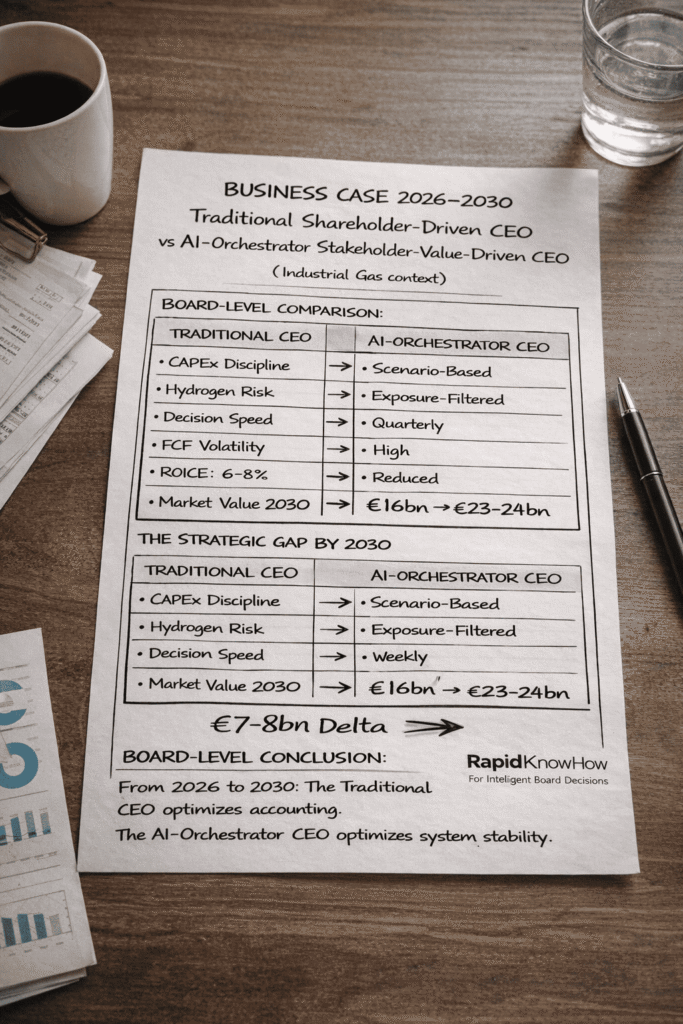
BUSINESS CASE 2026–2030
Traditional Shareholder-Driven CEO
vs
AI-Orchestrator Stakeholder-Value-Thriven CEO
(Industrial Gas context)
A) STRATEGIC ARCHETYPES
1️⃣ Traditional Shareholder-Driven CEO
Primary Focus:
- EPS growth
- EBITDA expansion
- IRR thresholds (>10–12%)
- Asset scale
Behavior Pattern:
- CapEx-led growth
- Hydrogen announcements
- Quarterly guidance protection
- Financial ratio optimization
Blind Spot:
- System volatility
- Energy shock exposure
- Portfolio rigidity
- Slow decision loops
2️⃣ AI-Orchestrator Stakeholder-Value CEO
Primary Focus:
- Free Cash Flow durability
- Exposure compression
- Capital discipline
- Knowledge scalability
- System resilience
Behavior Pattern:
- Signal → Simulate → Stress-Test → Allocate
- CapEx re-ranking quarterly
- Pricing compression within days
- AI-driven exposure index
Core Principle:
Capital is scarce.
Knowledge is scalable.
Volatility destroys enterprise value.
B) BASELINE INDUSTRIAL GAS PROFILE (ILLUSTRATIVE)
Revenue: €10bn
EBITDA margin: 25%
EBITDA: €2.5bn
CapEx: 15% of revenue = €1.5bn
FCF baseline: €1.0bn
Market Multiple: 15× FCF
Market Value: €15bn
C) 2026–2030 SCENARIO COMPARISON
1️⃣ CAPITAL ALLOCATION DISCIPLINE
Traditional CEO
- Hydrogen CapEx accelerated
- Political pressure-driven projects
- IRR assumptions optimistic
- CapEx remains rigid
Capital misallocation risk:
1% of revenue per year = €100m drag
5-year compounding drag:
≈ €500–600m cumulative
AI-Orchestrator CEO
- Hydrogen stress-tested under 3 macro scenarios
- 15–20% CapEx re-ranked
- Exposure Index gating
- AI demand prioritized
Capital efficiency gain:
1–2% improvement in FCF = €100–200m/year
5-year cumulative gain:
€500m–1bn advantage
2️⃣ FREE CASH FLOW TRAJECTORY (2026–2030)
Traditional CEO
Energy shocks + slower pricing response:
- FCF volatility ±15%
- Average FCF growth 2% CAGR
2026: €1.0bn
2030: ~€1.08bn
AI-Orchestrator CEO
Pricing compression in days, not quarters
Exposure-managed portfolio
Working capital release 2–3%
FCF CAGR 5–7%
2026: €1.0bn
2030: €1.28–1.40bn
Difference by 2030:
+€200–320m annually
3️⃣ ROICE COMPARISON
(Return on Innovation, Convenience & Efficiency)
Traditional CEO
Innovation tied to assets
ROICE: 6–8%
AI-Orchestrator CEO
AI-driven:
- Decision compression
- Capital re-ranking
- Working capital optimization
- Portfolio intelligence
ROICE: 12–18%
This is structural — not cyclical.
D) MARKET VALUE IMPACT 2030
Assume market rewards stability.
Traditional CEO
FCF 2030: €1.08bn
Multiple remains 15×
Market Value ≈ €16.2bn
AI-Orchestrator CEO
FCF 2030: €1.35bn
Volatility reduced
Market rewards predictability
Multiple expands to 17–18×
Market Value ≈ €23–24bn
E) STRATEGIC GAP BY 2030
Market Value Delta:
€7–8bn difference
on same industrial footprint.
This is not ideology.
It is volatility engineering.
F) WHY MULTIPLE EXPANSION OCCURS
Markets reward:
- Predictable FCF
- Capital discipline
- Exposure transparency
- Lower macro sensitivity
- Faster reaction capability
Stakeholder stability → Lower systemic risk
Lower systemic risk → Higher valuation multiple
G) BOARD-LEVEL DECISION MATRIX
| Dimension | Traditional CEO | AI-Orchestrator CEO |
|---|---|---|
| CapEx Discipline | IRR-based | Scenario-gated |
| Hydrogen Risk | Political cycle | Exposure-index filtered |
| Decision Speed | Quarterly | Weekly |
| FCF Volatility | High | Reduced |
| ROICE | Moderate | High |
| Market Multiple | Flat | Expanding |
| 2030 Market Value | €16bn | €23bn+ |
H) CONCLUSION
The traditional shareholder-driven CEO optimizes accounting performance.
The AI-Orchestrator Stakeholder-Value CEO optimizes system stability and capital durability.
From 2026–2030:
The difference is not ideology.
It is compounded FCF × valuation multiple expansion. – Josef David