Understanding, Managing, and Fixing Complex Problems — and Making Smarter Decisions
A) USING SYSTEM ARCHETYPES IN BUSINESS, GEOPOLITICS, AND LIFE
1. Why System Archetypes Matter
Most leaders fail not because they lack intelligence—but because they misread systems.
They react to events, while real leverage sits in structures and feedback loops.
System archetypes—popularized by Donella H. Meadows and Peter Senge—are recurring patterns that explain why problems persist.
They are your strategic shortcuts to insight in seconds.
2. The 5 Most Powerful System Archetypes
1. Fixes That Fail
Pattern:
Quick fix → temporary relief → long-term worsening
Business Example:
Cut costs → reduce innovation → lose competitiveness → need more cost cuts
Geopolitics Example:
Sanctions → short-term pressure → long-term self-reliance of opponent
Life Example:
Stress → alcohol → more stress
Insight:
👉 Short-term actions often create long-term dependency or damage.
2. Limits to Growth
Pattern:
Growth → constraint → slowdown → stagnation
Business:
Sales grow → operations overloaded → customer dissatisfaction
Geopolitics:
Economic expansion → resource scarcity → conflict
Life:
Career growth → burnout → plateau
Insight:
👉 Growth always hits hidden constraints—find and remove them.
3. Shifting the Burden
Pattern:
Symptom solution → dependency → root cause ignored
Business:
Consultants instead of capability building
Geopolitics:
Military intervention instead of diplomacy
Life:
Medication instead of lifestyle change
Insight:
👉 The system becomes addicted to quick fixes.
4. Tragedy of the Commons
Pattern:
Individual gain → collective loss
Business:
Price wars → industry margin collapse
Geopolitics:
Climate exploitation → global damage
Life:
Overcommitment → personal burnout
Insight:
👉 What benefits the individual can destroy the system.
5. Success to the Successful
Pattern:
Success → more resources → more success
Business:
Market leaders dominate via capital
Geopolitics:
Superpowers reinforce dominance
Life:
Skills → opportunities → more skills
Insight:
👉 Systems amplify advantage—and inequality.
3. Strategic Takeaway (A)
- Systems behave predictably once you see the pattern
- Most problems are not random—they are structural
- Real leadership = recognizing the archetype in seconds
B) APPLYING REAL-WORLD DEDUCTION, DECISION-MAKING, AND PROBLEM SOLVING
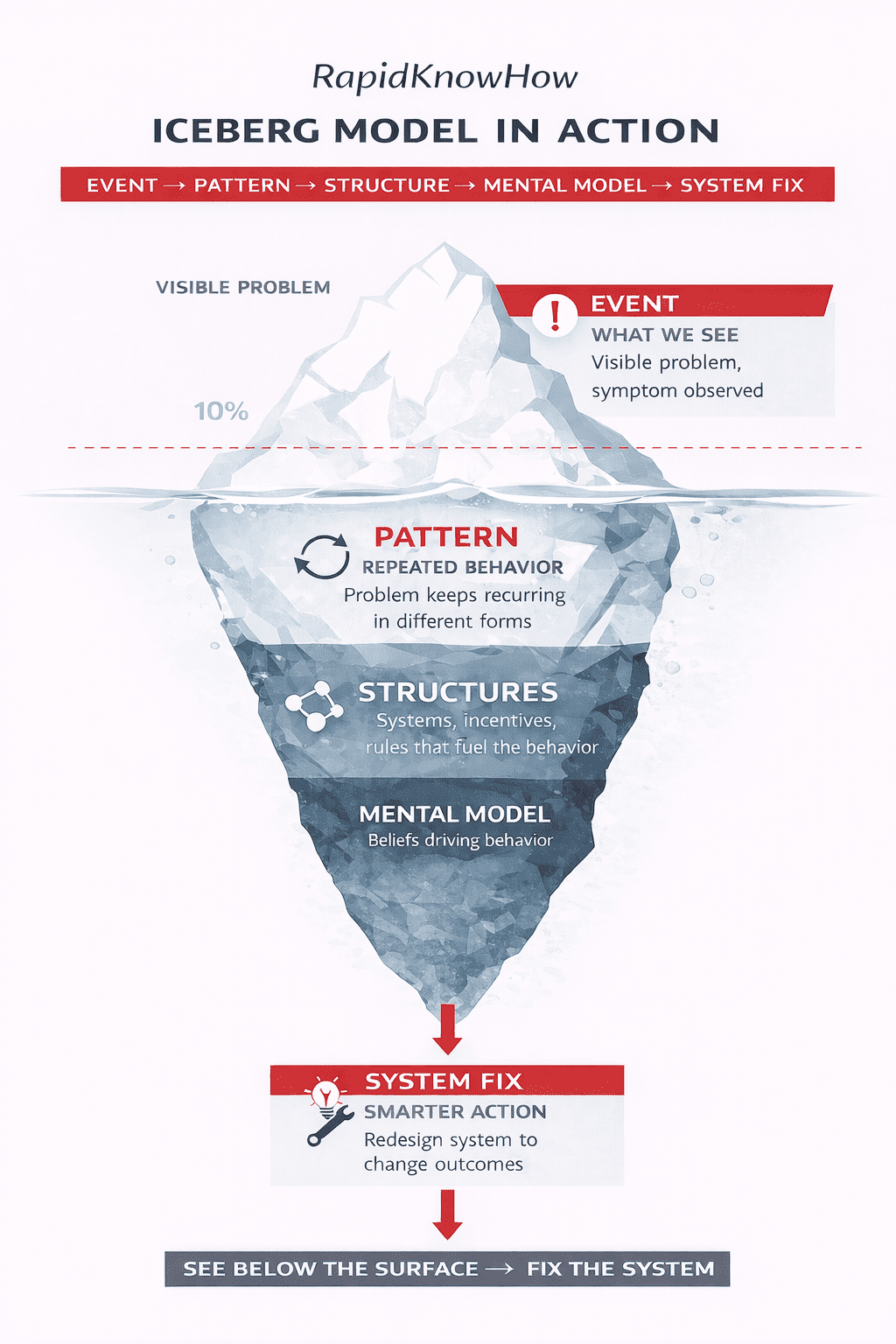
1. The System Thinking Decision Stack
To move from insight → action, use this 4-layer thinking model:
Layer 1: Events (What happened?)
- Symptoms
- Headlines
- Daily noise
Layer 2: Patterns (What repeats?)
- Trends
- Cycles
- Behavior over time
Layer 3: Structure (Why does it happen?)
- Feedback loops
- Incentives
- Constraints
Layer 4: Mental Models (How do we think about it?)
- Beliefs
- Assumptions
- Paradigms
👉 Most people operate at Layer 1.
👉 Leaders operate at Layer 3–4.
2. The 5 Core Mental Models for System Thinking
1. Feedback Loops (Core Engine)
- Reinforcing (growth / collapse)
- Balancing (stability)
👉 Ask: What amplifies? What stabilizes?
2. Second-Order Thinking
- Not: “What happens next?”
- But: “What happens after that?”
👉 This alone separates average vs elite decision-makers.
3. Inversion Thinking
Popularized by Charlie Munger
👉 Instead of asking:
“How do I succeed?”
Ask:
“What would guarantee failure?”
4. Leverage Points
From Donella H. Meadows
Not all actions are equal.
High leverage:
- Rules
- Incentives
- Information flows
Low leverage:
- Symptoms
5. System Mapping
Turn complexity into clarity:
Simple System Map:
- Nodes (actors)
- Flows (money, power, data)
- Feedback loops
👉 If you can draw it, you can manage it.
3. Real-World Application Framework
STEP 1: Define the Problem
- What is the visible issue?
STEP 2: Identify the Archetype
- Which pattern fits?
STEP 3: Map the System
- Actors, flows, feedback
STEP 4: Find Leverage Points
- Where small changes create big impact
STEP 5: Act Strategically
- Fix structure, not symptoms
4. Example: Business (Industrial Gas Context)
Problem:
Declining margins
System Archetype:
👉 Tragedy of the Commons
System Map:
- Competitors → price cuts → customer expectations ↓ → margins ↓
Wrong Action:
- More price cuts
Right Action:
- Shift to BaaS (Business-as-a-Service)
- Lock-in contracts
- Value-based pricing
👉 You change the system structure, not the symptom.
5. Example: Geopolitics
Problem:
Escalating conflict
Archetype:
👉 Fixes That Fail
Pattern:
- Military action → escalation → retaliation
Leverage Point:
- Communication channels
- Economic interdependence
6. Example: Life
Problem:
Chronic stress
Archetype:
👉 Shifting the Burden
Fix:
- Replace short-term coping with:
- Sleep
- Exercise
- Purpose alignment
MASTER INSIGHT (1500-WORD SYNTHESIS)
1. The Core Truth About Systems
The world is not chaotic—it is structured.
What appears as randomness is often:
- delayed feedback
- hidden loops
- misunderstood incentives
System thinking reveals that:
👉 Problems are outcomes of systems, not isolated events.
2. Why Smart People Make Bad Decisions
Because they:
- focus on events, not systems
- optimize locally, not globally
- ignore feedback delays
Example:
- A CEO cuts costs → profits rise → long-term capability collapses
👉 Intelligence without systems thinking = dangerous.
3. The Power of Seeing the Invisible
System thinking gives you a strategic superpower:
You see:
- what others miss
- what will happen next
- where to intervene
It transforms:
- reaction → anticipation
- complexity → clarity
- chaos → control
4. The Leadership Shift
From:
- solving problems
To:
- designing systems that don’t create them
5. The 3 Strategic Moves of System Leaders
1. Diagnose the Archetype Fast
- Recognize patterns instantly
2. Map the System Clearly
- Simplify complexity visually
3. Intervene at Leverage Points
- Small change → big impact
6. System Thinking in the AI Era
AI accelerates systems.
It:
- amplifies feedback loops
- speeds up consequences
- increases system complexity
👉 Therefore:
System thinking becomes a survival skill.
7. The Biggest Strategic Mistake
Trying to:
- control outcomes
Instead of:
- redesigning systems
8. The Ultimate Formula
Better System → Better Behavior → Better Results
Not the other way around.
9. One-Line Legacy Insight
👉 “Those who understand systems shape the future. Those who don’t are shaped by it.” Josef David
FINAL SNAPSHOT (15-SECOND INSIGHT)
- Problems = system outcomes
- Patterns repeat (archetypes)
- Fix structure, not symptoms
- Use leverage points
- Think second-order
SYSTEM THINKING APPLIED – 20 REAL-LIFE CASES
Event → Pattern → Leverage Point → System Solution (Power Report – Clean Executive Writing)
A) WHY THIS MATTERS
Leaders who react to events lose.
Leaders who understand patterns survive.
Leaders who redesign systems win.
Each case below follows the RapidKnowHow System Lens:
👉 Event → Pattern → Leverage Point → System Solution
B) 20 REAL-LIFE CASES
1. Declining Margins (Industrial Sector)
- Event: Prices fall, margins shrink
- Pattern: Race to the bottom (Tragedy of the Commons)
- Leverage Point: Pricing model & customer value perception
- System Solution: Shift to subscription / BaaS model
2. Supply Chain Disruptions
- Event: Delays, shortages
- Pattern: Overdependence on global sourcing (Limits to Growth)
- Leverage Point: Supplier diversification
- System Solution: Build regional supply ecosystems
3. Employee Burnout
- Event: High stress, low engagement
- Pattern: Continuous overload (Fixes That Fail)
- Leverage Point: Workload structure
- System Solution: Redesign roles for output vs hours
4. Escalating Geopolitical Conflict
- Event: Military escalation
- Pattern: Action → reaction loop (Fixes That Fail)
- Leverage Point: Communication channels
- System Solution: Institutionalized conflict de-escalation systems
5. Healthcare Cost Explosion
- Event: Rising costs
- Pattern: Treat symptoms, not causes (Shifting the Burden)
- Leverage Point: Incentives
- System Solution: Preventive care model
6. Innovation Stagnation
- Event: Few new products
- Pattern: Risk avoidance culture (Limits to Growth)
- Leverage Point: Reward system
- System Solution: Incentivize experimentation and failure
7. Customer Churn
- Event: Clients leave
- Pattern: Transactional relationships
- Leverage Point: Engagement model
- System Solution: Build long-term value ecosystems
8. Political Polarization
- Event: Society divides
- Pattern: Reinforcing echo chambers (Success to the Successful)
- Leverage Point: Information flow
- System Solution: Create balanced media ecosystems
9. Cash Flow Instability
- Event: Liquidity crises
- Pattern: Revenue volatility
- Leverage Point: Revenue model
- System Solution: Introduce recurring revenue streams
10. Climate Crisis
- Event: Rising emissions
- Pattern: Individual gain vs collective loss (Commons)
- Leverage Point: Regulation & incentives
- System Solution: Carbon pricing + circular systems
11. Talent Shortage
- Event: Open positions remain unfilled
- Pattern: Skills mismatch
- Leverage Point: Education system
- System Solution: Continuous upskilling platforms
12. Overloaded Cities
- Event: Congestion, housing crisis
- Pattern: Urban concentration (Limits to Growth)
- Leverage Point: Infrastructure policy
- System Solution: Develop regional hubs
13. Declining Trust in Institutions
- Event: Public distrust
- Pattern: Lack of transparency
- Leverage Point: Information access
- System Solution: Radical transparency systems
14. Digital Addiction
- Event: Excessive screen time
- Pattern: Dopamine loops (Shifting the Burden)
- Leverage Point: Platform design
- System Solution: Ethical attention design models
15. Industrial Energy Cost Shock
- Event: Energy prices spike
- Pattern: Dependency on volatile sources
- Leverage Point: Energy mix
- System Solution: Decentralized renewable systems
16. Startup Failure
- Event: Cash burn, collapse
- Pattern: Growth before profitability (Fixes That Fail)
- Leverage Point: Capital allocation
- System Solution: Focus on FCF-first growth
17. Education System Inefficiency
- Event: Low outcomes
- Pattern: Standardization vs personalization
- Leverage Point: Learning model
- System Solution: AI-driven adaptive learning
18. Healthcare Workforce Crisis
- Event: Staff shortage
- Pattern: Overload → exit loop
- Leverage Point: Work conditions
- System Solution: Automation + task redesign
19. Corporate Bureaucracy
- Event: Slow decisions
- Pattern: Layered control structures
- Leverage Point: Decision rights
- System Solution: Decentralized decision systems
20. Personal Financial Stress
- Event: Debt, no savings
- Pattern: Consumption > income
- Leverage Point: Financial habits
- System Solution: Automated saving & investing system
C) MASTER INSIGHT – SYSTEM LEADERSHIP
1. Patterns Repeat Across Domains
The same archetypes appear in:
- Business
- Geopolitics
- Society
- Personal life
👉 Only the context changes—not the structure.
2. Most People Act Too Late
They:
- react to events
- ignore patterns
- never change systems
👉 Result: recurring crises
3. Leverage Points Are the Game Changer
Small shifts in:
- incentives
- rules
- information flows
create disproportionate impact
4. The System Thinking Formula
👉 Event → Pattern → Structure → Leverage → System Redesign
5. Final Strategic Insight
👉 “You don’t fix problems—you redesign the system that creates them.” – Josef David
D) 15-SECOND CEO SNAPSHOT
- Events mislead
- Patterns reveal
- Systems decide outcomes
- Leverage points create impact
- Redesign beats reaction
System Thinking Applied – Multiple Choice Quiz
Objective: Test how well you understand system archetypes, mental models, system maps, deduction, decision-making, and problem solving.
Instructions: Select one answer per question, then click Calculate Result.

Owner RapidKnowHow
Josef is a strategic system leader . He builds decision frameworks , leadership dashboards , system maps that guide leaders, enterpreneurs and investors toward smarter actions and better results
Leave a Reply