
How The Orchestrator Model Transforms Modern Football (2026–2030)
1. Executive Summary (1 Page)
The global football landscape is entering a structural shift from speculative transfer markets to systemic value architectures.
Clubs that operate like Orchestrators — designing, automating, and compounding player assets, tactical IP, and exposure markets — will dominate sporting performance, financial resilience, and strategic autonomy.
Key Takeaways:
- Football is becoming a multi-asset compounding domain
- The competitive edge moves from buying talent → compounding talent
- Orchestrators operate with Operating Loops, not one-off decisions
- Exit economics matter as much as on-field performance
- Tactical IP & Data IP become major value drivers
- Autonomy (Minutes × Markets × Agents × Leagues) is the new currency
2. The Traditional Football Operating Model
Traditional model characteristics:
- Transaction-driven (buy & sell)
- Scout-to-Acquire focus
- Short-term managerial cycles
- Weak player compounding
- Little IP retention
- High reliance on transfer speculation
Result:
→ High volatility
→ No compounding mechanics
→ Poor capital efficiency
→ Dependency on external liquidity
→ Value leakage to intermediaries
3. The Orchestrator Paradigm Shift
The Orchestrator Model reframes football as an asset compounding system, not a speculative market.
Core Principles:
- Design Systems, not events
- Automate scouting & valuation pipelines
- Compound player assets & tactical IP
- Operate exposure markets & exit economics
- Retain data & IP for next cycles
- License knowledge & platforms
- Maximize autonomy & resilience
Outcome:
→ Lower variance, higher yield, strategic positioning.
4. The Soccer Asset Stack (Multi-Asset Perspective)
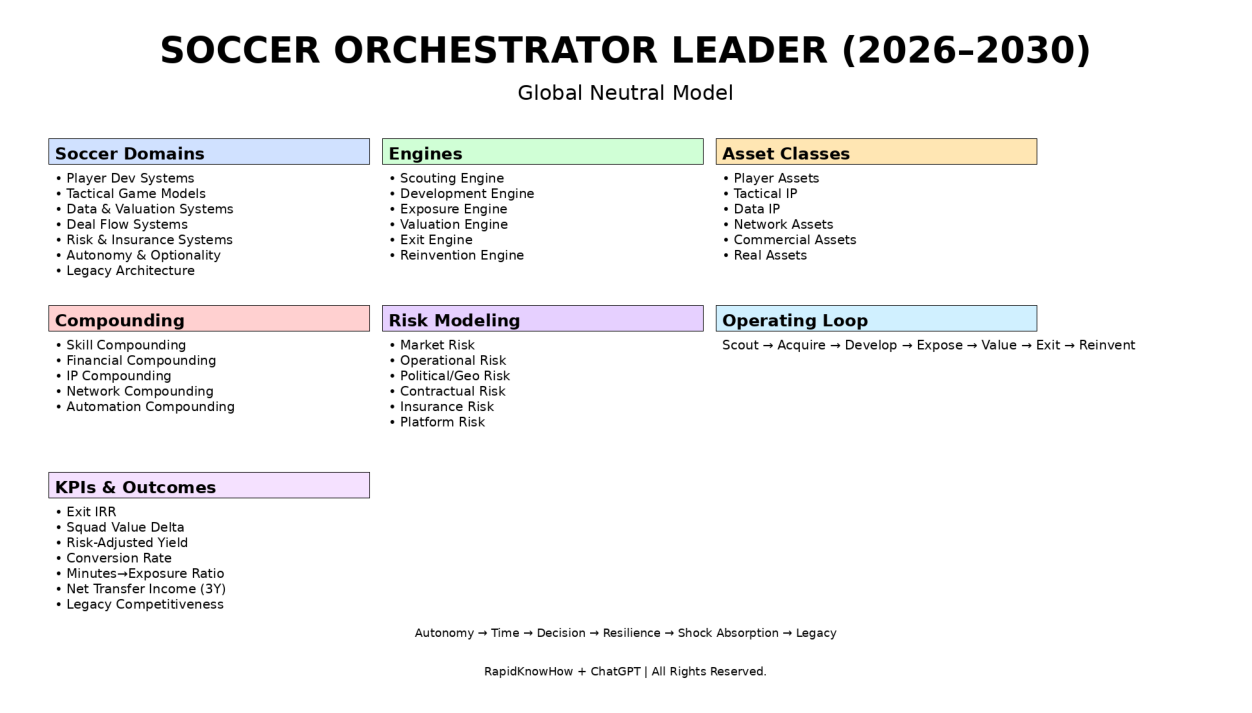
Orchestrators manage five primary asset classes:
- Player Assets (development → exit → IRR)
- Tactical IP Assets (principles, models, set plays)
- Data IP Assets (valuation, performance, forecasting)
- Network Assets (agents, converter leagues, federations)
- Commercial Assets (brand, licensing, media)
This turns football into a portfolio architecture, not a single-asset business.
5. The Operating Loop (Continuous Value Flywheel)
The Orchestrator Operating Loop:
Scout → Acquire → Develop → Expose → Value → Exit → Reinvent
Each stage compounds the next:
- Scout = edge detection
- Acquire = CAPEX allocation
- Develop = skill compounding
- Expose = data + league visibility
- Value = mark-to-market valuation
- Exit = IRR realization
- Reinvent = IP retention + reinvestment
This converts football into a flywheel, not a gamble.
6. Compounding Mechanics in Football
5 Compounding Layers:
- Skill Compounding
→ minutes, coaching, tactical repetition - Financial Compounding
→ transfer IRR, sell-on %, clauses - IP Compounding
→ tactical libraries, academy frameworks - Network Compounding
→ converter leagues, exposure markets - Automation Compounding
→ AI scouting, valuation models, exposure platforms
Compounding ≠ speculation → compounding is systematic.
7. Risk Modeling & Shock Absorption
Orchestrators manage risk with frameworks used in capital markets:
Risk Dimensions:
- Market Risk (liquidity, demand)
- Operational Risk (injury, form)
- Political / Geo Risk (visas, leagues, sanctions)
- Contractual Risk (agents, clauses)
- Insurance Risk (injury coverage)
- Platform Risk (league regulations)
Shock Absorption through:
- diversification
- optionality
- network redundancy
- data-driven exposure mapping
8. Strategic Outcomes
Orchestrator Clubs achieve:
- Higher Exit IRR
- Lower value variance
- Stronger academy leverage
- Greater autonomy vs intermediaries
- Resilience against market shocks
- Competitive legacy beyond single cycles
Key KPIs:
- Exit IRR
- Squad Value Delta
- Risk-Adjusted Yield
- Conversion Rate
- Minutes→Exposure Ratio
- Net Transfer Income (3Y)
- Legacy Competitiveness
9. The Future Landscape (2026–2030)
Prediction Matrix:
| Dimension | Traditional | Orchestrator |
|---|---|---|
| Talent | Purchase | Compound |
| Transfers | Speculative | IRR-based |
| Tactical | Manager-driven | IP-driven |
| Valuation | Agent-driven | Data-driven |
| Risk | Ignored | Modeled |
| Strategy | Season | Decade |
| Capital | Spent | Allocated |
Winners: Clubs with Operating Loops, not chequebooks.
10. Conclusion — The Orchestrator Advantage
Football is quietly converging toward:
Asset Management × Tactical IP × Network Liquidity
The clubs that master orchestration will:
- dominate sporting performance
- generate predictable yields
- build strategic autonomy
- and create legacy architectures
“The future of football is orchestrated – not bought”


