LOWER JOINT COST. PROVE THE CASH. SHARE THE VALUE.
A supplier reduces delivery costs by increasing batch size. The customer then pays for more inventory, storage and handling. One company’s KPI improves while the shared system may become more expensive.
ONE decision: approve one 90-day supplier–customer TCO pilot before expanding the system.
Why manage TCO across company borders?
Purchase price is one part of total cost. Acquisition, operation, maintenance, failure and end-of-life costs also matter. Map the flow from specification and ordering to delivery, use, returns and renewal.
Build two connected views: customer TCO and joint resource cost. In the joint model, avoid adding both the supplier invoice and the underlying supplier costs. Internal payments allocate value between partners; they do not automatically create new joint value.
The practical process
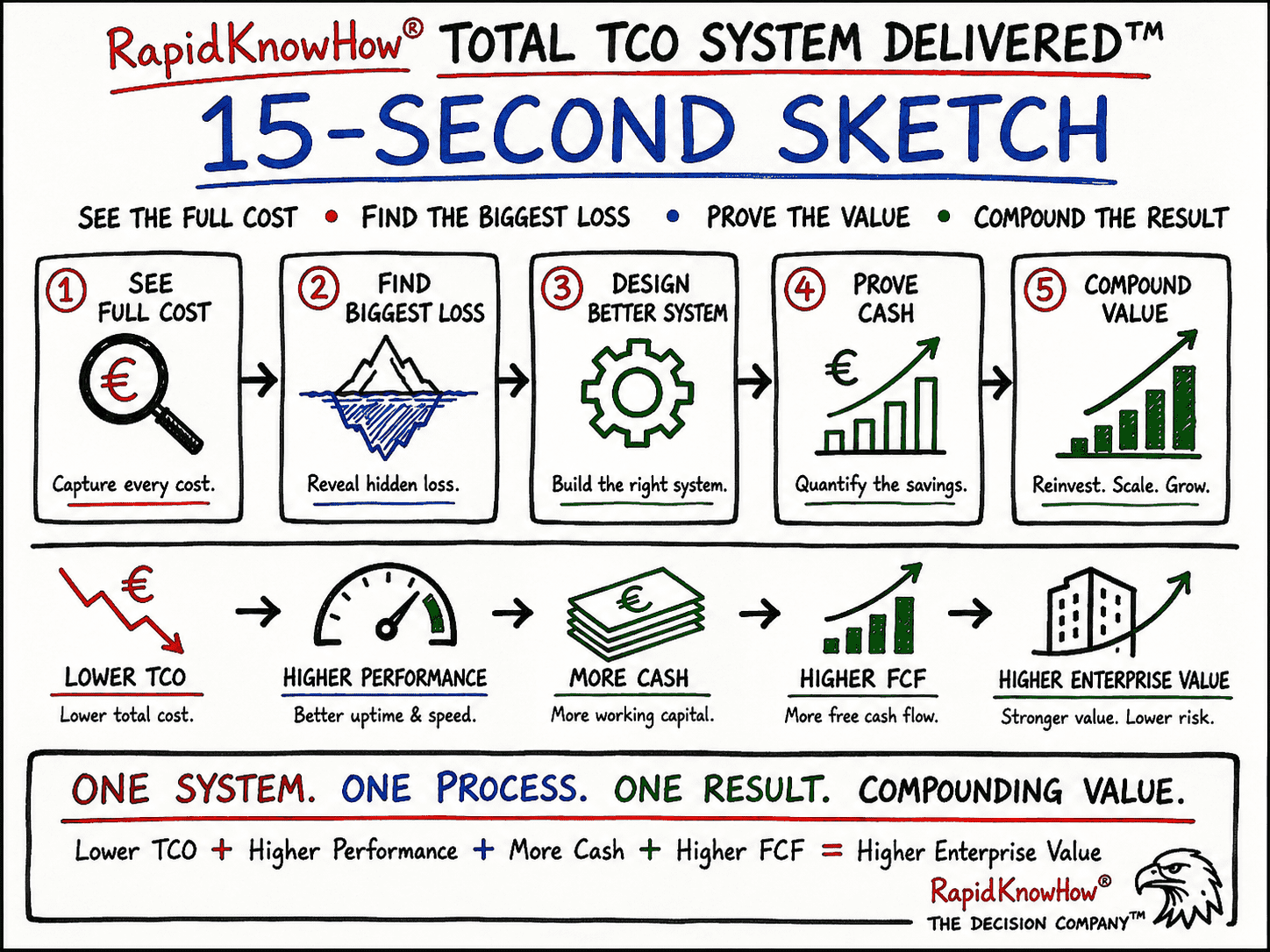
- See the full cost. Agree one output unit, service floor, boundary and baseline period.
- Find the largest loss. Inspect emergency trips, waiting, excess buffers, failed output and lost assets.
- Design the better flow. Assign triggers, owners, response times and stop conditions.
- Prove the cash. Separate recurring paid-cost reductions, one-time working-capital release and expected risk benefits.
- Share and preserve value. Agree implementation-cost recovery, net benefit sharing, review and renewal.
An industrial gas illustration
In a hypothetical replenishment pilot, annual joint resource costs fall from €390,000 to €355,000, including €6,000 of new monitoring costs. Net recurring benefit is €35,000. After €10,000 of implementation cash, year-one operating cash benefit is €25,000 before tax and working capital.
These are invented teaching figures, not customer results or market benchmarks. The actual pilot requires comparable output, approved technical conditions and finance validation.
TOP 3 ACTIONS NOW
- Name one supplier–customer flow and one owner on each side.
- Reconcile one baseline using operational records, invoices and finance evidence.
- Select one reversible intervention and establish the 90-day verification gate.
30-day result: one agreed cost map, one ranked loss and one approved pilot charter.
Your Commercial Flow
Buy PowerBook — Full process — €29
PowerPost → PowerBook → Action Guide → Board Decision → 90-Day Cash Proof → scoped annual PowerLicense → renewal and expansion.
PowerBook: Total Cost of Ownership Management across Company Borders. 14-page PDF with the joint cost model, industrial gas illustration, sharing calculation, pilot charter and verification record. Launch price €29.
Full process: explore the Commercial Flow
Buy License: discuss the scope for your companies, sites and teams
Enterprise licensing requires a separate agreement. Begin with one verified result, then scale the reusable method.
Source
CIPS: Total cost of ownership, accessed 9 October 2026. Cross-company method and templates: RapidKnowHow® synthesis.