RapidKnowHow® POWERPOST™
4 SEPTEMBER 2026
ONE CONCLUSION
THE BEST INDUSTRIAL GAS OPPORTUNITIES ARE OFTEN ALREADY VISIBLE IN THE CUSTOMER FLOW.
The problem is not lack of market information.
The problem is that companies often need weeks of meetings, market studies, sales discussions and spreadsheets before they decide where to act.
RapidKnowHow® takes a different approach:
SEE THE SIGNAL → FIND THE CHOKEPOINT → QUANTIFY THE VALUE → RANK THE OPPORTUNITY → CHOOSE ONE STRATEGY → ACT → PROVE THE RESULT
The objective is simple:
MOVE FROM REACTIVE PRODUCT SELLING TO FLOW-BASED VALUE GROWTH.
WHY THIS MATTERS NOW
The DACH & CEE industrial environment is changing quickly.
German manufacturing strengthened in August 2026, with the strongest increase in production since January 2022 and a significant rise in new orders. German industrial orders for July also increased 2.5%, although the underlying picture remains mixed when large orders are excluded. (Reuters)
At the same time, German industrial companies are under increasing competitive pressure. A DIHK survey found that 83% of industrial firms feel growing pressure from Chinese competitors. Companies are responding primarily through innovation, lower costs and new markets. (Reuters)
Energy remains another important uncertainty. The European Commission said on September 3 that there is currently no immediate EU gas-supply-security risk, but global energy conditions remain exceptional, Middle East instability continues and price volatility requires close monitoring. (Energy)
The industrial gas industry itself shows where value is moving. Linde reported an 18% rise in electronics-market demand in Q2 2026, while Air Liquide continues to highlight AI and semiconductor investment as an important growth driver. (Reuters)
These signals tell industrial gas leaders one thing:
DO NOT WAIT FOR THE ANNUAL STRATEGY PROCESS TO FIND THE NEXT OPPORTUNITY.
THE TRADITIONAL WAY
A typical new-business process looks like this:
Market Study → Sales Meeting → Segment Analysis → Customer Interviews → Opportunity List → Management Review → Business Case → Approval
The organization collects more and more information.
But time passes.
Meanwhile:
The customer experiences stockouts.
Emergency deliveries continue.
Working capital stays trapped.
Competitors increase share-of-wallet.
Energy volatility changes economics.
A new opportunity appears somewhere else.
By the time the strategy is approved, the signal may already have moved.
THE RapidKnowHow® WAY
DETECT THE VALUE FLOW FIRST.
Instead of starting with:
“What product can we sell?”
start with:
“WHERE IS THE CUSTOMER LOSING VALUE?”
Then follow the flow.
CUSTOMER DEMAND
→ GAS REQUIREMENT
→ SUPPLY
→ REPLENISHMENT
→ TRANSPORT
→ CUSTOMER INVENTORY
→ PRODUCTION
→ CUSTOMER VALUE
→ CASH
Every interruption can become a commercial opportunity.
THE FIVE QUESTIONS THAT DETECT AN OPPORTUNITY
1. WHAT CHANGED?
A demand pattern.
A customer investment.
An energy price.
A competitor move.
A supply problem.
A regulation.
A production increase.
A new semiconductor, battery, healthcare, food or manufacturing project.
2. WHERE IS THE CHOKEPOINT?
Look for:
Stockouts
Emergency deliveries
Excess inventory
Low tank visibility
Transport inefficiency
Capacity constraints
Customer downtime
High energy exposure
Weak pricing
Slow cash conversion
The chokepoint is where the commercial opportunity often hides.
3. WHAT VALUE IS AT RISK?
Translate the problem into money.
Ask:
€ Revenue at risk?
€ Customer production at risk?
€ Emergency cost?
€ Inventory trapped?
€ Margin leakage?
€ Working capital tied up?
€ FCF opportunity?
Now the sales discussion changes.
You are no longer discussing gas.
You are discussing customer value.
4. CAN WE SOLVE IT BETTER THAN THE CURRENT SYSTEM?
This is the strategic test.
A good new-business opportunity should produce a clear improvement in at least one of these dimensions:
Reliability ↑
Customer value ↑
Operating cost ↓
Working capital ↓
Risk ↓
Margin ↑
FCF ↑
ROCE ↑
5. CAN THE SOLUTION BE REPEATED?
This is crucial.
A one-off project creates revenue once.
A repeatable system creates:
Customer value → Proof → Standard → License → Expansion → Recurring FCF
That is a much stronger business model.
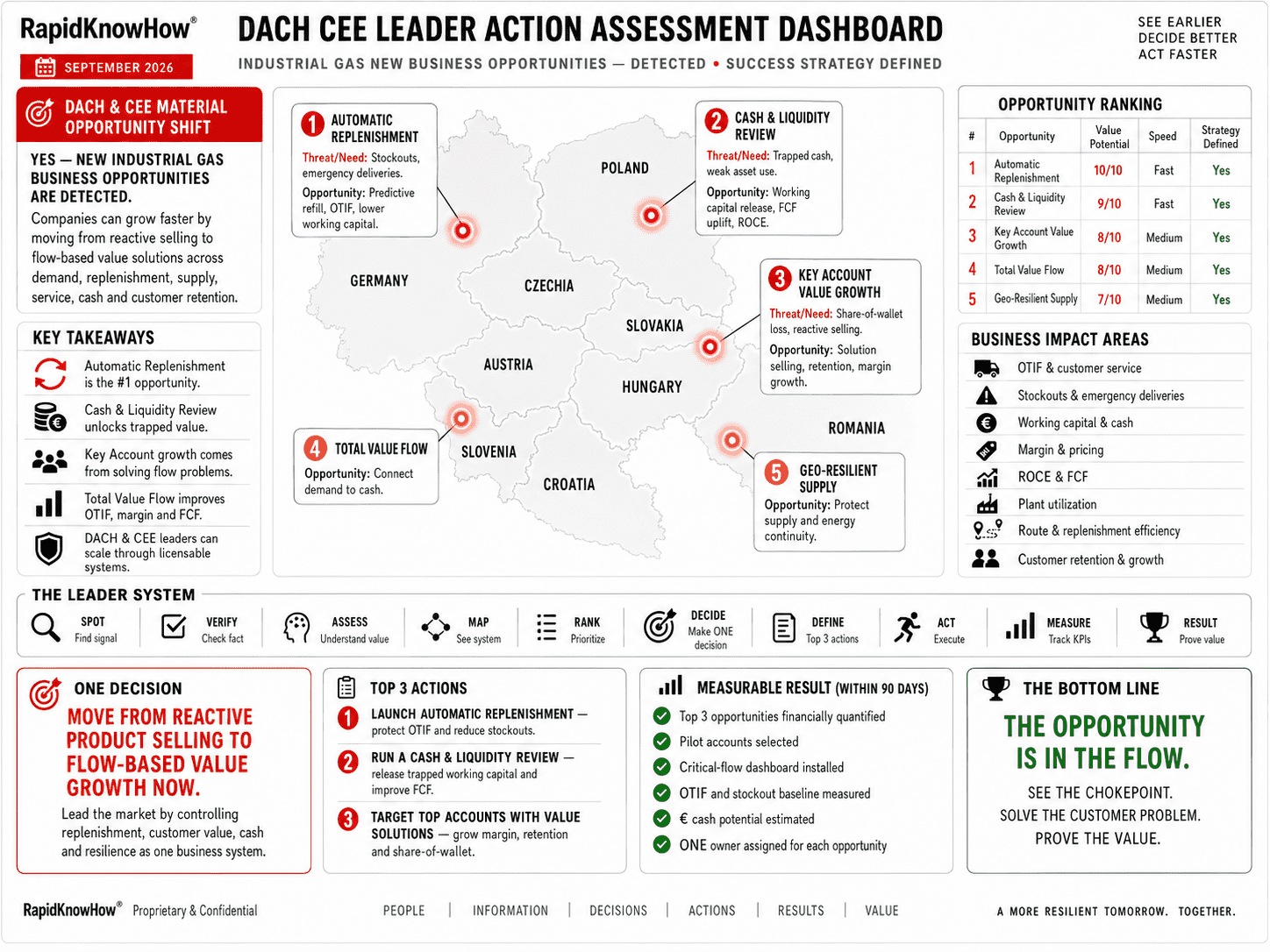
RapidKnowHow® DACH & CEE OPPORTUNITY RANKING
4 SEPTEMBER 2026
The following ranking is a RapidKnowHow® strategic assessment based on current industrial, energy and industrial-gas signals.
| Rank | Opportunity | Value Potential | Speed | Strategic Logic |
|---|---|---|---|---|
| 1 | Automatic Replenishment™ | 10/10 | FAST | Protect OTIF, eliminate stockouts, reduce emergency delivery and inventory |
| 2 | Cash & Liquidity Review™ | 9/10 | FAST | Release trapped working capital and strengthen FCF |
| 3 | Key Account Value Growth™ | 8/10 | MEDIUM | Solve customer flow problems and increase retention/share-of-wallet |
| 4 | Total Value Flow™ | 8/10 | MEDIUM | Connect demand, supply, operations, service and cash |
| 5 | Geo-Resilient Supply™ | 7/10 | MEDIUM | Reduce exposure to energy and supply disruptions |
OPPORTUNITY 1 — AUTOMATIC REPLENISHMENT™
THE SIGNAL
Customers increasingly expect reliable, low-effort supply.
Digital gas-management capability already exists across the industry. Air Liquide describes its Integrated Bulk Operations program as connecting customer storage and delivery assets to forecast consumption and optimize truck routes. Linde also markets digital gas and container management aimed at automating processes and improving inventory transparency. (Air Liquide)
THE CUSTOMER PROBLEM
Traditional replenishment often depends on:
Orders.
Telephone calls.
Manual forecasts.
Safety stock.
Planner intervention.
Emergency response.
THE OPPORTUNITY
Move to:
CONSUMPTION SIGNAL → PREDICTION → AUTOMATIC REPLENISHMENT → OPTIMIZED ROUTE → PROTECTED CUSTOMER SUPPLY
SUCCESS STRATEGY
Start with high-value customers where:
Consumption is predictable.
Stockouts are expensive.
Emergency deliveries occur.
Tank telemetry is available or can be installed.
Logistics density allows route optimization.
PROVE
Measure:
Stockouts ↓
Emergency deliveries ↓
OTIF ↑
Customer inventory ↓
Transport efficiency ↑
Working capital ↓
RANK: #1
OPPORTUNITY 2 — CASH & LIQUIDITY REVIEW™
THE SIGNAL
Growth is valuable only when it creates cash.
In industrial gas, cash can become trapped in:
Excess cylinders.
Customer stocks.
Distribution inventories.
Slow-moving products.
Emergency logistics.
Low asset utilization.
Unnecessary capital expenditure.
THE OPPORTUNITY
Turn an operating review into a cash review.
INVENTORY ↓ + WAITING ↓ + WASTE ↓ + ASSET UTILIZATION ↑ → FCF ↑
SUCCESS STRATEGY
Select one business unit.
Establish the baseline.
Map where cash is trapped.
Rank the Top 3 cash-release opportunities.
Act within 30 days.
PROVE
Measure:
€ Working capital released
€ Cost avoided
€ FCF improvement
ROCE improvement
RANK: #2
OPPORTUNITY 3 — KEY ACCOUNT VALUE GROWTH™
THE SIGNAL
Industrial customers are under pressure to increase productivity, reduce energy cost and strengthen supply resilience.
German industrial companies themselves identify innovation, cost reduction and entry into new markets as major responses to competitive pressure. (Reuters)
Industrial gas suppliers therefore have an opportunity to move beyond:
SELLING MORE GAS
toward:
SOLVING MORE CUSTOMER VALUE PROBLEMS.
THE OPPORTUNITY
For each strategic account identify:
One critical flow
One chokepoint
One measurable value opportunity
Examples:
Production downtime.
Unreliable gas availability.
Poor cylinder visibility.
High energy consumption.
Manual handling.
Process-gas inefficiency.
Excess inventory.
SUCCESS STRATEGY
Change the account conversation from:
PRICE PER UNIT
to:
TOTAL VALUE DELIVERED
PROVE
Measure:
Customer savings
Revenue protected
Margin improvement
Retention
Share-of-wallet
RANK: #3
OPPORTUNITY 4 — TOTAL VALUE FLOW™
Traditional management separates:
Sales.
Supply.
Production.
Transport.
Service.
Finance.
But the customer experiences one system.
THE OPPORTUNITY
Connect:
DEMAND → SUPPLY → PLANT → TRANSPORT → CUSTOMER → SERVICE → CASH → FCF
The commercial opportunity comes from solving the entire flow rather than optimizing one individual step.
SUCCESS STRATEGY
Install the RapidKnowHow® Total Managed Command Center™.
See the signal.
Find the chokepoint.
Make ONE decision.
Execute the Top 3 actions.
Measure the value.
PROVE
OTIF ↑
Inventory ↓
Emergency cost ↓
Margin ↑
Cash ↑
FCF ↑
ROCE ↑
RANK: #4
OPPORTUNITY 5 — GEO-RESILIENT SUPPLY™
THE SIGNAL
Energy and geopolitical uncertainty remain material.
Europe currently has no immediate gas-supply-security emergency, according to the European Commission, but Middle East instability and exceptional market conditions continue to create significant price volatility. Germany is simultaneously adding LNG infrastructure, including the Stade floating terminal expected to begin start-up operations in September 2026. (Energy)
THE OPPORTUNITY
Customers increasingly value:
Reliable local supply
Alternative sourcing
Energy resilience
Supply visibility
Contingency capability
Industrial gases can therefore compete on more than price.
SUCCESS STRATEGY
Sell:
SUPPLY SECURITY AS CUSTOMER VALUE.
Map critical customer dependencies.
Define alternative supply paths.
Quantify the economic value of avoided disruption.
RANK: #5
HOW TO DETERMINE THE SUCCESS STRATEGY IN MINUTES
RapidKnowHow® uses one decision sequence:
SIGNAL
What changed?
↓
PROBLEM
What customer problem does it create?
↓
VALUE
How much value is at risk or available?
↓
CHOKEPOINT
What is stopping the value flow?
↓
ONE DECISION
Which solution creates the greatest value?
↓
TOP 3 ACTIONS
What must happen now?
↓
PROOF
Which KPI proves success?
This can create an initial strategic hypothesis in minutes.
Not because analysis is unnecessary.
But because analysis is focused on the decision that matters.
THE 10-MINUTE OPPORTUNITY TEST™
Ask only six questions:
What is the ONE signal?
What customer problem does it reveal?
Where is the chokepoint?
What is the € value opportunity?
What solution removes the chokepoint?
What measurable result proves success?
If these questions cannot be answered clearly, the opportunity is not ready.
If they can:
ACT.
FROM OPPORTUNITY TO COMMERCIAL SYSTEM
The next mistake would be turning every detected opportunity into another consulting project.
Instead:
DETECT → PROVE → STANDARDIZE → LICENSE → SCALE
Example:
Automatic Replenishment Problem Detected
↓
Pilot with ONE Customer
↓
Stockouts + Emergency Deliveries Reduced
↓
€ Value Verified
↓
Solution Standardized
↓
RapidKnowHow® Action Guide / License
↓
Deploy Across Accounts
↓
RECURRING FCF
That is how knowledge becomes an asset.
ONE DECISION FOR DACH & CEE INDUSTRIAL GAS LEADERS
STOP WAITING FOR CUSTOMERS TO SEND ORDERS.
START DETECTING THE CUSTOMER FLOW PROBLEM BEFORE THE ORDER EXISTS.
The opportunity is often visible earlier in:
Consumption.
Inventory.
Downtime.
Logistics.
Energy.
Cash.
Competitor share-of-wallet.
TOP 3 ACTIONS NOW
1. LAUNCH AUTOMATIC REPLENISHMENT™
Select high-value accounts where stockouts, emergency delivery or excess customer inventory create measurable cost.
2. RUN A CASH & LIQUIDITY REVIEW™
Identify trapped working capital and the fastest FCF-release opportunities.
3. TARGET TOP ACCOUNTS WITH VALUE SOLUTIONS™
Find one expensive flow problem per account and sell the measurable result instead of the gas product.
90-DAY RESULT
Within 90 days the leadership team should have:
Top 3 opportunities financially quantified
Pilot customers selected
Baseline KPIs established
One Critical Flow Dashboard operating
€ cash/value potential quantified
One accountable leader for each opportunity
First verified customer result
FINAL CONCLUSION
Traditional industrial gas selling asks:
WHO NEEDS MORE GAS?
RapidKnowHow® asks:
WHERE IS CUSTOMER VALUE BLOCKED — AND CAN WE REMOVE THE CHOKEPOINT?
That question detects opportunities earlier.
It produces stronger customer conversations.
It creates measurable value.
And it turns reactive product selling into:
FLOW-BASED BUSINESS GROWTH.
RapidKnowHow®
THE DECISION COMPANY™
SEE THE SIGNAL → FIND THE CHOKEPOINT → SOLVE THE CUSTOMER PROBLEM → PROVE THE VALUE → SCALE THE SYSTEM
SEE EARLIER • DECIDE BETTER • ACT FASTER
RapidKnowHow® Proprietary & Confidential
Leave a Reply