TOP 30 WORLD ECONOMIES — WIN-WIN vs WIN-LOSE
Snapshot: 4 September 2026
ONE CONCLUSION
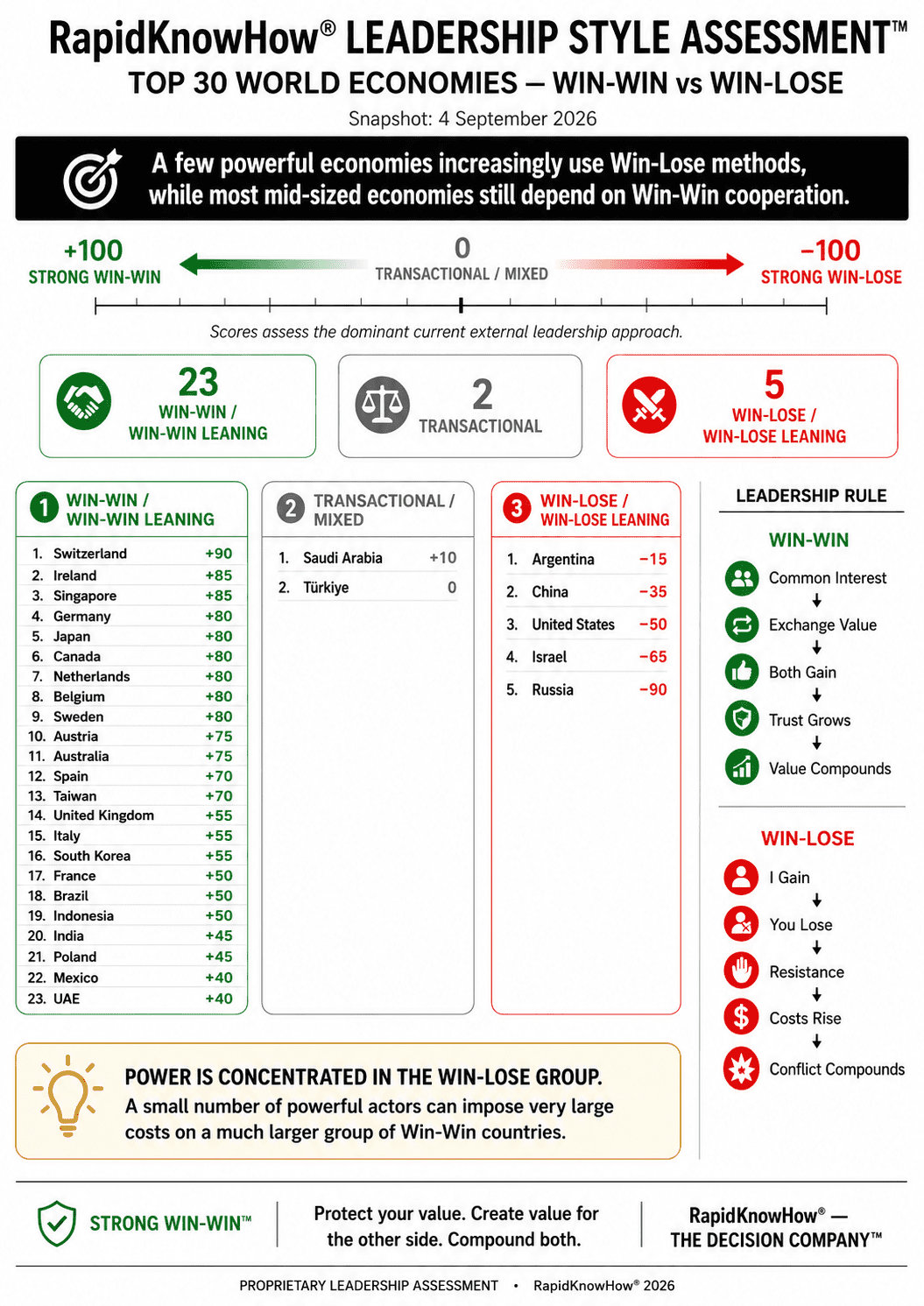
The world is not predominantly Win-Lose. The greater danger is that several of its most powerful actors increasingly use Win-Lose methods—military force, tariffs, sanctions, economic leverage and coercion—while many medium-sized economies still depend on Win-Win cooperation to prosper.
ASSESSMENT SCALE
+100 = STRONG WIN-WIN
Creates mutual value, predictable rules, alliances, trade and negotiated solutions.
0 = TRANSACTIONAL / MIXED
Cooperates when useful but readily applies pressure.
−100 = STRONG WIN-LOSE
Domination, coercion, territorial force or systematic imposition of costs on others.
These scores assess the dominant current external leadership approach. They are not judgments about a country’s population or culture.
TOP 30 LEADERSHIP STYLE ASSESSMENT
| Rank | Country / Economy | Score | Leadership Style | Core Assessment |
|---|---|---|---|---|
| 1 | 🇺🇸 United States | −50 | 🔴 Win-Lose leaning | Power, tariffs, sanctions and military leverage increasingly dominate |
| 2 | 🇨🇳 China | −35 | 🔴 Competitive | Partnership and investment combined with strategic state leverage |
| 3 | 🇩🇪 Germany | +80 | 🟢 Win-Win | Coalition, EU integration, trade and negotiated rules |
| 4 | 🇯🇵 Japan | +80 | 🟢 Win-Win | Alliance building, investment and stability |
| 5 | 🇬🇧 United Kingdom | +55 | 🟢 Win-Win leaning | Alliances and trade backed by hard-power capability |
| 6 | 🇮🇳 India | +45 | 🟢 Win-Win leaning | Multi-alignment, trade and strategic autonomy |
| 7 | 🇫🇷 France | +50 | 🟢 Win-Win leaning | European cooperation plus independent power projection |
| 8 | 🇮🇹 Italy | +55 | 🟢 Win-Win | EU/NATO cooperation and commercial diplomacy |
| 9 | 🇷🇺 Russia | −90 | 🔴 Strong Win-Lose | Territorial and military power remain central |
| 10 | 🇧🇷 Brazil | +50 | 🟢 Win-Win leaning | Dialogue, BRICS and Western relationships |
| 11 | 🇨🇦 Canada | +80 | 🟢 Strong Win-Win | Rules, alliances, trade and trusted partnerships |
| 12 | 🇦🇺 Australia | +75 | 🟢 Win-Win | Alliance-based, trade-oriented and rules-based |
| 13 | 🇲🇽 Mexico | +40 | 🟢 Win-Win leaning | Integration and negotiation despite external pressure |
| 14 | 🇪🇸 Spain | +70 | 🟢 Win-Win | EU cooperation and multilateralism |
| 15 | 🇰🇷 South Korea | +55 | 🟢 Win-Win leaning | Trade, technology partnerships and alliances |
| 16 | 🇹🇷 Türkiye | 0 | 🟠 Transactional | Balances competing blocs using strategic leverage |
| 17 | 🇮🇩 Indonesia | +50 | 🟢 Win-Win leaning | Non-alignment, ASEAN cooperation and investment |
| 18 | 🇳🇱 Netherlands | +80 | 🟢 Strong Win-Win | Rules, trade and European cooperation |
| 19 | 🇸🇦 Saudi Arabia | +10 | 🟠 Transactional | Deal-driven strategic balancing |
| 20 | 🇨🇭 Switzerland | +90 | 🟢 Strong Win-Win | Neutrality, mediation, trade and predictable institutions |
| 21 | 🇵🇱 Poland | +45 | 🟢 Win-Win leaning | Strong alliances combined with tougher security posture |
| 22 | 🇹🇼 Taiwan | +70 | 🟢 Win-Win | Trade, technology and international partnerships |
| 23 | 🇧🇪 Belgium | +80 | 🟢 Strong Win-Win | EU/NATO institution-building and trade |
| 24 | 🇮🇪 Ireland | +85 | 🟢 Strong Win-Win | Open economy, investment and multilateral rules |
| 25 | 🇸🇪 Sweden | +80 | 🟢 Strong Win-Win | Cooperation plus collective security |
| 26 | 🇦🇷 Argentina | −15 | 🟠 Competitive | Increasingly assertive national-interest posture |
| 27 | 🇮🇱 Israel | −65 | 🔴 Win-Lose leaning | Current security strategy heavily dominated by military coercion |
| 28 | 🇸🇬 Singapore | +85 | 🟢 Strong Win-Win | Trade, neutrality, predictability and connectivity |
| 29 | 🇦🇹 Austria | +75 | 🟢 Win-Win | EU integration, economic cooperation and negotiated solutions |
| 30 | 🇦🇪 UAE | +40 | 🟢 Pragmatic Win-Win | Investment, commercial diplomacy and strategic balancing |
THE STRATEGIC PATTERN
🟢 WIN-WIN / WIN-WIN LEANING
23 economies
🟠 TRANSACTIONAL
2 economies
🔴 WIN-LOSE / WIN-LOSE LEANING
5 economies
But the number of countries is not the decisive factor.
POWER IS CONCENTRATED IN THE WIN-LOSE GROUP.
The United States, China and Russia possess enormous economic, military, technological, energy and nuclear leverage.
Therefore:
A relatively small number of Win-Lose leadership systems can impose very large costs on a much larger group of Win-Win countries.
RapidKnowHow® LEADERSHIP RULE
WIN-LOSE
I GAIN
→ YOU LOSE
→ YOU RESIST
→ COST RISES
→ CONFLICT COMPOUNDS
WIN-WIN
COMMON INTEREST
→ EXCHANGE VALUE
→ BOTH GAIN
→ TRUST GROWS
→ VALUE COMPOUNDS
THE WINNING LEADERSHIP MODEL 2026–2030
SEE THE COMMON INTEREST
↓
CREATE MUTUAL VALUE
↓
PROTECT YOUR CORE INTEREST
↓
NEGOTIATE FROM STRENGTH
↓
SHARE THE UPSIDE
↓
VERIFY THE RESULT
↓
COMPOUND TRUST + VALUE
This is not weak leadership.
It is:
STRONG WIN-WIN™
Strong enough to defend your interests.
Smart enough not to destroy the value of the other side.
FINAL ASSESSMENT
The defining strategic contest of 2026–2030 may increasingly be understood not simply as:
DEMOCRACY vs AUTOCRACY
but as:
WIN-LOSE POWER
versus
WIN-WIN POWER
The leadership system with the greatest potential for sustainable long-term economic and strategic value is:
STRONG WIN-WIN™
PROTECT YOUR VALUE.
CREATE VALUE FOR THE OTHER SIDE.
COMPOUND BOTH.
RapidKnowHow® — THE DECISION COMPANY™
PROPRIETARY LEADERSHIP ASSESSMENT
RapidKnowHow® 2026
Leave a Reply