GLOBAL MATERIAL SHIFT ALERT — 4 SEPTEMBER 2026
ONE CONCLUSION
YES — THERE IS A MATERIAL SHIFT.
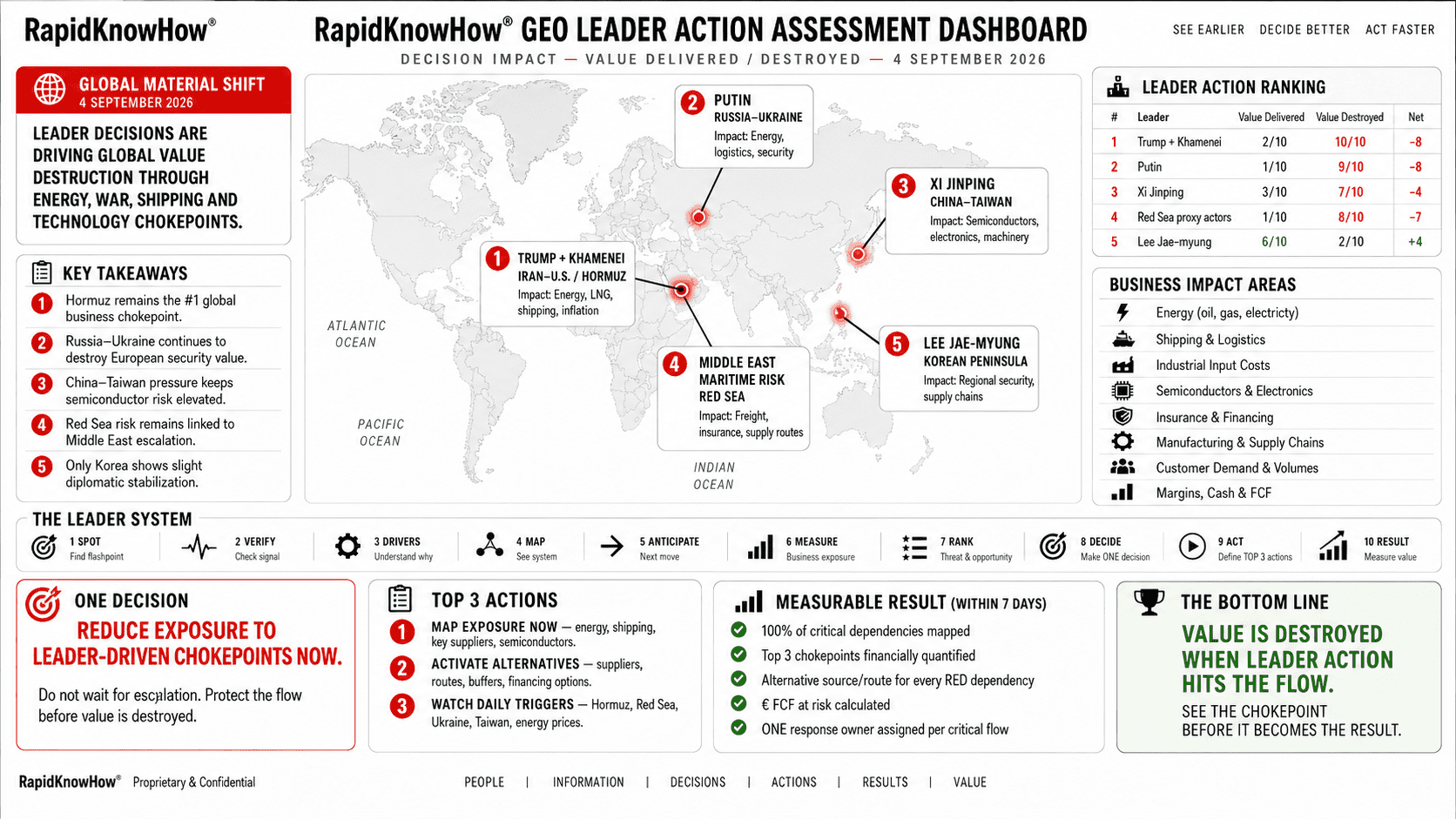
The most important change is the renewed U.S.–Iran military exchange and the resulting rise in Strait of Hormuz risk. That matters directly to DACH & CEE businesses because it can transmit rapidly through oil, LNG, shipping, insurance, electricity and industrial input costs. South Korea is now preparing military assets to support freedom of navigation in Hormuz, showing that the crisis is becoming an international supply-security issue rather than only a bilateral military confrontation.
TOP 5 FLASHPOINTS — MATERIAL CHANGE RANKING
| Rank | Flashpoint | Shift | Threat | Opportunity | Business implication |
|---|---|---|---|---|---|
| 1 | Iran–U.S.–Israel / Hormuz | 🔴 ↑↑ | 10/10 | 7/10 | Energy, LNG, shipping, insurance, petrochemicals |
| 2 | Russia–Ukraine / NATO Europe | 🔴 ↔ / mixed | 9/10 | 6/10 | Energy security, Black Sea logistics, defence, cyber |
| 3 | China–Taiwan / Pacific | 🟠 ↑ | 8/10 | 7/10 | Semiconductors, electronics, machinery supply |
| 4 | Red Sea / Bab el-Mandeb | 🔴 ↑ | 8/10 | 6/10 | Freight routes, tanker availability, insurance |
| 5 | Korean Peninsula | 🟡 ↓ | 6/10 | 5/10 | Dialogue signals modestly reduce near-term escalation risk |
1. IRAN–U.S.–ISRAEL / STRAIT OF HORMUZ
SPOT THE FLASHPOINT
The U.S. launched renewed strikes on Iranian military assets this week and Iran retaliated. Reuters reported renewed fears of a wider Middle East war; Iran also fired toward Kuwait, while South Korea is preparing a possible deployment to support freedom of navigation through Hormuz.
VERIFY THE SIGNAL
Commodity-vessel passages through Hormuz remain at single-digit levels, an exceptionally important indicator for global energy logistics.
DRIVERS
U.S. military pressure → Iranian retaliation → Hormuz leverage → allied naval involvement → energy-security response
SYSTEM MAP
IRAN CONFLICT
→ HORMUZ
→ OIL + LNG SHIPPING
→ FREIGHT / INSURANCE
→ EUROPEAN ENERGY COST
→ INDUSTRIAL COST
→ MARGIN + FCF
ANTICIPATE NEXT MOVE
The most consequential next move would be additional Iranian pressure on tanker traffic, mining capacity or coordinated activity through allied groups. A move affecting Hormuz and the Red Sea simultaneously would create a much larger energy-and-logistics shock.
DACH & CEE BUSINESS EXPOSURE
VERY HIGH
Industrial gases are particularly exposed indirectly through:
Electricity → natural gas → transport → customer production volumes → working capital.
THREAT: 10/10
OPPORTUNITY: 7/10
Opportunity lies in energy resilience, local supply, efficiency, inventory visibility and customer continuity solutions.
2. RUSSIA–UKRAINE / EUROPEAN SECURITY
MATERIAL SHIFT: MIXED
Russia continued major strikes on Kyiv and Ukrainian infrastructure. At the same time, Putin publicly said there was a chance of reaching an agreement, and U.S. negotiators were expected to engage both sides.
There is therefore a significant divergence:
**TACTICAL ESCALATION ↑
DIPLOMATIC OPTION ↑**
A second concern for DACH is the widening hybrid-security dimension. Germany and EU institutions have accused Russia over a drone incident in Leipzig and announced increased pressure, while Moscow rejects the allegation.
Black Sea commercial vessels are also adopting improvised anti-drone protection as attacks intensify.
SYSTEM
WAR → INFRASTRUCTURE / BLACK SEA / HYBRID RISK → ENERGY + LOGISTICS + INSURANCE → DACH & CEE INDUSTRIAL COST
THREAT: 9/10
OPPORTUNITY: 6/10
Changed implication: Do not treat a possible negotiation track as sufficient reason to remove resilience measures.
3. CHINA–TAIWAN
MATERIAL SHIFT: ↑ MODERATE
China disclosed a seabed survey in waters east of Taiwan, alongside coast-guard activity; Taiwan rejected Beijing’s jurisdiction and characterized the activity as harassment.
Taiwan simultaneously proposed an additional US$4.6 billion of 2026 defence spending, including large numbers of drones, surveillance systems and anti-ballistic capabilities.
Australia and the U.S. also agreed to deepen defence cooperation as competition with China in the Pacific grows.
SYSTEM
CHINESE PRESSURE
→ TAIWAN DEFENCE HARDENING
→ U.S./ALLIED RESPONSE
→ CROSS-STRAIT RISK
→ SEMICONDUCTORS
→ INDUSTRIAL ELECTRONICS / AUTOMATION
THREAT: 8/10
OPPORTUNITY: 7/10
For DACH & CEE companies, the main exposure remains semiconductors, controls, sensors, automation equipment and electronics supply chains.
4. RED SEA / BAB EL-MANDEB
This remains tightly connected to Iran.
The Houthis have previously threatened a maritime blockade and attacked Saudi oil shipping. Iran has also reportedly asked them to be prepared to close the Red Sea gateway under specified escalation conditions.
The key danger is no longer evaluating Hormuz and Bab el-Mandeb separately.
HORMUZ + RED SEA = ONE ENERGY-SHIPPING SYSTEM
THREAT: 8/10
For Europe, simultaneous pressure on both chokepoints would sharply increase routing, insurance and energy risk.
5. KOREAN PENINSULA
Here the movement is in the opposite direction.
South Korean officials reported signs that the U.S. and North Korea may be moving toward renewed dialogue, and President Lee called for conditions enabling talks to resume.
Kim Jong Un has nevertheless strengthened centralized political and wartime decision authority.
SHIFT
Immediate confrontation risk ↓ slightly
Structural military risk remains high
THREAT: 6/10
This is currently not the flashpoint requiring a new business action.
MATERIAL SHIFT FROM THE PREVIOUS BASELINE
The strategic hierarchy has changed.
Previously, Russia–Ukraine and European security could reasonably dominate a DACH & CEE risk screen.
Today:
1. HORMUZ / IRAN
2. RUSSIA–UKRAINE
3. TAIWAN
The Middle East has moved to #1 because the military conflict is now directly intersecting the world’s most important energy chokepoint.
ONE DECISION
MOVE HORMUZ / MIDDLE EAST ENERGY-SUPPLY EXPOSURE TO RED STATUS NOW.
Do not wait for an actual closure of the Strait.
The business decision is to protect the flow before the chokepoint fails.
TOP 3 ACTIONS
1 — MAP EXPOSURE NOW
Quantify DACH & CEE exposure to oil, LNG, electricity, maritime freight, critical feedstocks and suppliers connected to Hormuz/Red Sea routes.
2 — ACTIVATE ALTERNATIVES
Identify alternate suppliers, logistics routes, inventory buffers and energy-price contingencies for the highest-value flows.
3 — WATCH THREE TRIGGERS DAILY
Hormuz vessel traffic → Iranian/Houthi maritime action → European energy-price response.
If any two deteriorate materially together, escalate from preparedness → execution.
MEASURABLE RESULT
Within 7 days, the leadership team should be able to state:
100% of critical energy/supply dependencies mapped
Top 3 chokepoints financially quantified
Alternative source/route identified for every RED dependency
€ FCF at risk calculated
ONE response owner assigned for each critical flow
RapidKnowHow® FINAL SIGNAL
THE FLASHPOINT IS NOT IRAN ALONE.
THE FLASHPOINT IS THE FLOW.
IRAN → HORMUZ → ENERGY → EUROPE → INDUSTRIAL COST → CUSTOMER → CASH
And therefore: