
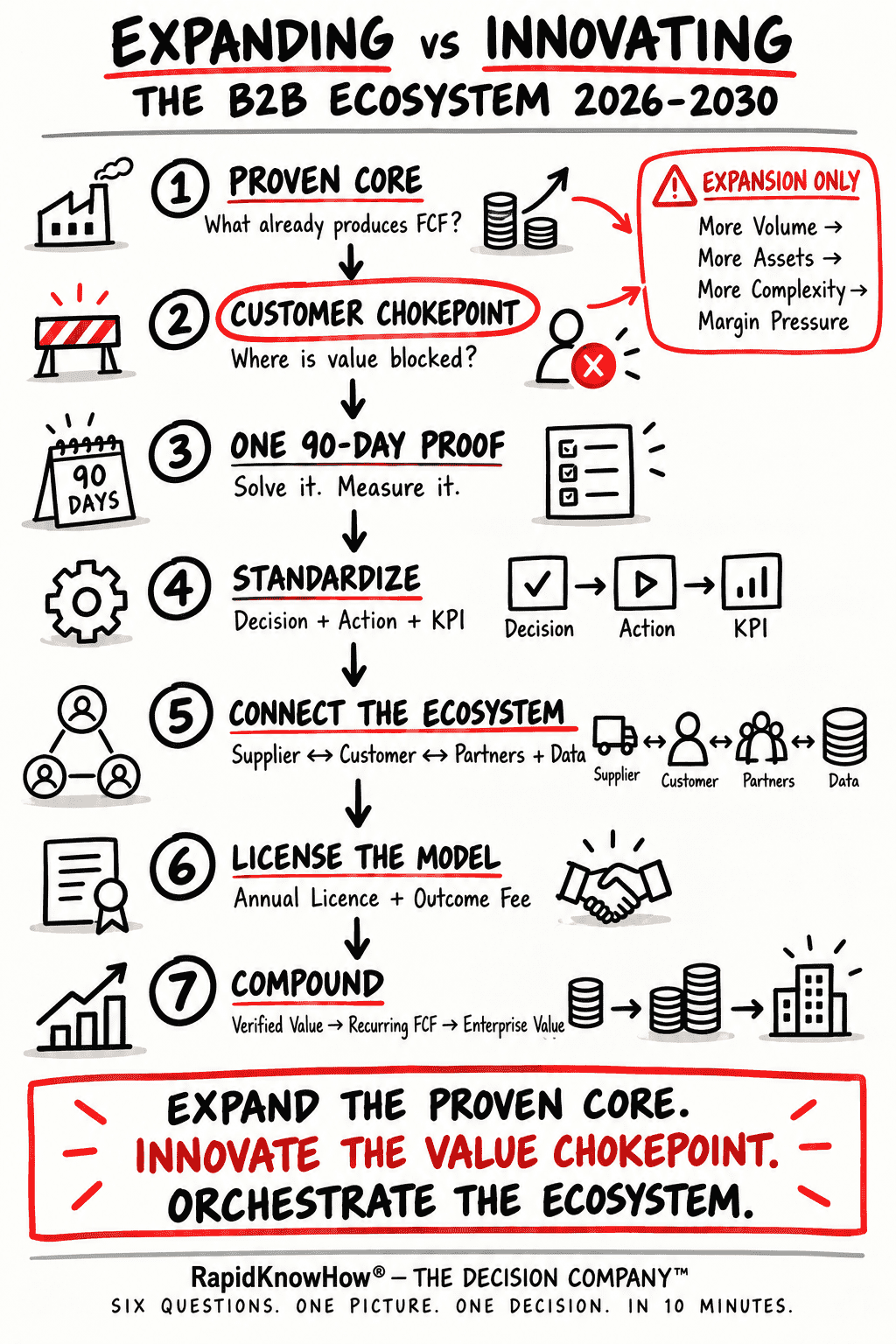
RapidKnowHow® Power Report
The strategic conclusion
Expansion makes the existing business larger.
Innovation makes the business system more valuable.
The winning strategy for 2026–2030 is not Expansion OR Innovation.
It is:
EXPAND THE PROVEN CORE.
INNOVATE THE VALUE CHOKEPOINT.
ORCHESTRATE THE ECOSYSTEM.
Expansion without innovation produces more revenue—but often more complexity, capital employed and competitive pressure.
Innovation without expansion produces interesting pilots—but rarely scalable cash.
The objective must be:
Convert proven capabilities into an AI-enabled, recurring-revenue B2B ecosystem that compounds customer value, FCF and enterprise value.
1. What is B2B expansion?
B2B expansion extends the existing business model.
Typical expansion routes:
- More customers
- More regions
- More products
- More sales channels
- More applications
- More capacity
- More acquisitions
- More volume through existing assets
Expansion question
How can we sell more of what already works?
Expansion creates
- Revenue growth
- Market penetration
- Capacity utilization
- Purchasing leverage
- Geographic reach
- Customer access
Expansion risk
If the underlying business model remains transactional, expansion may also increase:
- Working capital
- Asset intensity
- organizational complexity
- price competition
- customer-acquisition cost
- dependency on individual salespeople
Expansion can make a weak system larger without making it better.
2. What is B2B ecosystem innovation?
Ecosystem innovation changes how multiple participants jointly create, verify and share value.
It may connect:
- Suppliers
- Customers
- technology partners
- distributors
- service providers
- financiers
- regulators
- data providers
- license partners
Innovation question
How can the entire ecosystem produce a better measurable result?
Ecosystem innovation creates
- New value propositions
- Shared operating data
- outcome-based services
- recurring revenue
- automated decisions
- lower customer risk
- verified customer FCF
- platform and network effects
- scalable intellectual property
The company stops selling only a product and begins orchestrating a measurable business outcome.
3. Expansion versus innovation
| Strategic dimension | Expand the existing business | Innovate the ecosystem |
|---|---|---|
| Primary objective | Increase market coverage | Increase total value created |
| Starting point | Existing products and customers | Customer problem or system chokepoint |
| Growth mechanism | More volume | Better decisions and shared outcomes |
| Customer relationship | Supplier–buyer | Value partners |
| Revenue model | Transactional sales | Services, outcomes, subscriptions and licenses |
| Data | Internal operating information | Shared decision and value data |
| Competitive advantage | Scale, price and access | Trust, integration and verified results |
| Capital requirement | Frequently high | Potentially asset-light |
| Replicability | Geography-dependent | System and IP-dependent |
| Main KPI | Revenue and market share | Verified customer value and recurring FCF |
| Main risk | Scaling complexity | Innovation without commercial adoption |
| 2030 result | Larger supplier | Ecosystem orchestrator |
4. The strategic mistake
The most common mistake is expanding the physical business while leaving the value model unchanged.
A company may add:
- countries,
- factories,
- salespeople,
- products,
- distributors,
- digital tools,
while customers still perceive it as a replaceable supplier.
The result is:
MORE SALES → MORE ASSETS → MORE COMPLEXITY → MARGIN PRESSURE
The stronger alternative is:
CUSTOMER CHOKEPOINT → SHARED DATA → BETTER DECISION → VERIFIED VALUE → RECURRING REVENUE → COMPOUNDING FCF
5. Why ecosystem innovation matters now
Europe’s competitiveness agenda for 2030 is built around closing the innovation gap, linking decarbonisation with competitiveness and reducing strategic dependencies. Shaping Europe’s digital future
The European Commission’s 2026 Digital Decade assessment says that Europe has progressed in connectivity and business digitalisation, but must now deliver at greater scale, speed and consistency. Shaping Europe’s digital future
Austria shows strong SME digitalisation and growing AI adoption, but still needs more cloud and data-analytics adoption and better growth financing. Shaping Europe’s digital future
The opportunity for DACH and CEE companies is therefore not simply to “add AI.” It is to use AI, data and industrial expertise to create better ecosystem decisions and measurable commercial results.
6. The recommended 2026–2030 strategy
2026 — PROVE
Select one costly customer chokepoint.
Examples:
- Unplanned supply interruptions
- excessive inventory
- energy inefficiency
- slow replenishment
- poor asset utilization
- high total cost of ownership
- missed sales opportunities
Deliver one verified customer result within 90 days.
Result: Proof that customers will adopt and pay.
2027 — STANDARDIZE
Convert the successful intervention into a repeatable system:
- ONE diagnostic
- ONE decision process
- ONE implementation guide
- ONE KPI dashboard
- ONE value-verification method
- ONE commercial offer
Result: Founder-independent delivery.
2028 — CONNECT
Bring selected ecosystem partners into the system:
- Customers
- suppliers
- technology partners
- data providers
- implementation partners
Create common rules for data, decisions, value measurement and value sharing.
Result: An operating ecosystem rather than isolated transactions.
2029 — LICENSE
License the proven system to regions, partners or customer groups.
Revenue moves from one-time projects toward:
- Annual licenses
- subscriptions
- certified partner fees
- outcome-based payments
- renewals
- expansion modules
Result: Recurring, capital-efficient FCF.
2030 — COMPOUND
Use accumulated cases, data and trusted relationships to improve decisions across the ecosystem.
Each additional case makes the system:
- More credible
- easier to sell
- faster to implement
- less founder-dependent
- more valuable to license
- harder to replace
Result: Compounding platform value and transferable enterprise value.
7. Industrial B2B example
Traditional expansion
An industrial-gas supplier enters another CEE market, adds production capacity and competes for gas volume.
Success is measured through:
- Tonnes sold
- revenue
- market share
- plant utilization
The customer continues to compare suppliers mainly through price and reliability.
Ecosystem innovation
The company connects gas supply with:
- customer demand data
- automatic replenishment
- application optimization
- energy consumption
- equipment utilization
- predictive maintenance
- carbon and cost reporting
The commercial promise changes from:
“We reliably supply industrial gas.”
to:
“We reduce your total operating cost, supply risk and capital tied up—and verify the resulting FCF.”
The business becomes harder to replace because the provider is embedded in the customer’s value-creation system.
8. The ecosystem innovation test
A proposed innovation should pass all six questions:
- PROBLEM
Does it solve a costly, urgent customer problem? - VALUE
Can the financial effect be measured? - ADOPTION
Can the customer use it without excessive complexity? - REPEATABILITY
Can it be delivered using a standardized process? - RECURRING CASH
Will customers renew, subscribe or license? - COMPOUNDING
Does every additional customer make the system stronger?
If fewer than four answers are YES, the initiative is probably a feature or experiment—not an ecosystem business.
9. Board decision rule
Choose expansion when:
- The offer is already proven.
- Customer retention is strong.
- Margins are attractive.
- Delivery is standardized.
- New markets have similar requirements.
- Additional volume improves FCF.
Choose ecosystem innovation when:
- Products are becoming commoditized.
- Customers focus increasingly on total cost and risk.
- Growth requires disproportionate capital.
- Customer data remains fragmented.
- Several parties influence the final outcome.
- The company possesses valuable know-how that has not been systemized.
Choose the combined strategy when:
The company has a strong core business but needs a more defensible, recurring and capital-efficient growth engine.
This is the recommended position for most established European B2B companies.
10. The 70–20–10 capital allocation rule
Allocate strategic resources deliberately:
- 70% — Expand the proven cash engine
- 20% — Digitize and standardize delivery
- 10% — Prove one new ecosystem business model
Do not scale the 10% innovation portfolio until one model demonstrates:
- Verified customer value
- customer willingness to pay
- repeatable delivery
- positive contribution margin
- renewal potential
Once proven, move it into the 20% standardization portfolio and subsequently into the 70% scaling engine.
ONE DECISION
Do not expand a transactional B2B model unchanged through 2030.
Expand the profitable core while converting the most important customer chokepoint into a standardized, AI-enabled, measurable and licensable ecosystem solution.
TOP 3 ACTIONS
- Select one high-value customer chokepoint.
- Prove measurable customer FCF within 90 days.
- Convert the verified solution into a recurring ecosystem offer.
2030 TARGET RESULT
FROM PRODUCT SUPPLIER
TO VALUE PROVIDER
TO ECOSYSTEM ORCHESTRATOR
TO COMPOUNDING FCF PLATFORM
RapidKnowHow® Action Checklist
- Identify the strongest existing cash engine.
- Identify the customer’s most expensive chokepoint.
- Select one 90-day proof customer.
- Define the baseline before intervening.
- Implement one decision-and-action system.
- Verify customer value and FCF.
- Standardize the delivery process.
- Define recurring pricing.
- Establish data, trust and value-sharing rules.
- Test founder-independent delivery.
- Scale only after commercial proof.
Final pass/fail test
If the system cannot produce, verify and repeat customer value without depending on one individual, it is not ready to scale.
Leave a Reply