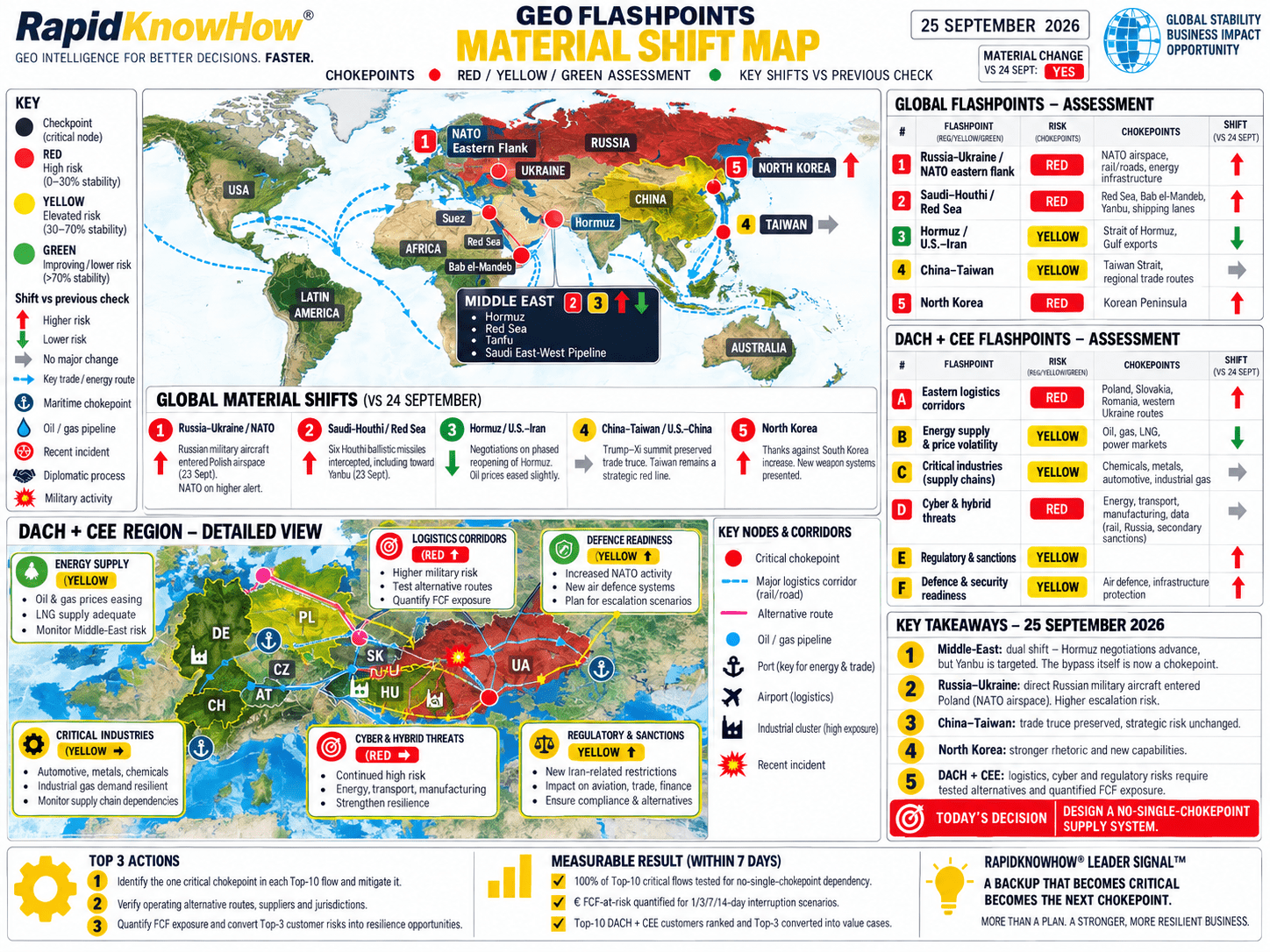
GLOBAL MATERIAL SHIFT ALERT — 25 SEPTEMBER 2026
YES — there is a meaningful change since 24 September.
Today’s strongest signal is a two-direction Middle-East shift: negotiations are becoming concrete enough to offer a credible Hormuz off-ramp, while Houthi attacks are simultaneously threatening the very Saudi bypass that reduced Hormuz dependence.
U.S. and Iranian negotiators in New York are discussing a phased arrangement to reopen the Strait of Hormuz. Oil prices eased slightly on September 25 as markets began pricing that possibility. Reuters
But Saudi Arabia says it intercepted six Houthi ballistic missiles, including missiles aimed toward the Yanbu area—the Red Sea outlet of the Saudi East-West Pipeline that only just resumed operation. Sight Magazine
That changes the business implication:
THE BYPASS ITSELF HAS BECOME A TARGET.
1–4 | SPOT → VERIFY → DRIVERS → SYSTEM
The critical system is now:
Hormuz constrained → East-West Pipeline/Yanbu bypass restored → Houthi attack on Yanbu → bypass vulnerability ↑
while simultaneously:
U.S.–Iran negotiations → possible phased Hormuz reopening → Gulf flow capacity ↑ → oil scarcity premium ↓.
The two forces are moving in opposite directions.
There is an additional escalation: Saudi Arabia, Turkey and Pakistan are due to hold an urgent high-level meeting under their defence pact to discuss support for Saudi Arabia against Houthi attacks. Internazionale
This means the Yemen conflict has increasing potential to evolve from Saudi–Houthi confrontation → wider regional security system.
5 | ANTICIPATE THE NEXT MOVE
There are now two very clear paths.
GREEN: U.S.–Iran phased agreement → Hormuz reopening → sustained Saudi Gulf exports + Yanbu bypass → redundancy increases → oil/freight risk falls substantially.
RED: Yanbu successfully hit → Saudi–Turkey–Pakistan military involvement increases → Red Sea risk rises while Hormuz remains constrained.
The single most important trigger is therefore:
CAN HORMUZ AND YANBU OPERATE SIMULTANEOUSLY?
If yes, Middle-East energy resilience improves dramatically.
If no, the system remains dependent on rotating chokepoints.
6 | BUSINESS EXPOSURE
For DACH/CEE, immediate oil-price pressure is slightly improving, but physical continuity risk remains HIGH. Brent edged lower on September 25 as markets weighed the possibility of a U.S.–Iran truce against continuing attacks on Saudi Arabia. Reuters
A second material business development is regulatory: new U.S. sanctions targeting companies in third countries doing business with Iran have already led neighbouring states including the UAE and Oman to bar Iranian airline operations. This demonstrates that the sanctions system is moving from announcement to real cross-border operating restriction. The Straits Times
So the exposure chain expands:
GEO CONFLICT → PHYSICAL ROUTE + SANCTIONS GATE → ENERGY/TRANSPORT → INDUSTRIAL OPERATION → WORKING CAPITAL → FCF.
7 | GLOBAL THREAT / OPPORTUNITY RANKING
| Rank | Flashpoint | Threat | Opportunity | Δ vs 24 Sept |
|---|---|---|---|---|
| 1 | Russia–Ukraine / NATO eastern flank | 10/10 | 9/10 | → Remains #1 |
| 2 | Saudi–Houthi / Red Sea | 10/10 | 9/10 | 🔴 ↑ Yanbu targeted |
| 3 | Hormuz / U.S.–Iran | 7/10 | 10/10 | 🟢 Talks become concrete |
| 4 | China–Taiwan / U.S.–China | 7.5/10 | 8/10 | 🟢 Short-term economic risk ↓ |
| 5 | Korean Peninsula | 9/10 | 5/10 | 🔴 Rhetorical escalation ↑ |
On Russia–Ukraine/NATO, I find no fresh development today that warrants raising yesterday’s already-extreme assessment. Russia’s new jet-powered drones and NATO-edge exposure remain the critical operational issues. Reuters
There is, however, a modest positive CEE structural signal: Poland has joined Ukraine and partners in developing a cheaper anti-ballistic missile system, increasing regional defensive cooperation. Reuters
China–Taiwan: short-term de-escalation
The September 24 Trump–Xi summit produced no major breakthrough, but it preserved the trade truce and diplomatic channel. Taiwan and arms sales remain unresolved strategic issues. Reuters
This supports no change in the operating posture, but marginally lowers near-term U.S.–China economic-disruption risk.
North Korea: escalation
North Korea warned on September 25 that South Korea would become a “decisive target” for retaliation if it becomes a hub for a U.S.-led collective-defence system. Reuters
That raises the Korean security signal, but it does not yet alter today’s DACH/CEE business decision.
8 | ONE DECISION
STOP DESIGNING A BACKUP ROUTE. DESIGN A NO-SINGLE-CHOKEPOINT SYSTEM.
The September sequence has demonstrated the problem perfectly:
Hormuz fails → use Yanbu.
Yanbu becomes the target → what next?
Therefore the resilience standard should become:
NO SINGLE EVENT CAN STOP THE CUSTOMER FLOW.
9 | TOP 3 ACTIONS
1 — RUN THE SINGLE-CHOKEPOINT TEST. For every Top-10 critical flow ask: Which ONE port, pipeline, border, supplier, jurisdiction or logistics node can stop this flow? Eliminate or mitigate it.
2 — ADD REGULATORY REDUNDANCY. Verify not only Source B + Route B/C, but also Jurisdiction B + insurer/payment/logistics alternatives so sanctions cannot disable a physically functioning route.
3 — COMMERCIALIZE NO-SINGLE-CHOKEPOINT SUPPLY ASSURANCE™. Rank DACH/CEE Industrial Gas customers by downtime FCF × critical-gas dependency × single-chokepoint exposure. Select the Top 3 where redundancy creates the largest verified € value.
10 | MEASURABLE RESULT
Within 7 days:
100% Top-10 critical flows have their ONE critical chokepoint identified.
Zero RED flow remains dependent on one unmitigated physical or regulatory chokepoint.
€ FCF-at-risk quantified for every remaining chokepoint.
Top-10 DACH/CEE customer chokepoints ranked.
Top-3 converted into quantified Verified Supply Assurance™ cases.
MATERIAL SHIFT: 24 → 25 SEPTEMBER
24 September:
Russia physically tested the NATO boundary.
25 September:
HORMUZ MAY GET AN OFF-RAMP — BUT THE SAUDI BYPASS IS NOW UNDER DIRECT MISSILE PRESSURE.
That produces today’s RapidKnowHow® GEO insight:
A BACKUP THAT BECOMES CRITICAL BECOMES THE NEXT CHOKEPOINT.
SIGNAL → VERIFY → CHOKEPOINT → ALTERNATIVE FLOW → SECOND CHOKEPOINT → € FCF → ONE DECISION → TOP 3 ACTIONS → VERIFIED FCF PROTECTED Reuters

Oil prices fall as markets look to Iran truce, but remain wary of attacks on oil facilities
heute


Leave a Reply