
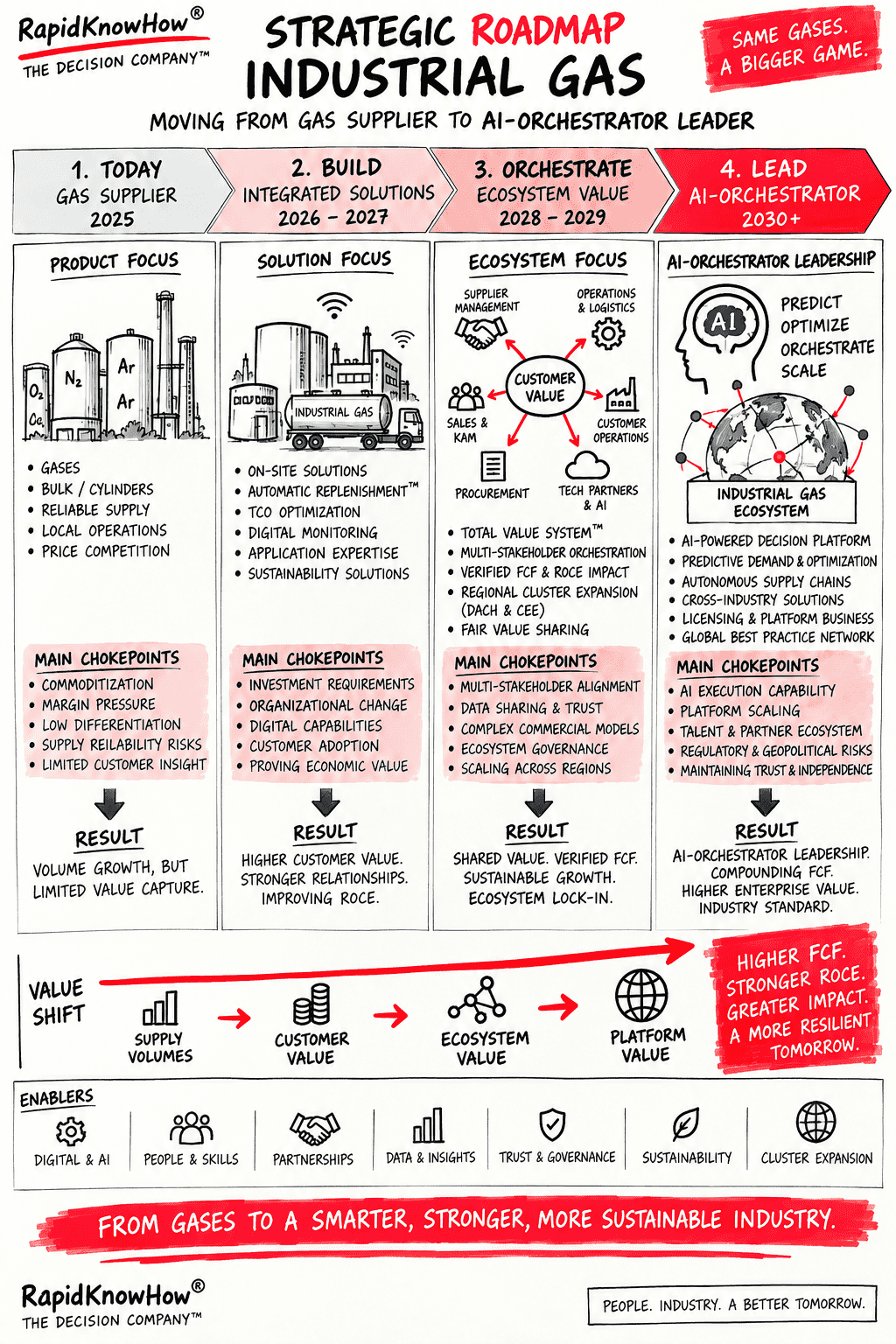
RapidKnowHow® POWER REPORT
THE SYSTEM CHANGE STRATEGIST IN ACTION
Industrial Gas Automatic Replenishment Case
SEE THE FLOW. FIND THE CHOKEPOINT. PULL THE LEVER. PROVE THE VALUE.
Executive Decision
An industrial-gas supplier experiences emergency deliveries, customer stockouts, inefficient routes and excessive safety inventory.
The traditional response is to add:
- more trucks;
- more drivers;
- more dispatching;
- more customer inventory.
The System Change Strategist does not immediately add resources.
The strategist examines the complete flow and discovers:
The controlling chokepoint is not delivery capacity. The demand signal arrives too late.
One decision
Launch a controlled 30-day automatic-replenishment pilot using tank telemetry, a defined reorder trigger and route integration.
1. The Visible Problem
A multi-site industrial customer orders gas manually.
The customer normally reacts when:
- the tank level appears low;
- production consumption unexpectedly increases;
- an employee remembers to check the tank;
- or a delivery becomes urgent.
This creates:
- emergency orders;
- expensive special deliveries;
- customer stockouts;
- production-interruption risk;
- inefficient truck utilization;
- excessive safety inventory;
- conflict between customer and supplier.
The visible problem is the delivery.
The real problem starts much earlier.
2. See the Whole System
Critical Industrial Gas Flow
CUSTOMER CONSUMPTION
→ TANK LEVEL
→ LEVEL INFORMATION
→ REORDER DECISION
→ DELIVERY PLANNING
→ ROUTE SELECTION
→ DELIVERY
→ CUSTOMER UPTIME
Every activity after the level information depends on receiving a reliable demand signal early enough.
If the signal is late:
- the order becomes urgent;
- routing flexibility disappears;
- delivery costs increase;
- customer risk rises;
- the supplier must react rather than optimize.
3. Identify the Real Chokepoint
Symptom
Emergency deliveries and unreliable replenishment.
Suspected cause
Insufficient delivery capacity.
Evidence
The supplier has available product and trucks during normal planning periods. The problem occurs because demand becomes visible only when the tank approaches its critical level.
Real chokepoint
MISSING OR LATE TANK-CONSUMPTION INFORMATION
The chokepoint controls:
- when the order is created;
- how much planning time is available;
- whether the delivery can join an optimized route;
- how much safety inventory the customer requires;
- and whether production remains protected.
4. Find the Leverage Point
The leverage point is the earliest intervention capable of changing all downstream results.
Selected lever
TANK TELEMETRY + AUTOMATIC REORDER TRIGGER
The telemetry system provides:
- current tank level;
- consumption trend;
- estimated run-out date;
- abnormal-usage alerts;
- automatic replenishment signals.
New system
REAL-TIME LEVEL DATA
→ PREDICTED DEMAND
→ AUTOMATIC TRIGGER
→ PLANNED DELIVERY
→ OPTIMIZED ROUTE
→ RELIABLE SUPPLY
One better signal changes the entire operating system.
5. Connect the Lever to Decisive Action
Technology alone does not create system change.
The strategist converts the leverage point into one accountable decision.
30-Day Pilot
| Element | Pilot definition |
|---|---|
| Customer | One qualified industrial customer |
| Scope | One production site |
| Assets | Selected critical tanks |
| Product | One high-impact gas |
| Intervention | Telemetry plus automatic reorder rule |
| Owner | One supplier-customer pilot leader |
| Baseline | Previous 90-day operating performance |
| Duration | 30 days |
| Review | Weekly exception review |
| Decision | Stop, improve or scale |
Trigger rule example
Create the planned replenishment order when:
AVAILABLE INVENTORY
− FORECAST CONSUMPTION DURING LEAD TIME
≤ AGREED SAFETY LEVEL
The actual trigger must reflect:
- consumption variability;
- normal delivery lead time;
- production criticality;
- tank capacity;
- agreed safety margin.
6. Define the Verified Result
The pilot must improve the total system—not merely install telemetry.
Pilot scorecard
| Measure | Baseline | 30-day target |
|---|---|---|
| Customer stockouts | Current incidents | Zero |
| Emergency deliveries | Current frequency | Reduce ≥50% |
| On-time replenishment | Current level | ≥99% |
| Route-fill performance | Current level | Improve ≥10 percentage points |
| Customer safety inventory | Current level | Reduce ≥10–15% |
| Production interruptions | Current incidents | Zero |
| Reorder administration | Current hours | Reduce ≥50% |
These figures are illustrative pilot targets. The supplier and customer must agree the actual baseline and measures before launch.
Verified Value Formula
Supplier Value
**Emergency-delivery cost avoided
- route-productivity gain
- administrative cost avoided
- customer-retention value
- additional profitable volume
= Supplier Value**
Customer Value
**Inventory cash released
- production loss avoided
- ordering cost avoided
- supply-risk reduction
= Customer Value**
Shared Total Value
**SUPPLIER VALUE
- CUSTOMER VALUE
− TELEMETRY AND IMPLEMENTATION COST
= VERIFIED TOTAL VALUE**
Finance representatives from both parties should verify the baseline, calculation period and attribution rules.
Stakeholder Value
| Stakeholder | Value created |
|---|---|
| Supplier management | Profitable growth, retention and FCF |
| Supplier logistics | Fewer emergencies and better routes |
| Supplier sales/KAM | Stronger relationship and expansion case |
| Customer management | Resilience, productivity and FCF |
| Customer procurement | Lower TCO and greater transparency |
| Customer operations | Uptime and reliable supply |
| Finance | Verifiable economic result |
The strategist converts conflicting interests into one shared value case.
Traditional Manager vs System Change Strategist
| Traditional response | System Change Strategist |
|---|---|
| Adds trucks | Verifies whether trucks are the constraint |
| Treats the emergency | Finds what created the emergency |
| Optimizes one department | Maps the end-to-end value flow |
| Installs technology | Changes the operating decision |
| Measures activity | Measures system performance |
| Claims savings | Verifies shared economic value |
| Rolls out immediately | Tests before scaling |
| Solves one incident | Creates a repeatable system |
Board Decision in 10 Minutes
Six questions
- What result is being blocked?
Reliable, cost-effective customer replenishment. - What critical flow creates the result?
Consumption signal through delivery planning to customer uptime. - Where is the chokepoint?
Late or missing tank-level information. - What is the leverage point?
Telemetry connected to an automatic reorder rule. - What decisive action should be approved?
One controlled 30-day customer pilot. - What result must be verified?
Zero stockouts, fewer emergency deliveries, higher route productivity, lower inventory and positive shared value.
One decision
APPROVE THE 30-DAY AUTOMATIC-REPLENISHMENT PILOT WITH ONE OWNER, ONE BASELINE AND ONE VERIFIED VALUE SCORECARD.
From Pilot to Commercial System
CHOKEPOINT SCAN
→ PAID PILOT
→ VERIFIED CUSTOMER VALUE
→ REUSABLE CASE
→ MULTI-TANK ROLLOUT
→ MULTI-SITE EXPANSION
→ ANNUAL SYSTEM LICENCE
→ RECURRING FCF
The commercial product is not the telemetry device.
The commercial product is:
A PROVEN INDUSTRIAL GAS REPLENISHMENT SYSTEM THAT CREATES RELIABLE SUPPLY AND VERIFIED SHARED FCF.
Strategic Risks and Safeguards
| Risk | Safeguard |
|---|---|
| Incorrect tank readings | Sensor validation and exception alerts |
| Poor consumption forecast | Weekly forecast-versus-actual review |
| Automatic over-delivery | Maximum inventory and delivery rules |
| Customer data concerns | Defined access, ownership and security |
| Dispatcher resistance | Include dispatch in pilot design |
| Local improvement only | Measure total route and customer effect |
| Unverified savings | Finance-approved baseline and formula |
| Premature rollout | Scale only after pilot proof |
ACTION CHECKLIST
Setup
- Select one customer, site and critical gas.
- Confirm telemetry feasibility.
- Agree the 90-day baseline.
- Name one accountable pilot owner.
Core system
- Validate the tank-level signal.
- Define the automatic reorder rule.
- Connect the trigger to delivery planning.
- Establish exception handling.
Value and result
- Track stockouts and emergency deliveries.
- Measure route-fill performance.
- Calculate inventory cash released.
- Verify supplier and customer value.
Customer journey
- Make the system understandable without technical assistance.
- Give operations visibility of tank status and deliveries.
- Provide one clear exception contact.
Trust and governance
- Agree data ownership and access.
- Separate verified value from illustrative estimates.
- Obtain Finance confirmation.
Final pass/fail
PASS: Reliable supply improves, total cost declines and verified shared value exceeds implementation cost.
FAIL: The technology works, but total system performance does not improve.
First review
After 30 days, identify the next constraint before adding features or expanding the rollout.
Final Conclusion
The System Change Strategist does not ask:
“How can we deliver emergencies faster?”
The strategist asks:
“What creates the emergency—and which one intervention will prevent it?”
MASTER formula
SEE THE SYSTEM
→ FIND THE CHOKEPOINT
→ SELECT THE LEVER
→ MAKE ONE DECISION
→ VERIFY THE VALUE
→ SCALE WHAT WORKS
RapidKnowHow® — THE DECISION COMPANY™
Industrial Gas Leadership 2030
PROVE VALUE. THEN SCALE.
Watch the 60-second roadmap: 10 strategic actions for DACH and CEE, 2026–2030.
Start with ONE customer challenge. Use the Industrial Gas Action Guide to turn your first action into a measurable result.
RapidKnowHow® — Leading Industrial Gas Opportunity Signal Identifier in DACH & CEE
Leave a Reply