
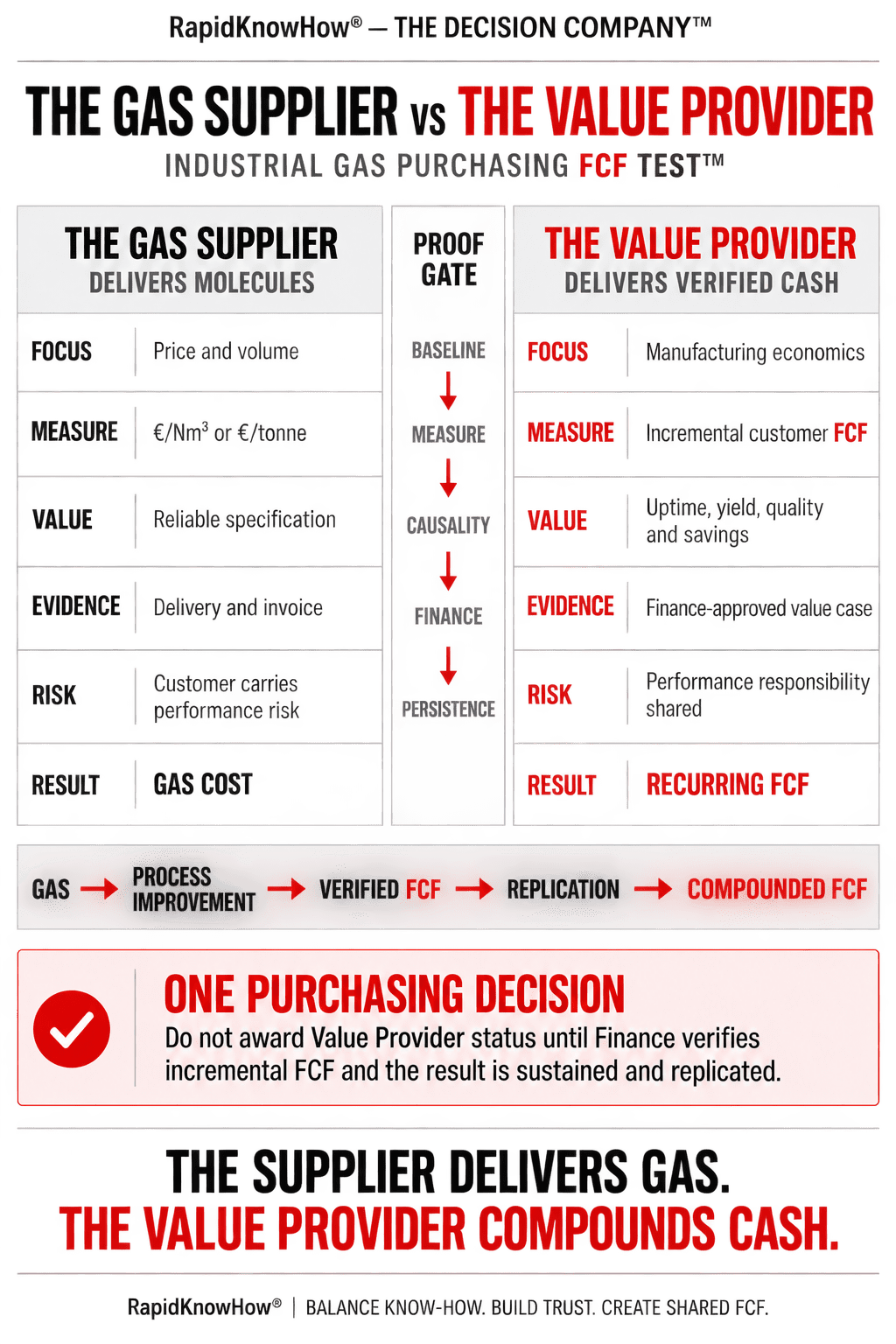
Industrial Gas Purchasing should verify the supplier in two stages:
First prove incremental annual FCF. Then prove that the FCF repeats, expands and compounds.
A lower gas price alone identifies a Gas Supplier. Measurable improvement in the customer’s manufacturing economics identifies an Industrial Gas Value Provider.
1. Supplier versus Value Provider
| Verification dimension | Industrial Gas Supplier | Industrial Gas Value Provider |
|---|---|---|
| Commercial focus | Gas price and volume | Total manufacturing value |
| Main promise | Deliver specification reliably | Improve cash-producing process performance |
| Baseline | Gas spend | Gas, energy, output, quality, downtime and capital |
| Engineering role | Technical support | Joint process optimization |
| Measurement | €/Nm³ or €/tonne | Incremental customer FCF |
| Risk | Customer carries performance risk | Performance responsibility is shared |
| Evidence | Delivery and invoice data | Finance-approved value-proof case |
| Renewal logic | Price and supply availability | Verified recurring value |
| Scalability | More gas volume | Replication across lines, plants and applications |
| Strategic result | Operating supplier | Compounding FCF partner |
2. Establish the Customer Baseline
Purchasing, Operations and Finance jointly freeze the baseline before implementation:
- Annual gas consumption and total gas expenditure
- Energy consumption attributable to the gas application
- Good units produced per hour
- Scrap, rework and quality-loss costs
- Downtime hours and contribution margin lost
- Maintenance and labor costs
- Inventory and working capital
- Installed gas-system capital and utilization
- Emissions, waste and compliance costs
- Current annual process FCF
The supplier cannot claim value that was not measured against this agreed baseline.
3. Calculate Verified Incremental FCF
Only cash effects count. Avoided costs must be genuinely avoidable—not theoretical accounting savings.
4. Apply the Five Proof Gates
A supplier becomes a verified Value Provider only after passing all five gates:
| Proof gate | Required evidence |
|---|---|
| 1. Baseline proof | Customer-approved pre-project operating and financial data |
| 2. Technical proof | Measured change in consumption, uptime, yield or throughput |
| 3. Causality proof | Evidence that the supplier intervention produced the change |
| 4. Financial proof | Finance-approved incremental FCF calculation |
| 5. Persistence proof | Benefits sustained for at least two operating cycles |
5. Prevent False Value Claims
Normalize the before-and-after figures for:
- Production volume and product mix
- Energy and raw-material prices
- Planned shutdowns
- Seasonal demand
- Customer investments
- Labor or process changes
- Market-price and inflation effects
Use a control line, comparable plant or normalized baseline wherever possible.
Supplier value = verified result minus changes that would have happened without the supplier.
6. Verify Compounded FCF
Annual FCF becomes compounded FCF only when the proven result produces additional recurring value.
The four tests are:
- Retain: Does the original FCF improvement continue?
- Expand: Does continuous optimization increase annual FCF?
- Replicate: Can the verified solution be transferred to other lines or plants?
- Reinvest: Is part of the cash gain invested in further value-producing projects?
Illustrative Five-Year Verification
| Year | Original process | Expansion and replication | Annual verified FCF |
|---|---|---|---|
| 1 | €300,000 | €0 | €300,000 |
| 2 | €300,000 | €100,000 | €400,000 |
| 3 | €300,000 | €250,000 | €550,000 |
| 4 | €300,000 | €400,000 | €700,000 |
| 5 | €300,000 | €600,000 | €900,000 |
| Total | €2,850,000 |
This is compounded FCF because the initial verified case becomes a reusable system—not simply because the same annual saving continues.
7. Industrial Gas Value Provider Scorecard
Score each dimension from 0 to 5:
| Criterion | Weight |
|---|---|
| Reliable and safe supply | 15% |
| Competitive total lifecycle cost | 10% |
| Application-engineering capability | 15% |
| Measurable process improvement | 15% |
| Verified customer FCF | 20% |
| Benefit persistence | 10% |
| Replication capability | 10% |
| Transparent value sharing | 5% |
Classification
- Below 50: Industrial Gas Supplier
- 50–69: Technical Solution Supplier
- 70–84: Verified Value Provider
- 85–100: Compounding FCF Partner
A supplier should not receive the “Value Provider” classification without passing the Finance verification gate—regardless of the total score.
8. Contract for Value, Not Promises
Include five commercial elements:
- Agreed baseline and measurement period
- Named KPIs and data sources
- FCF calculation approved by Customer Finance
- Value-sharing only after verification
- Annual retention, expansion and replication review
Payment can combine:
- Base payment for reliable gas supply
- Performance payment for verified incremental FCF
- Renewal or gainshare for sustained value
- Expansion payment for successful replication
ONE Purchasing Decision
Do not award Value Provider status for presentations, technical activity or claimed savings. Award it only when Finance verifies incremental FCF and the result is sustained and replicated.
Final Aha
The Gas Supplier delivers molecules.
The Value Provider improves the process.
The Compounding FCF Partner repeatedly converts that improvement into verified cash across time, applications and plants.
Leave a Reply