
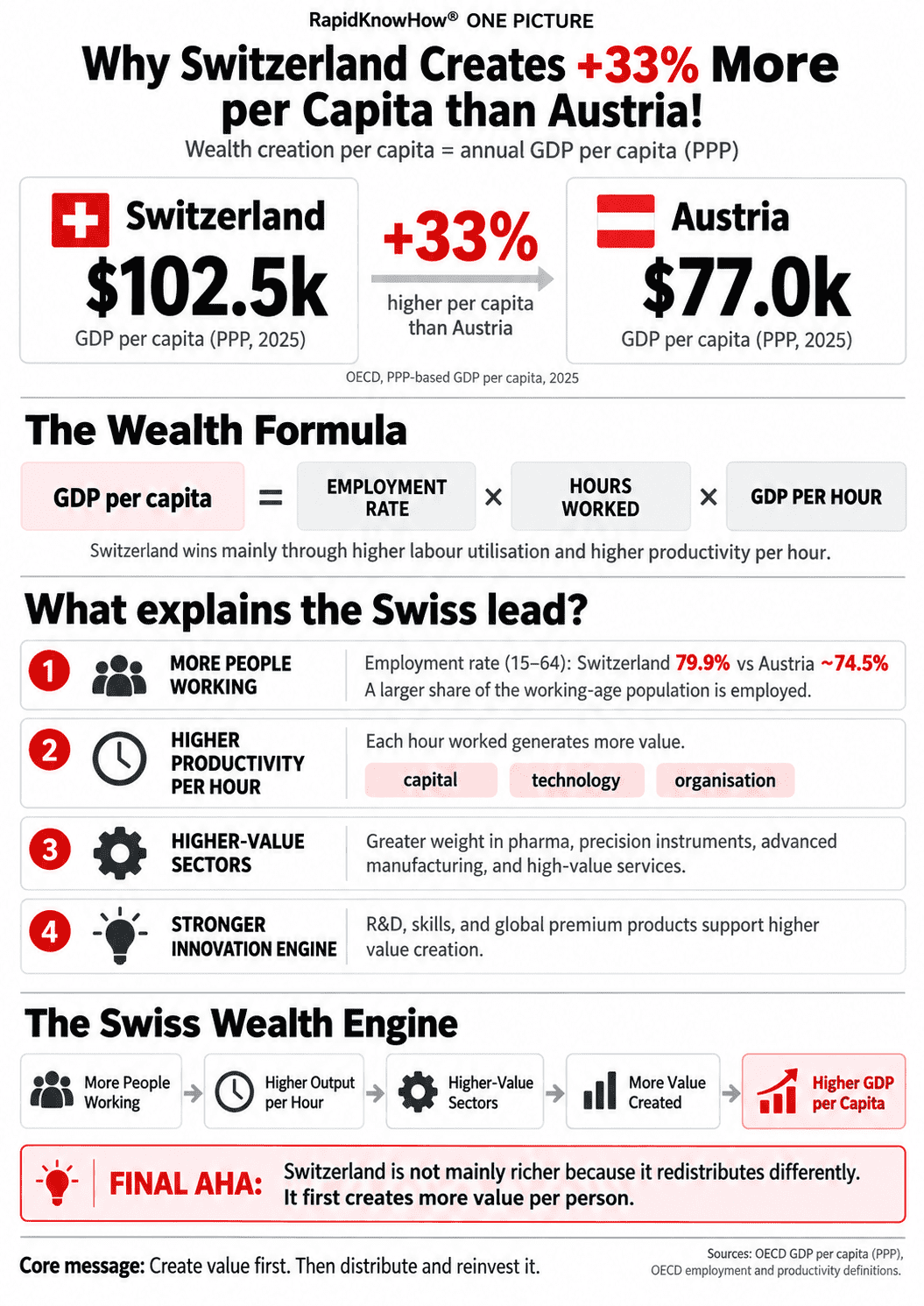
Switzerland creates about 33% more GDP per capita than Austria mainly because it combines higher labour utilisation with significantly higher labour productivity.
And the larger part of the gap is productivity, not simply “people working more.” The GDP-per-capita comparison we are using is the OECD’s PPP-based measure of annual GDP per person.
1) Start with the simple wealth formula
A useful decomposition is:
GDP per capita = workers per population × output per worker
and, one step deeper:
GDP per capita = employment rate × hours worked × GDP per hour worked
The OECD defines GDP per hour worked as labour productivity, and explicitly says it reflects not only labour effort, but also capital, technology, intermediate inputs, and organisational efficiency.
2) Switzerland gets more of its working-age population into work
For 2025, the OECD Data Explorer shows a 15–64 employment rate of 79.9% for Switzerland. Austria’s recent OECD annual employment-rate series is around 74.5%. The OECD’s labour-market release also notes that Swiss employment rates were above 80% in 2025, placing Switzerland among the OECD leaders.
What this means:
Switzerland has roughly a 7% labour-utilisation advantage over Austria just from the employment-rate difference alone:
79.9 / 74.5 ≈ 1.07
So if Swiss workers were no more productive than Austrian workers, Switzerland would still have a noticeable per-capita advantage simply because more of the population is employed.
3) But employment explains only part of the +33% gap
Your starting gap is about +33% GDP per capita.
If employment explains roughly +7%, then the remaining ~24% must come from higher output per worker / per hour and related structural factors.
Roughly:
1.33 / 1.07 ≈ 1.24
So the logic is:
- about one part of the Swiss lead comes from higher employment
- the bigger part comes from higher productivity per hour / per worker
That conclusion follows directly from the decomposition above and from the OECD definition of productivity.
4) Why is Swiss productivity higher?
This is the real explanation.
Because OECD’s productivity concept includes capital, technology, and organisation, the Swiss advantage is not just about effort; it is about a higher-value economic system.
The most plausible structural reasons are:
A. Higher-value sector mix
Switzerland is more concentrated in high-value activities such as:
- pharmaceuticals / life sciences
- precision instruments
- specialty chemicals
- advanced manufacturing
- financial and professional services
These sectors generate more value added per worker than a more average industrial mix.
B. Stronger capital and technology intensity
If each hour worked is supported by better equipment, better processes, better digital systems, and better management, then output per hour rises. That is exactly what the OECD productivity definition captures.
C. Innovation and R&D intensity
The OECD defines gross domestic spending on R&D as all current and capital spending on research and development, measured also as a share of GDP.
In practical terms, economies that convert more R&D into commercial output usually achieve a stronger high-value-productivity engine.
D. Better labour-market mobilisation
Switzerland not only has high overall employment, but also a labour-market structure that is generally effective at drawing people into productive work. The OECD Employment Database is designed exactly for this kind of cross-country comparison of labour-force and employment outcomes.
5) So what is the real Swiss “wealth engine”?
Here is the clean board-level answer:
THE SWISS WEALTH ENGINE
More people working
+
Higher output per hour
+
More high-value sectors
+
More capital / technology / know-how per worker
= More GDP per capita
6) What Austria should learn
If Austria wants to close the gap, the main levers are not only redistribution or tax debates.
The levers are:
- Raise employment / participation
- Lift productivity per hour
- Shift toward higher-value sectors
- Increase innovation-to-commercial-value conversion
- Improve organisational and capital efficiency
Bottom line
Switzerland creates about +33% more per capita than Austria not because it redistributes differently, but because it first creates more value.
And that extra value comes from:
- higher employment
- higher productivity
- higher-value economic specialization
Leave a Reply