
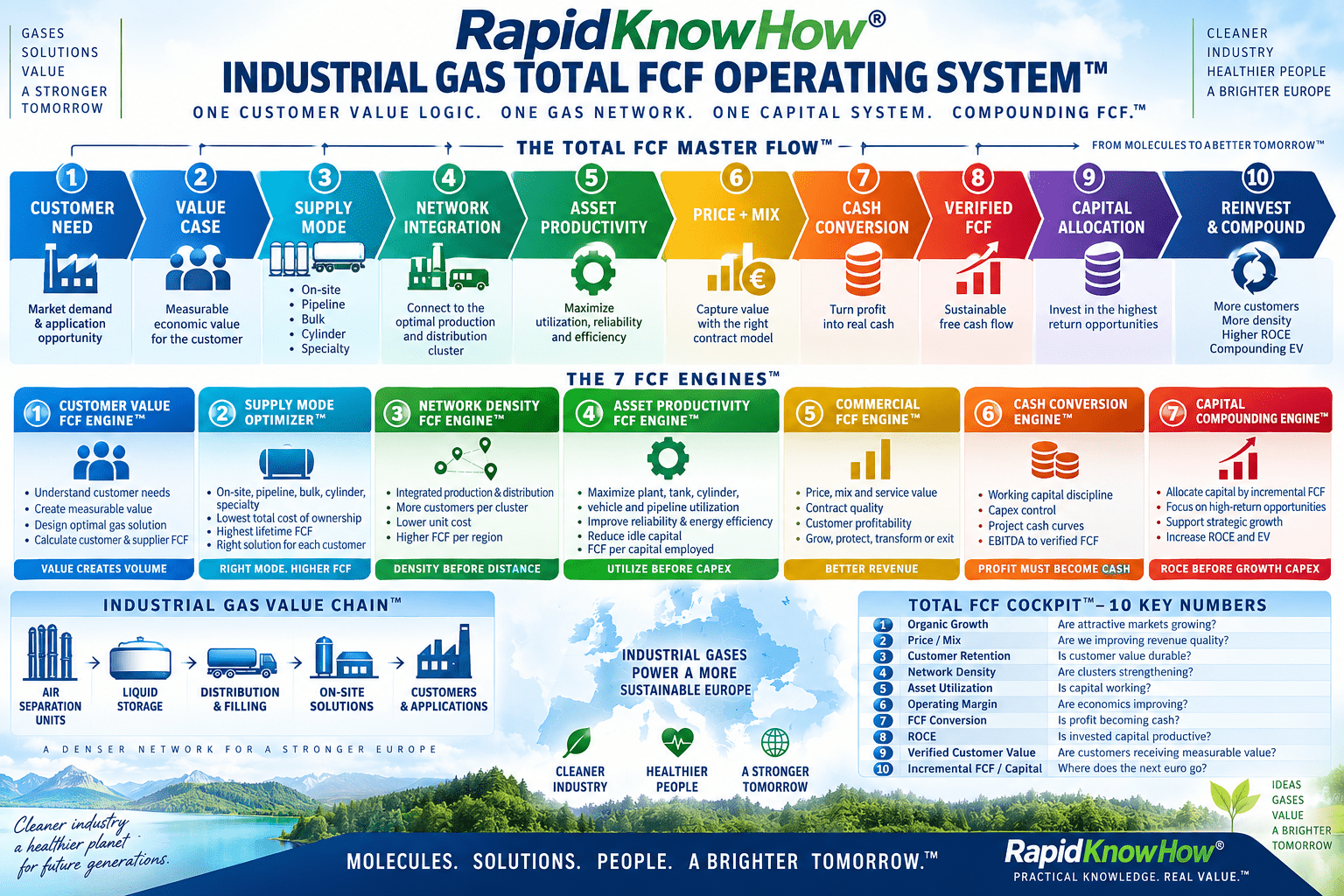
ONE CUSTOMER VALUE LOGIC. ONE GAS NETWORK. ONE CAPITAL SYSTEM. ONE FCF ENGINE.
MASTER OBJECTIVE
Turn an Industrial Gas company from a collection of:
Plants + Products + Countries + Customers
into ONE integrated system that continuously converts:
CUSTOMER VALUE → NETWORK PRODUCTIVITY → VERIFIED FCF → REINVESTMENT → COMPOUNDING EV™
THE TOTAL FCF MASTER FLOW™
1. CUSTOMER / MARKET SIGNAL
What valuable problem exists?
↓
2. CUSTOMER VALUE CASE
What measurable economic value can Industrial Gas create?
↓
3. BEST SUPPLY MODE
ON-SITE • PIPELINE • BULK • CYLINDER • SMALL ON-SITE • SPECIALTY
↓
4. NETWORK INTEGRATION
Connect the customer into the strongest local production/distribution cluster.
↓
5. ASSET PRODUCTIVITY
Maximize plant, tank, cylinder, vehicle and infrastructure utilization.
↓
6. PRICE + MIX + CONTRACT QUALITY
Capture a fair share of the value delivered.
↓
7. CASH CONVERSION
Convert margin into real cash.
↓
8. VERIFIED FCF
↓
9. CAPITAL ALLOCATION
Direct capital toward the highest incremental FCF opportunities.
↓
10. REINVEST
Customers • Density • Plants • Applications • Technology
↓
COMPOUNDING FCF + EV™
↺
THE 7 INDUSTRIAL GAS FCF ENGINES™
ENGINE 1 — CUSTOMER VALUE FCF ENGINE™
Stop beginning with:
“How much gas can we sell?”
Begin with:
What economic result does the customer need?
Examples:
Lower energy
Higher productivity
Less downtime
Lower labor cost
Higher yield
Improved quality
Lower emissions
Greater supply security
Then calculate:
CUSTOMER VERIFIED FCF™
Customer Benefit
− Customer Investment
− Incremental Operating Cost
=
VERIFIED CUSTOMER FCF
Only then design the gas solution.
ENGINE 2 — SUPPLY MODE OPTIMIZER™
For every customer choose the economically superior supply architecture.
LARGE ON-SITE
Large continuous demand
Long-term contracts
Dedicated/shared production
SMALL ON-SITE
Local generation
Reduced logistics
Recurring contractual cash flow
BULK / MERCHANT
Liquid gas
Tank + distribution
Network-density economics
PACKAGED / CYLINDER
Lower-volume customers
High service content
Route and cylinder-turn economics
SPECIALTY / ELECTRONICS
High purity
Application know-how
High customer criticality
The major industry players already integrate these supply modes rather than treating them as unrelated businesses. (Linde)
KEY QUESTION
Which supply mode maximizes Customer TCO Value + Supplier Lifetime FCF?
ENGINE 3 — NETWORK DENSITY FCF ENGINE™
This is the heart of the Industrial Gas model.
PRODUCTION
↓
LIQUID CAPACITY
↓
BULK CUSTOMERS
↓
CYLINDER FILLING
↓
LOCAL ROUTES
↓
MORE CUSTOMERS
↓
GREATER DENSITY
↓
LOWER UNIT COST
↓
HIGHER FCF
Linde explicitly identifies network density, integrated supply, pricing discipline and productivity as central strategic elements. (linde.com)
Core measures
Customers / cluster
Revenue / km
Gross margin / route
Volume / stop
Plant utilization
Liquid availability
Delivery cost / unit
FCF / cluster
MASTER RULE
DENSITY BEFORE DISTANCE™
ENGINE 4 — ASSET PRODUCTIVITY FCF ENGINE™
Every physical asset must produce cash.
ASU
HYDROGEN PLANT
CO₂ PLANT
FILLING CENTER
STORAGE TANK
CYLINDER
TRAILER
TRUCK
PIPELINE
SMALL ON-SITE UNIT
Measure:
FCF ÷ CAPITAL EMPLOYED
and:
Utilization
Turns
Reliability
Energy efficiency
Maintenance
Asset life
Downtime
Idle capital
Air Liquide notes that large production facilities may support multiple customers and business lines, illustrating why shared-asset utilization is central to Industrial Gas economics. (Air Liquide)
OPERATING RULE
UTILIZE BEFORE CAPEX™
ENGINE 5 — COMMERCIAL FCF ENGINE™
Revenue does not equal value.
For every account determine:
Volume
×
Price
Mix
Services
−
Energy
−
Production
−
Distribution
−
Asset Cost
−
Working Capital
=
CUSTOMER FCF CONTRIBUTION™
Then classify:
HIGH FCF + HIGH POTENTIAL
GROW
HIGH FCF + LOW GROWTH
PROTECT
LOW FCF + HIGH POTENTIAL
TRANSFORM
LOW FCF + LOW POTENTIAL
REPRICE • REDESIGN • EXIT
ENGINE 6 — CASH CONVERSION ENGINE™
EBITDA is not cash.
The bridge is:
EBITDA
↓
Inventory
↓
Receivables
↓
Payables
↓
Maintenance Capex
↓
Growth Capex
↓
Taxes
↓
Other Cash Costs
↓
FREE CASH FLOW
Manage:
DSO
DPO
Inventory
Cylinder losses
Tank utilization
Capex
Project cash curves
FCF conversion
MASTER RULE
PROFIT MUST BECOME CASH™
ENGINE 7 — CAPITAL COMPOUNDING ENGINE™
Every new euro competes for capital.
Potential uses:
New customer
New on-site unit
ASU expansion
Bulk tank
Cylinder fleet
Filling plant
Specialty gases
Electronics
Healthcare
Hydrogen
CO₂ infrastructure
Digitalization
Acquisition
Rank opportunities by:
INCREMENTAL VERIFIED FCF ÷ INCREMENTAL CAPITAL
Large industrial-gas companies increasingly use long-term contracted projects to underpin new capital deployment; for example, Linde describes a substantial sale-of-gas project backlog supported by long-term agreements. (linde.com)
MASTER RULE
ROCE BEFORE GROWTH CAPEX™
THE SHARED VALUE BRIDGE™
The TOTAL system does not optimize the supplier at the customer’s expense.
It seeks:
CUSTOMER VALUE + SUPPLIER FCF
Example:
Customer productivity gain
€2.0m
Customer implementation cost
− €0.4m
=
CUSTOMER VERIFIED VALUE = €1.6m
↓
Industrial Gas supplier incremental FCF
€0.5m
↓
SHARED VALUE CREATED = €2.1m
This becomes the foundation for:
TRUST
↓
LONGER CONTRACT
↓
SHARE OF WALLET
↓
MULTI-SITE EXPANSION
↓
RECURRING FCF
INDUSTRIAL GAS TOTAL FCF COCKPIT™
10 NUMBERS. ONE CAPITAL DECISION.
| KPI | Decision Question |
|---|---|
| 1. Organic Growth | Are attractive markets growing? |
| 2. Price / Mix | Are we improving revenue quality? |
| 3. Customer Retention | Is customer value durable? |
| 4. Network Density | Are clusters strengthening? |
| 5. Asset Utilization | Is capital working? |
| 6. Operating Margin | Are economics improving? |
| 7. FCF Conversion | Is profit becoming cash? |
| 8. ROCE | Is invested capital productive? |
| 9. Verified Customer Value | Are customers receiving measurable value? |
| 10. Incremental FCF / Capital | Where does the next euro go? |
THE CLUSTER OPERATING SYSTEM™
Do not start with:
COUNTRY → COMPANY → PRODUCT
Start with:
INDUSTRIAL CLUSTER™
For example:
ANCHOR ON-SITE CUSTOMER
↓
ASU / PRODUCTION
↓
AVAILABLE LIQUID
↓
BULK CUSTOMERS
↓
FILLING CENTER
↓
CYLINDER CUSTOMERS
↓
SPECIALTY + SERVICES
↓
MORE DENSITY
↓
MORE FCF
This is why an additional customer can sometimes create value far beyond its own standalone margin.
It may improve the economics of the entire cluster.
THE CONTRACT FCF SYSTEM™
Not all revenue has equal quality.
Rank contracts by:
1. DURATION
2. MINIMUM VOLUME / TAKE-OR-PAY
3. ENERGY PASS-THROUGH
4. INFLATION INDEXATION
5. CAPITAL PROTECTION
6. CUSTOMER CREDIT
7. ASSET REDEPLOYABILITY
8. NETWORK SYNERGY
9. EXPANSION POTENTIAL
10. LIFETIME FCF
Large-industry contracts can run for 15 years or longer and may include guaranteed minimum-volume provisions, illustrating why contract structure materially affects the quality of industrial-gas cash flows. (Air Liquide)
DO NOT CHASE VOLUME.
BUILD CONTRACTED FCF.
THE NEW BUSINESS ENGINE™
SIGNAL
New plant
Expansion
Energy transition
Semiconductor investment
Food production
Healthcare need
Metal-processing upgrade
↓
QUALIFY
Customer value potential
↓
DESIGN
Application + supply mode
↓
ECONOMICS
Customer TCO + Supplier FCF
↓
CONTRACT
Protect value and capital
↓
CONNECT
Integrate into network
↓
PROVE
Verify delivered customer value
↓
SCALE
Site → Cluster → Country → Region
Linde’s current investments in semiconductor on-site projects are examples of capacity being added under long-term supply agreements where high-purity, reliability and operating efficiency are central customer requirements. (linde.com)
THE STRATEGIC CHOKEPOINT™
The biggest Industrial Gas risk is not:
“Insufficient gas volume.”
It is:
CAPITAL GROWING FASTER THAN FCF.
More plants
More tanks
More cylinders
More kilometers
More capex
without sufficient:
CUSTOMER VALUE
DENSITY
UTILIZATION
CONTRACT QUALITY
can destroy returns.
Therefore:
VALUE BEFORE VOLUME™
DENSITY BEFORE DISTANCE™
UTILIZATION BEFORE CAPEX™
FCF BEFORE SCALE™
ONE DECISION™
RUN THE INDUSTRIAL GAS BUSINESS THROUGH ONE TOTAL FCF OPERATING SYSTEM™.
Replace:
TONNES → REVENUE → EBITDA
with:
CUSTOMER VALUE
↓
BEST SUPPLY MODE
↓
NETWORK DENSITY
↓
ASSET PRODUCTIVITY
↓
CONTRACT QUALITY
↓
VERIFIED FCF
↓
ROCE
↓
REINVESTMENT
↓
COMPOUNDING EV
INDUSTRIAL GAS 2030 END STATE™
CUSTOMER-VALUE DRIVEN
NETWORK-DENSE
CONTRACT-PROTECTED
ASSET-PRODUCTIVE
APPLICATION-LED
CASH-CONVERSION DRIVEN
CAPITAL-DISCIPLINED
AI-ORCHESTRATED
FCF-COMPOUNDING
INDUSTRIAL GAS = A COMPOUNDING FCF NETWORK BUSINESS™
ACTION CHECKLIST™
☐ Establish ONE Total FCF definition
☐ Calculate customer-level FCF
☐ Calculate verified customer value
☐ Optimize supply mode by customer
☐ Map production and distribution clusters
☐ Measure cluster density
☐ Measure plant utilization
☐ Measure tank and cylinder productivity
☐ Rank contracts by lifetime FCF
☐ Establish price/mix discipline
☐ Establish working-capital targets
☐ Calculate FCF conversion
☐ Rank capex by incremental FCF / capital
☐ Create the 10-number Total FCF Cockpit
☐ Identify ONE current FCF chokepoint
☐ Fix it before adding capital or complexity
FINAL PASS / FAIL™
Can the Industrial Gas company increase VERIFIED FCF faster than CAPITAL EMPLOYED while simultaneously increasing VERIFIED CUSTOMER VALUE?
YES
SCALE + COMPOUND.
NO
Find the ONE chokepoint:
CUSTOMER VALUE?
SUPPLY MODE?
DENSITY?
PRICE / MIX?
ASSET UTILIZATION?
CONTRACT?
WORKING CAPITAL?
CAPEX?
Fix it first.
THE MASTER FORMULA™
CUSTOMER VALUE
× NETWORK DENSITY
× ASSET PRODUCTIVITY
× CONTRACT QUALITY
× CASH CONVERSION
× CAPITAL DISCIPLINE
= COMPOUNDING INDUSTRIAL GAS FCF + EV™
RapidKnowHow® Industrial Gas Total FCF Operating System™
CONTROL THE CRITICAL FLOWS. PROVE THE VALUE. COMPOUND THE CASH.
This is the umbrella MASTER: SIAD, Linde, Air Liquide, Messer, SOL or a regional Industrial Gas operator can all be mapped underneath it without changing the core FCF logic.
Leave a Reply