
PowerReport: How to Thrive in Business-to-Business, 2027–2030
Case: Industrial Gas
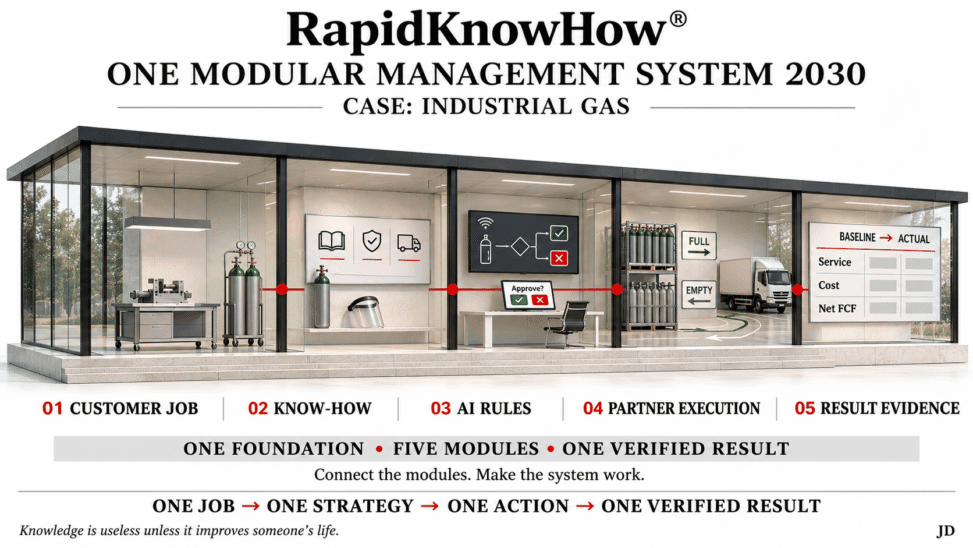
The opportunity: connect customer needs, specialist knowledge, AI decision rules, partner execution and financial evidence into ONE working management system.
The strategic objective is clear: help customers operate reliably, use capital productively and verify the value delivered.
ONE JOB → ONE STRATEGY → ONE ACTION → ONE VERIFIED RESULT
1. The industrial gas opportunity
Industrial gas connects production, supply infrastructure, logistics and customer operations. Linde describes three principal distribution methods: on-site supply, merchant bulk deliveries and packaged gases. Each requires a different operating configuration.
The proposed RapidKnowHow® approach starts with packaged gases at ONE customer site, where cylinder movements, rental charges, delivery frequency and service performance can be examined together.
The customer’s job:
“Keep production running with the right gas available, while controlling total cost and cash tied up.”
This creates a practical management question:
How much supply reliability can we deliver with less avoidable inventory, handling and expense?
2. ONE system. FIVE connected modules.
| Module | Management function | Industrial gas application | Required output |
|---|---|---|---|
| Customer Job | Define success | Agree gas requirements, service levels and site constraints | ONE measurable customer objective |
| Know-How | Make expertise applicable | Combine technical, safety, logistics and commercial knowledge | Approved operating standard |
| AI Rules | Turn information into decisions | Monitor consumption, flag exceptions and recommend replenishment | Traceable recommendation within approval limits |
| Partner Execution | Coordinate delivery | Assign replenishment, cylinder collection and issue resolution | Completed action with an accountable owner |
| Result Evidence | Establish what changed | Reconcile service records, cylinder movements, invoices and cash | Verified operational and financial result |
The modules work through shared definitions, clear responsibilities and standard information interfaces.
3. Design → Function → Flow → Value → Free Cash Flow
| Principle | What it means in practice |
|---|---|
| Design | Five modules built around ONE customer job |
| Function | Every module has an owner, an input and an output |
| Flow | Information moves into decisions, actions and evidence |
| Value | Service improves or holds while avoidable resource use falls |
| Free Cash Flow | Actual cash effects are reconciled after implementation costs |
The operating flow is:
Demand → Replenish → Deliver → Use → Return → Verify
Evidence feeds back into demand assumptions and decision rules. This makes the system capable of learning from execution.
4. The first business case: cylinder circulation
ONE JOB: maintain agreed gas availability while reducing avoidable cylinder-related costs.
ONE STRATEGY: connect cylinder visibility, replenishment decisions and return execution.
ONE ACTION: reconcile the cylinder-rental invoice with the physical cylinder register at ONE site.
ONE VERIFIED RESULT: establish which charges actually stop, which refunds are received and whether service remains within the agreed standard.
The first review should answer five questions:
- Which cylinders are physically present, and who owns them?
- Which are full, in use, empty or awaiting collection?
- Which charges match the contract and register?
- What conditions must be met before rental charges stop?
- Who will complete each approved return and verify the billing change?
An identified opportunity becomes a result only when the action is completed and its effect is evidenced.
5. AI rules with clear authority
AI can organize records, detect discrepancies, forecast consumption and recommend actions.
For example:
When projected stock falls below the approved replenishment threshold, recommend an order. Escalate unusual demand, missing data or exceptions to the responsible person.
Thresholds must reflect lead time, demand variability, storage limits and the required service level.
Technical suitability, safety requirements and authorized approval boundaries remain explicit. Every recommendation should retain its source data, rule version, approval and execution record.
6. Prove the economics
Use separate operational and financial measures.
| Measure | What it establishes |
|---|---|
| Gas availability and stockouts | Whether customer service holds |
| Cylinder cycle time | Whether cylinders circulate faster |
| Cylinder count and rental expense | Whether resource use and charges change |
| Emergency deliveries | Whether avoidable interventions fall |
| Implementation and running costs | What the improvement costs |
| Verified net cash benefit | What cash remains after incremental costs |
Illustrative calculation—assumptions, not achieved results:
Suppose approved returns eliminate €1,000 in monthly rental charges. Additional monitoring and collection cost €250 monthly, with €2,000 in initial implementation expenditure.
- Recurring net cash benefit before tax: €750 per month
- First-year net cash benefit before tax: €7,000
- Simple payback: approximately 2.7 months
This assumes twelve full months of savings, timely execution and unchanged service.
Returning rented cylinders does not automatically release customer-owned capital. For owned assets, a lower cylinder requirement improves cash only through an actual disposal, avoided expenditure or another evidenced cash effect.
ROCE = EBIT ÷ average capital employed. Assess profit and capital changes separately. Higher FCF can support enterprise value; valuation also depends on durability, growth and risk.
7. Build the business, 2027–2030
Proposed development path, conditional on evidence.
| Year | Priority | Gate before expansion |
|---|---|---|
| 2027: Prove | Complete ONE site pilot | Verified benefit with service maintained |
| 2028: Repeat | Apply the modules at comparable sites | Repeatable results and manageable delivery costs |
| 2029: Connect | Coordinate qualified partners across a cluster | Clear accountability and demonstrated shared value |
| 2030: License | License the documented management system | Reliable implementation, verification and renewal economics |
The proposed commercial path is:
ONE Module → 90-Day Pilot → Annual System Licence → Verified Value Review
The licence can include operating standards, decision rules, integration specifications, approval boundaries, partner responsibilities and verification methods.
8. The leadership decision
Own the management method. Coordinate qualified execution. Earn trust through evidence.
RapidKnowHow® positions itself as the independent system designer and orchestrator connecting customer objectives with partner capabilities.
The five-module model is a proposed management framework. Its commercial promise must be established through pilots and repeatable customer results.
ONE first action: select ONE industrial customer site, agree its baseline and reconcile cylinder rentals against the physical register.
Connect the modules. Make the system work. Verify the value.
RapidKnowHow® — Knowledge is useless unless it improves someone’s life.
Josef David | JD
RapidKnowHow® — THE DECISION COMPANY™
Industrial Gas Leadership 2030
PROVE VALUE. THEN SCALE.
Watch the 60-second roadmap: 10 strategic actions for DACH and CEE, 2026–2030.
Start with ONE customer challenge. Use the Industrial Gas Action Guide to turn your first action into a measurable result.
RapidKnowHow® — Leading Industrial Gas Opportunity Signal Identifier in DACH & CEE