
POWER REPORT · INDUSTRIAL GAS
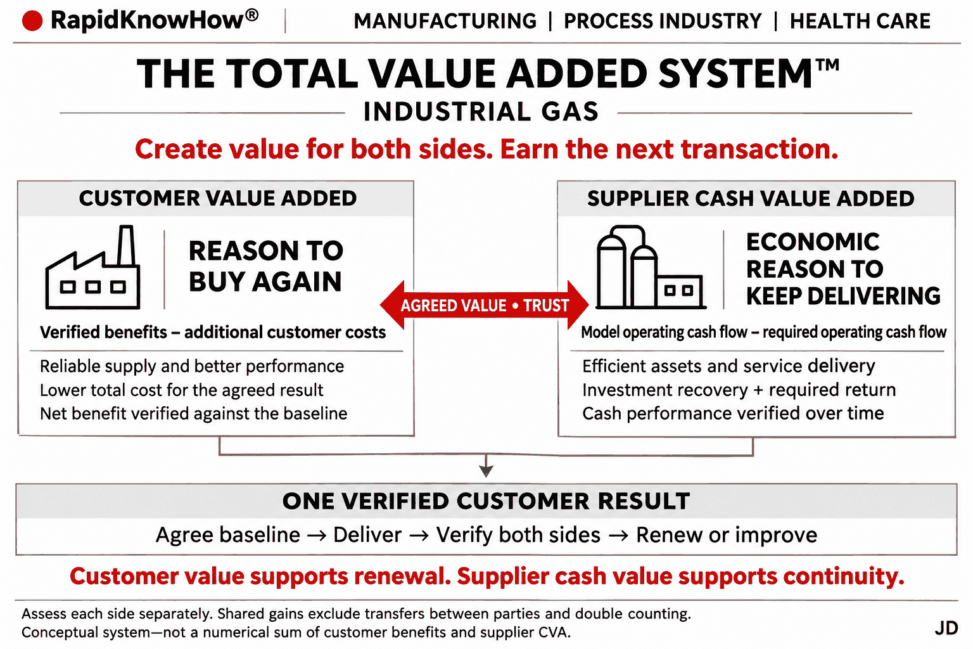
Customer Value Added — Reason to Buy Again.
Supplier Cash Value Added — Economic Reason to Keep Delivering.
For business owners, company boards and key investors.
ONE relationship. TWO economic tests.
An industrial gas relationship becomes sustainable when the customer achieves a better result and the supplier earns an adequate return delivering it.
The RapidKnowHow® Total Value Added System connects these two conditions through an agreed customer job, shared evidence and separate value accounts.
Create value for both sides. Verify the result. Earn the next transaction.
Customer Value Added: earn the next purchase
Customers purchase productive capacity, process reliability or dependable care. Gas, equipment, logistics and expertise make that result possible.
Use this practical measure:
Customer Value Added = Verified customer benefits − Additional customer costs
Compare the same scope, period, output and service requirements. Include implementation costs and additional fees. Separate recurring improvements from one-time benefits.
The customer’s renewal question is:
“Does this relationship improve my result enough to justify its full cost?”
Supplier Cash Value Added: sustain delivery
Revenue alone does not establish that a relationship rewards the assets and capital it requires.
Under the operating cash-flow-demand model:
Supplier Cash Value Added = Model operating cash flow − Required operating cash flow
The required cash flow covers investment recovery over its economic life and the required return. Reconcile the model with financial records and use consistent assumptions for tax, inflation, working capital and sustaining expenditure. pruss.narod.ru
The supplier’s continuation question is:
“Can we deliver the agreed customer result while recovering our investment and earning the required return?”
Apply it across the three business areas
| Business area | Customer reason to buy again | Supplier discipline that sustains delivery |
|---|---|---|
| Manufacturing | Reliable availability, conforming output and lower total cost per good unit | Cylinder circulation, filling utilisation, delivery density and collection |
| Process Industry | Contracted availability, purity, pressure and stable production | Energy efficiency, plant loading, contract economics and capital discipline |
| Health Care | Dependable medical-gas supply, functioning devices and responsive service | Device utilisation, service productivity, collection and capital recovery |
Clinical requirements and safety remain explicit conditions. Lower cost alone does not demonstrate better care.
ONE illustrative customer case
One manufacturing customer and its existing supplier improve gas use, cylinder management and application performance.
Illustrative assumptions—not measured results.
| Customer value account: year one | Amount |
|---|---|
| Lower gas consumption for the same good output | €20,000 |
| Idle cylinder rental payments eliminated | €8,000 |
| Lower scrap costs, excluding gas savings already counted | €12,000 |
| Total benefits | €40,000 |
| Additional supplier service fee | −€10,000 |
| Customer implementation costs | −€5,000 |
| Net Customer Value Added | €25,000 |
The customer has a quantified reason to consider renewal.
The supplier must separately reconcile additional service receipts, lost gas and rental receipts, avoided operating payments, recovery costs, working capital and capital requirements.
The €10,000 fee alone does not prove positive supplier Cash Value Added.
A payment between the parties transfers value. Shared gains come from reduced waste, better resource use or additional profitable output. Customer benefits and supplier Cash Value Added use different measurement bases; adding them does not produce a meaningful “total value” figure.
ONE operating protocol
- Define ONE JOB: agree the customer result and service conditions.
- Establish ONE BASELINE: reconcile assets, consumption, output, invoices, payments and investment.
- Select ONE STRATEGY: choose an evidenced opportunity that can work for both parties.
- Approve ONE ACTION: agree responsibilities, price, investment and verification.
- Verify ONE RESULT: confirm customer benefits and supplier economics separately.
- Renew or improve: continue, redesign or expand according to the evidence.
The board’s decision rule
| Customer value | Supplier cash value | Decision |
|---|---|---|
| Positive | Positive | Consider renewal; assess expansion separately |
| Positive | Negative | Redesign pricing, service or cost-to-serve |
| Negative | Positive | Improve customer outcomes or commercial terms |
| Negative | Negative | Redesign or assess an orderly exit |
Assess performance against the investment-life plan. A single period may reflect ramp-up, disruption or payment timing.
ONE first pilot
ONE manufacturing customer → ONE site → ONE cylinder fleet.
Reconcile the cylinder register, ownership, invoices and return conditions. Identify idle cylinders. Approve return or redeployment. Verify both parties’ cash effects while maintaining availability.
Customer value earns renewal. Supplier cash value sustains continuity. Verified performance builds trust.
ONE JOB → ONE STRATEGY → ONE ACTION → ONE VERIFIED RESULT
RapidKnowHow® — THE DECISION COMPANY™
Industrial Gas Leadership 2030
PROVE VALUE. THEN SCALE.
Watch the 60-second roadmap: 10 strategic actions for DACH and CEE, 2026–2030.
Start with ONE customer challenge. Use the Industrial Gas Action Guide to turn your first action into a measurable result.
RapidKnowHow® — Leading Industrial Gas Opportunity Signal Identifier in DACH & CEE