RapidKnowHow Situational Snapshot V2 — Week 4 / 26
Detect GeoPolitical Drivers (High-Impact Global Signals)
U.S.–EU Trade Escalation & Retaliation Dynamics —
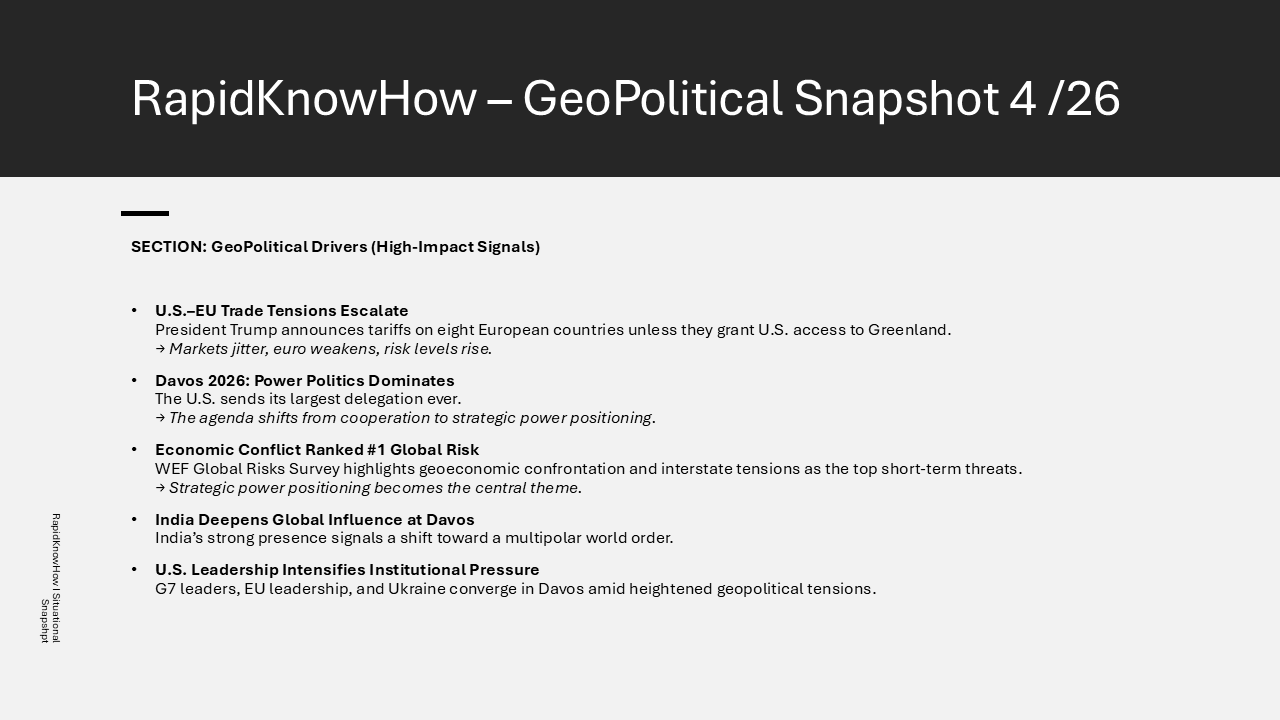
President Trump’s threat of tariffs on multiple European countries unless Greenland access is granted has jolted markets and sparked EU retaliation planning, including possible €93 billion tariffs on U.S. goods. This sharp escalation is stressing transatlantic political and economic ties and is likely to affect global trade policy.
Economic Confrontation as Top Global Risk —
World Economic Forum Global Risks data underscore geoeconomic confrontation (sanctions, tariffs) as the foremost near-term risk to global stability, ahead of state-based conflict and climate risks.
Davos Power Shift & Global Policy Framing —
As the World Economic Forum convenes with record participation of government leaders, CEOs, and policymakers, geopolitical and trade risks are influencing discourse more than traditional cooperation agendas.
Greenland Strategic Significance —
Greenland’s Arctic position, rare earth potential, and shipping routes link climate-induced geographic change with intensifying geopolitical competition involving the U.S., Russia, and China.
Market Volatility & Safe-Haven Flows —
Gold and other safe-haven assets have seen heightened interest amid geopolitical uncertainty and policy stress, while oil markets remain reactive to geopolitical shifts in sanctioned supply and broader trade risks.
Assess Urgent & Important Drivers (Eisenhower Prioritization)
Q1 — ACT (Urgent + Important)
Transatlantic Trade Dispute Escalation
The threat of tariffs and EU retaliation are immediate market and policy shocks.
Priority: Prepare scenarios and alerts for tariff triggers and supply-chain impacts.
Q2 — DESIGN (Important, Not Urgent)
Geoeconomic Risk Framework Integration
Economic confrontation is ranked top global risk; integrate this into mid-term strategy and risk models.
Priority: Build 30–90-day playbooks incorporating global risk projections and trade fragmentation scenarios.
Q3 — DELEGATE (Urgent, Not Important)
Safe-Haven Asset Noise
Short-term commodity price moves (e.g., gold or silver spikes) can be noise if not tied to fundamental shifts.
Priority: Automate filtering to focus on root causes rather than price swings.
Q4 — ELIMINATE (Not Urgent, Not Important)
General Market Outlook Clutter
Broad, long-term financial forecasts without actionable signals should be deprioritized.
Priority: Remove thematic noise not linked to geopolitically driven decisions.
Convert Urgent & Important into Actions
Business Actions
• Tariff Scenario Modeling: Define threshold triggers for tariff escalations and responses across major markets.
• Trade & Supply-Chain Resilience: Reassess supply routes and diversification strategies in light of escalating trade measures.
• Geopolitical Risk Monitoring: Enhance real-time dashboards for news and policy shifts (EU summits, Davos communiqués, Arctic developments).
Life Actions
• Financial Positioning: Reinforce liquidity buffers; consider safe-haven allocations where appropriate.
• Information Hygiene: Streamline trusted intelligence sources; eliminate speculative media signals.
• Mobility & Personal Planning: Evaluate travel, relocation, or operational plans against evolving geopolitical flashpoints.
Rapid Snapshot: Week 4/26 — Priority Summary
| Priority | Strategic Focus | Required Action |
|---|---|---|
| Q1 — ACT | U.S.–EU trade dispute & market volatility | Define tariff trigger scenarios & supply-chain actions |
| Q2 — DESIGN | Economic confrontation risk framework | Build mid-term geopolitical risk playbooks |
| Q3 — DELEGATE | Safe-haven price noise | Automate noise filtering |
| Q4 — ELIMINATE | General broad market forecasts | Discard signals not tied to geopolitical drivers |
Leave a Reply