
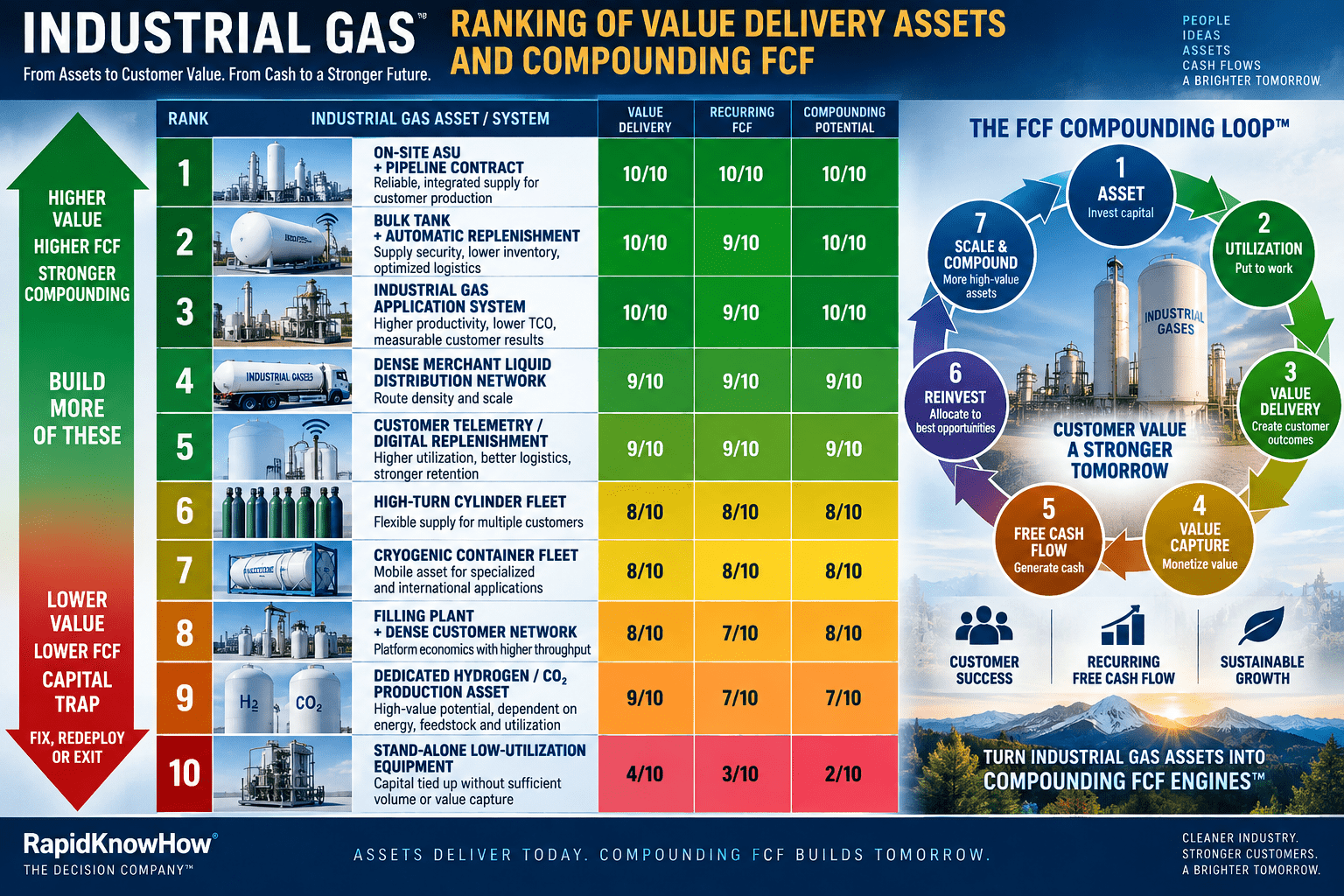
Below is the board-level ranking I would use for the RapidKnowHow® Industrial Gas system. The ranking is not based on asset book value; it ranks assets by their ability to deliver measurable customer value, generate recurring cash, and compound FCF when the operating model is strong.
RapidKnowHow® INDUSTRIAL GAS — VALUE DELIVERY ASSET & COMPOUNDING FCF RANKING™
| Rank | Industrial Gas Asset / System | Value Delivery | Recurring FCF | Compounding Potential | Strategic Logic |
|---|---|---|---|---|---|
| 1 | On-site ASU + Pipeline Contract | 10/10 | 10/10 | 10/10 | Long contracts, embedded supply, high switching barriers, predictable demand |
| 2 | Bulk Tank + Automatic Replenishment System | 10/10 | 9/10 | 10/10 | Recurring volume + asset + telemetry + optimized logistics |
| 3 | Industrial Gas Application System | 10/10 | 9/10 | 10/10 | Gas becomes tied directly to customer productivity and TCO |
| 4 | Dense Merchant Liquid Distribution Network | 9/10 | 9/10 | 9/10 | Route density converts existing infrastructure into incremental FCF |
| 5 | Customer Telemetry / Digital Replenishment Network | 9/10 | 9/10 | 9/10 | Small incremental capital can improve tank utilization, logistics and retention |
| 6 | High-Turn Cylinder Fleet | 8/10 | 8/10 | 8/10 | Strong economics when cylinder turns, pricing and distribution density are high |
| 7 | Cryogenic Container Fleet | 8/10 | 8/10 | 8/10 | Mobile asset supports specialized, international and temporary applications |
| 8 | Filling Plant + Dense Customer Network | 8/10 | 7/10 | 8/10 | Platform economics improve rapidly with throughput and regional density |
| 9 | Dedicated Hydrogen / CO₂ Production Asset | 9/10 | 7/10 | 7/10 | Potentially high-value, but economics depend heavily on energy, feedstock and utilization |
| 10 | Stand-alone Low-Utilization Equipment | 4/10 | 3/10 | 2/10 | Capital tied up without sufficient volume, value capture or network advantage |
The key finding
The strongest industrial gas assets are usually not single pieces of equipment.
The strongest FCF engines are:
ASSET + CUSTOMER APPLICATION + CONTRACT + SERVICE + DATA + LOGISTICS
For example:
Bulk Tank alone
is an asset.
But:
**Bulk Tank
- Telemetry
- Automatic Replenishment
- Optimized Route
- Long-Term Contract
- High-Value Application**
becomes a:
COMPOUNDING FCF ENGINE™
TOP 3 VALUE-DELIVERY ASSET SYSTEMS
#1 — ON-SITE ASU + PIPELINE
Value delivered
Continuous gas availability
- production security
- very high volumes
- integrated customer process.
FCF engine
Long Contract
→ predictable volume
→ high utilization
→ recurring cash
→ incremental capacity expansion
→ contract renewal
→ higher lifetime FCF.
Strategic advantage
Once the asset is integrated into the customer’s production process, the economic relationship can become very durable.
Primary chokepoint
Poor contract economics or low plant utilization.
#2 — BULK TANK + AUTOMATIC REPLENISHMENT
This may be the most attractive scalable asset system for merchant industrial gases.
Value delivered
Customer does not simply receive liquid gas.
The system delivers:
**SUPPLY SECURITY
- LOW INVENTORY RISK
- LOWER ADMINISTRATION
- LOWER LOGISTICS COST
- HIGHER UPTIME**
FCF loop
Tank
→ telemetry
→ replenishment data
→ optimized delivery
→ higher tank turns
→ lower logistics cost / tonne
→ stronger customer retention
→ higher FCF
→ install next profitable tank.
This creates:
TANK → FCF → NEXT TANK → MORE FCF
#3 — APPLICATION ASSET SYSTEM
This is strategically powerful because it changes the commercial discussion.
Instead of:
“What is your gas price?”
the discussion becomes:
“What economic result does our gas system produce?”
Applications can deliver:
- increased production output
- reduced scrap
- improved product quality
- lower energy consumption
- higher furnace productivity
- better freezing performance
- increased welding productivity
- improved process control
That creates the strongest connection:
GAS → CUSTOMER VALUE → VERIFIED VALUE → VALUE CAPTURE
The physical gas becomes only one component of the economic solution.
THE COMPOUNDING FCF MATRIX™
The asset portfolio can be divided into four zones:
| LOW FCF | HIGH FCF | |
|---|---|---|
| HIGH CUSTOMER VALUE | IMPROVE / MONETIZE | SCALE AGGRESSIVELY |
| LOW CUSTOMER VALUE | REDEPLOY / EXIT | HARVEST / PROTECT |
The most interesting zone is:
HIGH CUSTOMER VALUE + LOW FCF
because the company may already be creating significant customer value but failing to capture it.
That is often the fastest FCF opportunity.
THE FCF MULTIPLIER
The strongest assets combine six variables:
1. UTILIZATION
How intensively is the asset used?
2. CUSTOMER VALUE
How economically important is the asset to the customer?
3. VALUE CAPTURE
How much of the value comes back to the supplier?
4. CASH CONVERSION
How much accounting profit becomes real cash?
5. REPEATABILITY
Can the model be copied?
6. REINVESTMENT
Can the FCF finance additional profitable assets?
So the RapidKnowHow® logic becomes:
ASSET FCF POWER™
UTILIZATION
× CUSTOMER VALUE
× VALUE CAPTURE
× CASH CONVERSION
× REPEATABILITY
× REINVESTMENT QUALITY
=
COMPOUNDING FCF POWER
RAPIDKNOWHOW® BOARD PRIORITY
If I reduced the whole Industrial Gas portfolio to three asset systems to manage first, I would focus on:
1. BULK TANK + TELEMETRY + AUTOMATIC REPLENISHMENT
Best scalable merchant-gas FCF engine.
2. ON-SITE / PIPELINE SYSTEM
Best long-duration recurring cash asset.
3. APPLICATION + VERIFIED CUSTOMER VALUE
Best mechanism for escaping commodity pricing and increasing value capture.
Together they create:
INFRASTRUCTURE + DATA + CUSTOMER VALUE
and therefore:
RECURRING FCF + RETENTION + REINVESTMENT + COMPOUNDING
FINAL AHA
Do not rank industrial gas assets by:
purchase price, age, depreciation or installed base.
Rank them by:
VERIFIED CUSTOMER VALUE × SUSTAINABLE FCF × REPEATABILITY
The winning asset is the one that creates the strongest loop:
ASSET → VALUE DELIVERY → VALUE CAPTURE → FCF → REINVEST → MORE HIGH-VALUE ASSETS → MORE FCF
RapidKnowHow® rule
DON’T OWN MORE ASSETS.