

Core Message:
Gustaf Dalén did not just build a company. He built a lighthouse system: technology that worked automatically, saved energy, reduced risk, scaled globally, and protected human life.
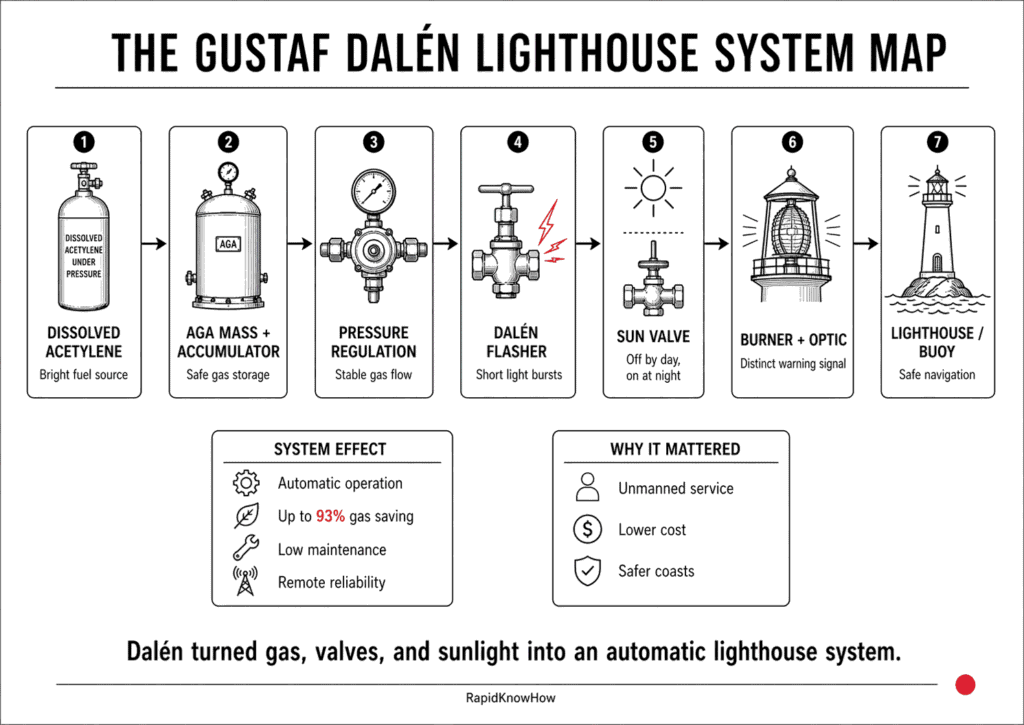
Dalén’s Nobel Prize in Physics 1912 honored his automatic regulators for gas accumulators used in lighthouses and buoys. His solar valve switched beacon lights off during daylight and on at night, saving gas and making remote lighthouse systems dramatically more efficient.
B) The AGA Legacy Formula
AGA = Automatic Guidance Architecture
- Innovation with Purpose
Not invention for ego — invention for safety, efficiency, and reliability. - Automation Before Digitalization
Dalén created self-regulating systems long before AI: lights that reacted to daylight, conserved energy, and worked without human presence. - Efficiency as Strategy
The AGA lighthouse system reduced gas use massively through flashing and daylight regulation. That is the same logic as today’s AI-Orchestrator: less waste, more output, higher reliability. - Resilience Under Pressure
Dalén lost his sight after a 1912 acetylene explosion, yet continued leading AGA until his death in 1937. - Industrial Gas as Civilization Infrastructure
AGA’s core was not “selling gas.” It was enabling safer navigation, industry, cooking, heating, welding, healthcare, and modern life.
C) RapidKnowHow Translation: From Dalén Lighthouse to AI-Orchestrator
Gustaf Dalén’s lighthouse principle becomes today’s leadership principle:
Build systems that guide people safely through uncertainty — automatically, efficiently, and reliably.
Then:
Gas + regulator + lighthouse = safer navigation.
Now:
Human leader + AI + strategic system = safer business navigation.
AGA Legacy → RapidKnowHow Legacy
| Dalén / AGA | RapidKnowHow / AI-Orchestrator |
|---|---|
| Lighthouse | Command Center |
| Solar valve | AI signal detection |
| Gas saving | FCF improvement |
| Automatic regulator | AI-Orchestrator |
| Safe navigation | Strategic leadership |
| Industrial gas infrastructure | Compounding value ecosystem |
D) One-Line Legacy Statement
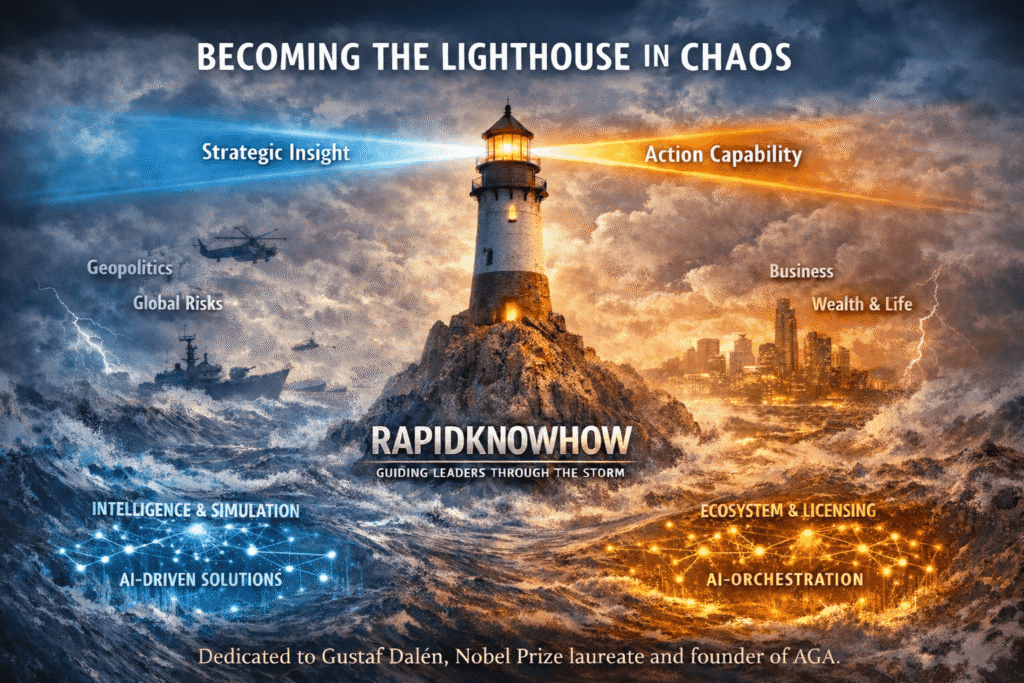
Gustaf Dalén showed how industrial gas, automation, and human purpose can create a lighthouse for the world. RapidKnowHow carries this legacy forward by building AI-Orchestrated systems that help leaders navigate uncertainty, generate Free Cash Flow, and create compounding value.
RapidKnowHow I The Lighthouse in Chaos
Primary Sources — Gustaf Dalén / Nobel / AGA Legacy
- Nobel Prize — Gustaf Dalén Facts
Official Nobel Prize page: prize motivation, solar valve, lighthouse technology, 1912 Nobel Prize. - Nobel Prize — Gustaf Dalén Documentary
Official Nobel documentary page with biographical and historical context. - Dalén Museum — About the Dalén Museum
Strong source for AGA origins, Dalén joining AGA in 1904, lighthouse innovation, safe/economic acetylene use, and becoming managing director in 1909.
B) Technical / Industrial Gas / Lighthouse Sources
- United States Lighthouse Society — “Gustaf Dalen” PDF
Useful for the “four pillars” of the AGA lighthouse system: flashing apparatus, porous AGA mass, sun valve, and related lighthouse technology. - Pharos Marine Automatic Power — History of AGA / Automatic Power
Useful for AGA’s 1904 origins and the statement that AGA was built on Dalén’s inventions. - ResearchGate / IEEE-related paper — “Nils Gustav Dalén, the Unknown Nobel Prize Winner”
Helpful for framing Dalén’s work as an early control-engineering breakthrough.
C) Biographical / Interpretive Sources
- Linda Hall Library — “Scientist of the Day: Gustaf Dalén”
Useful biographical source on the 1912 explosion, blindness, continued leadership of AGA, and later AGA cooker context. - Tekniska Museet — Gustaf Dalén
Good Swedish technology-history source for Dalén’s inventions, solar valve, AGA, and innovation legacy.
(This was used in the previous answer; the live search result did not reappear in this search set, but it remains a relevant source to include.) - gasworld — AGA Gas roots and Gustaf Dalén
Useful industrial-gas industry source noting AGA’s roots in Dalén’s inventions and legacy.
RapidKnowHow® — THE DECISION COMPANY™
Industrial Gas Leadership 2030
PROVE VALUE. THEN SCALE.
Watch the 60-second roadmap: 10 strategic actions for DACH and CEE, 2026–2030.
Start with ONE customer challenge. Use the Industrial Gas Action Guide to turn your first action into a measurable result.
RapidKnowHow® — Leading Industrial Gas Opportunity Signal Identifier in DACH & CEE
Leave a Reply