
RapidKnowHow® — THE DECISION COMPANY™
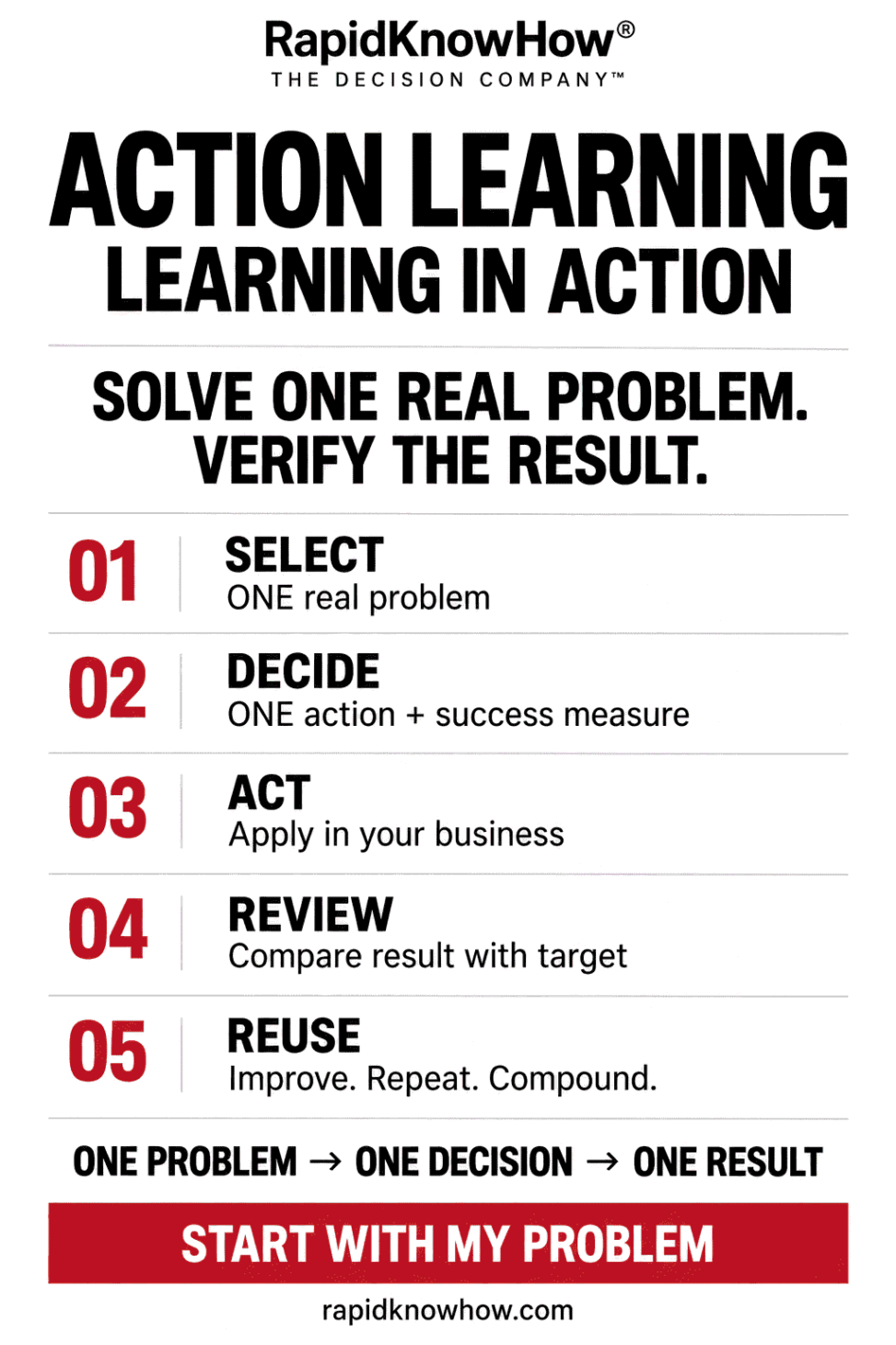
SOLVE ONE REAL PROBLEM. APPLY. VERIFY. IMPROVE.
Action Learning — Learning in Action — starts with a real leadership challenge. You ask questions, test assumptions, choose an action and learn from the result. Progress means both a better business outcome and a better next decision.
ONE problem. ONE decision. ONE measurable result.
Choose a challenge you can influence in the next 30 days: release trapped cash, win a valuable customer, improve reliability or protect a critical flow. Write the problem in one sentence and record the starting position.
1. SELECT — Define the real challenge
Ask: What is happening? What evidence do we have? Who is affected? Which assumption needs testing?
Output: ONE clear problem, a baseline and a named owner.
2. DECIDE — Choose one action
Ask: What action is within our control? What result would justify continuing? What would make us stop or change course?
Output: ONE decision, a success measure and a review date.
3. ACT — Test in the real business
Apply the chosen action on a manageable scale. Record what you did, the resources used and what happened. Capture evidence rather than relying on impressions.
Output: An executed action and observable results.
4. REVIEW — Learn from the evidence
Ask: What changed against the baseline? What worked? What surprised us? What else may have influenced the result? Which assumption should we revise?
Output: A measured result and a clear learning point.
5. REUSE — Improve and repeat
Keep what the evidence supports. Adjust what did not work. Record the conditions under which the approach is useful before applying it elsewhere.
Output: Reusable know-how and ONE next decision.
TOP 3 ACTIONS — Start today
- Write your challenge: “By [date], improve [measure] from [baseline] to [target].”
- Choose your first test: Name one owner, one action and the evidence you will collect.
- Set the review: Review the first evidence in seven days; make the continue, adjust or stop decision by day 30.
Leadership teams — Question. Act. Reflect.
Bring different perspectives to one shared challenge. Let the problem owner explain the situation, then use open questions to clarify the facts before proposing solutions. Agree on one action and one accountable owner. At the review, examine both the business result and what the team learned.
Your 30-day Action Learning record
ONE SIGNAL: What evidence shows the problem?
ONE DECISION: What will we do?
WHY NOW: What is the cost of waiting?
TOP 3 ACTIONS: What happens, who owns it and by when?
30-DAY RESULT: Baseline → target → actual result.
CONFIDENCE: Low / medium / high — and why.
DECISION / RESULT: Continue, adjust or stop — with the evidence.
LEARNING: What will we do differently next time?
Example — Release trapped cash
A supplier identifies overdue invoices as a cash constraint. The finance and commercial leaders select ten overdue accounts, resolve disputed items and agree collection dates. After seven days, they compare cash received and unresolved disputes with the baseline. By day 30, they decide which collection practices to reuse. This is an illustrative test, not a promised financial outcome.
From learning to verified value
PowerPost → Relevant PowerActionGuide → Apply in Business → Verify Value → PowerLicense.
Start with your problem in RapidFind. Use its Top 3 Strategic Actions to select your next move and the relevant existing guide. Record the result before considering broader reuse or enterprise licensing.
Explore Action Guides · Explore the Licensing System
Learning creates value when it changes action—and action produces a verified result.