








RapidKnowHow® Power Report | 2026–2030
One strategic decision
Enter Europe as a European-governed value provider. Use Chinese speed, scale and cost strength to support a locally accountable offer that European customers can trust.
European B2B customers buy more than a product. They buy continuity, compliance, service, cybersecurity, control over their data and confidence that the supplier will remain accountable. The entrant must establish trust before pursuing volume.
Scope: This is a general market-entry framework for industrial and technology B2B businesses. Product and sector requirements must be checked before launch.
1. The board decision
Build one European beachhead around one high-value industry segment, one EU operating company and three paying reference customers. Expand only when customer value and service performance have been proved.
Why this approach works
- Local accountability reduces procurement concerns about a remote supplier.
- Documented compliance gives customers evidence they can use internally.
- Measured savings, uptime and cash impact shift the discussion beyond purchase price.
- Service, spare parts, software and upgrades create recurring revenue.
- Investment in local assembly or acquisitions follows proven demand.
The strategic chokepoint is trust. Even a technically strong product can fail if a buyer cannot defend the purchase. Prepare a complete evidence package covering conformity, ownership, supply chain, cybersecurity, data handling, local service, warranty and business continuity.
2. Where to compete
Choose a specific customer problem where you can demonstrate a substantial advantage in total cost, uptime, energy use, quality or working capital. A lower invoice price alone is an insufficient reason for a customer to switch.
Start with one industry segment and a focused DACH–CEE corridor. Select approximately 30 target accounts that share the same use case. Country choice should follow customer density, certification requirements, service economics and the ability to transfer successful reference cases.
Recommended operating model
- EU operating company: Own contracts, compliance and major customer relationships.
- Local leadership: Give an accountable European team clear decision authority.
- Certified partners: Extend sales and service reach under measurable standards.
- Outcome offer: Combine the product with commissioning, service levels, data terms and measurable customer results.
- Staged operations: Import first, position critical spare parts locally and add assembly only when demand justifies it.
3. The ten-step Europe entry system
- Signal: Quantify one costly European customer problem and identify the buying decision-maker.
- Select: Choose one industry segment, one corridor and a defined group of target accounts.
- Localize: Adapt standards, documentation, language, interfaces and contracts.
- Govern: Establish the EU company, accountable leadership and transparent ownership and data rules.
- Comply: Review product, customs, carbon, cyber, data, labour and sector obligations.
- Prove: Deliver three paid projects with an agreed baseline and verified results.
- Serve: Establish local spare parts, trained technicians, response times and warranty capacity.
- Scale: Replicate the proven offer through certified partners and key-account teams.
- Localize capital: Add testing, assembly, refurbishment or acquisitions only after an investment review.
- Compound: Grow recurring profit from service, software, upgrades and the installed customer base.
Customer promise: European accountability. Chinese speed. Verified lifecycle cash impact.
Value equation:
Verified annual customer value = avoided downtime + energy and material savings + labour productivity + quality gains + working-capital release − transition costs − risk reserve.
4. Choose the entry model
Recommended for the first stage: An EU subsidiary supported by selected sales and service partners. This gives the company local accountability while preserving control over strategic accounts, customer data and evidence of delivered value.
Direct exporting can test interest, but offers limited local reassurance. A master distributor can accelerate reach, but may create distance from customers. Joint ventures and acquisitions require careful assessment of control, integration, investment and exit rights.
Suggested geographic sequence
- Beachhead: Germany and Austria, connected with Czechia and Slovakia.
- Replication: Poland and Northern Italy, where the proven offer fits customer demand.
- Further expansion: Select other countries according to the industry segment and demonstrated economics.
5. Roadmap: 2026–2030
- 2026 — Establish the right to operate: Select the niche and corridor, establish EU accountability and complete the product and operating compliance review.
- 2027 — Prove customer value: Win three paid reference accounts, deliver local service and document verified lifecycle results.
- 2028 — Replicate: Standardize the offer, certify partners and expand to a second suitable customer cluster.
- 2029 — Localize selectively: Assess assembly, refurbishment, circular services or an acquisition against demand and return on invested capital.
- 2030 — Compound: Increase recurring profit per installed unit and operate European delivery and renewals through the local organization.
The first 90 days
- Days 1–30: Choose one niche, identify 30 target accounts, interview buyers and map applicable rules.
- Days 31–60: Define the customer offer, landed-cost model, EU operating structure, service plan and partner shortlist.
- Days 61–90: Submit three paid pilot proposals with baselines, success measures, data terms and acceptance criteria.
30-day result: A board-approved beachhead with one customer problem, one industry segment, one corridor, one accountable EU leader and a clear path to a compliant offer.
6. Manage cash quality
Revenue growth is insufficient if warranty costs, inventory, channel margins or customer financing consume the cash it produces. Review these measures together:
- Landed contribution margin after freight, duties, carbon-related costs, warranty and channel costs.
- Verified customer value relative to the full customer price.
- Conversion from paid pilot to rollout.
- Sales-cycle duration.
- Service response and first-time repair performance.
- Warranty and quality costs.
- Cash conversion cycle.
- Recurring gross profit per installed unit.
- Dependence on any single customer.
Price the initial diagnostic or pilot. Then offer the core product, commissioning and service agreement. Add monitoring, software, spare parts and upgrades where customers see continuing value. Use outcome-based contracts only after both parties trust the measurement baseline.
Capital rule: Invest in the sequence of proof. Move from interviews to compliance work, paid pilots, local service capacity and partner coverage before committing to major local facilities.
7. Ten failure modes and the response
- Price becomes the only argument. Show verified lifecycle value and reduced operating risk.
- Europe is treated as one market. Adapt to country-specific buying, language, standards and service needs.
- Decisions remain remote. Delegate defined authority to European leaders.
- A distributor owns the customer relationship. Retain strategic account contact and access to value evidence.
- Compliance starts after launch. Check obligations before finalizing the offer and price.
- Data handling creates uncertainty. Define hosting, access, portability, retention and incident responsibilities.
- Service is promised without capacity. Position parts, train technicians and measure response performance.
- Supply-chain or subsidy questions cannot be answered. Maintain auditable records.
- Local assembly starts too early. Require volume and return-on-capital evidence.
- Expansion outruns proof. Produce reusable customer cases before entering another country.
Three red lines: No opaque data transfers. No installed base that cannot be serviced. No public performance claim without evidence.
8. Final board decision
Approve expansion only when the team can answer seven questions with evidence:
- What measurable customer problem makes Europe attractive now?
- Which industry segment, corridor and accounts will we pursue first?
- What proves our governance, compliance, data control and continuity?
- What verified lifecycle value gives customers a reason to switch?
- Can we reliably service the product after installation?
- Will growth produce contribution margin and cash?
- Can the European organization deliver and renew without constant intervention from China?
GO / NO-GO: Proceed when a European buyer can defend the purchase using documented evidence of value, trust and service.
Action checklist
- Appoint one EU entry leader and one executive sponsor in China.
- Select one customer problem, one industry segment and one corridor.
- Agree on the customer baseline and value calculation.
- Design the journey from discovery through pilot, delivery, service and renewal.
- Test local spare-parts availability and service response.
- Prepare buyer-ready documentation and a clear European value proposition.
- Submit three paid reference-project proposals.
- Track margin, conversion, service, quality, cash and recurring profit.
- Obtain specialist review of applicable legal and regulatory requirements.
- Ask whether a cautious European board could approve the purchase from the evidence package.
- Remove the main obstacle to the first paid customer before adding more countries or products.
One-picture logic
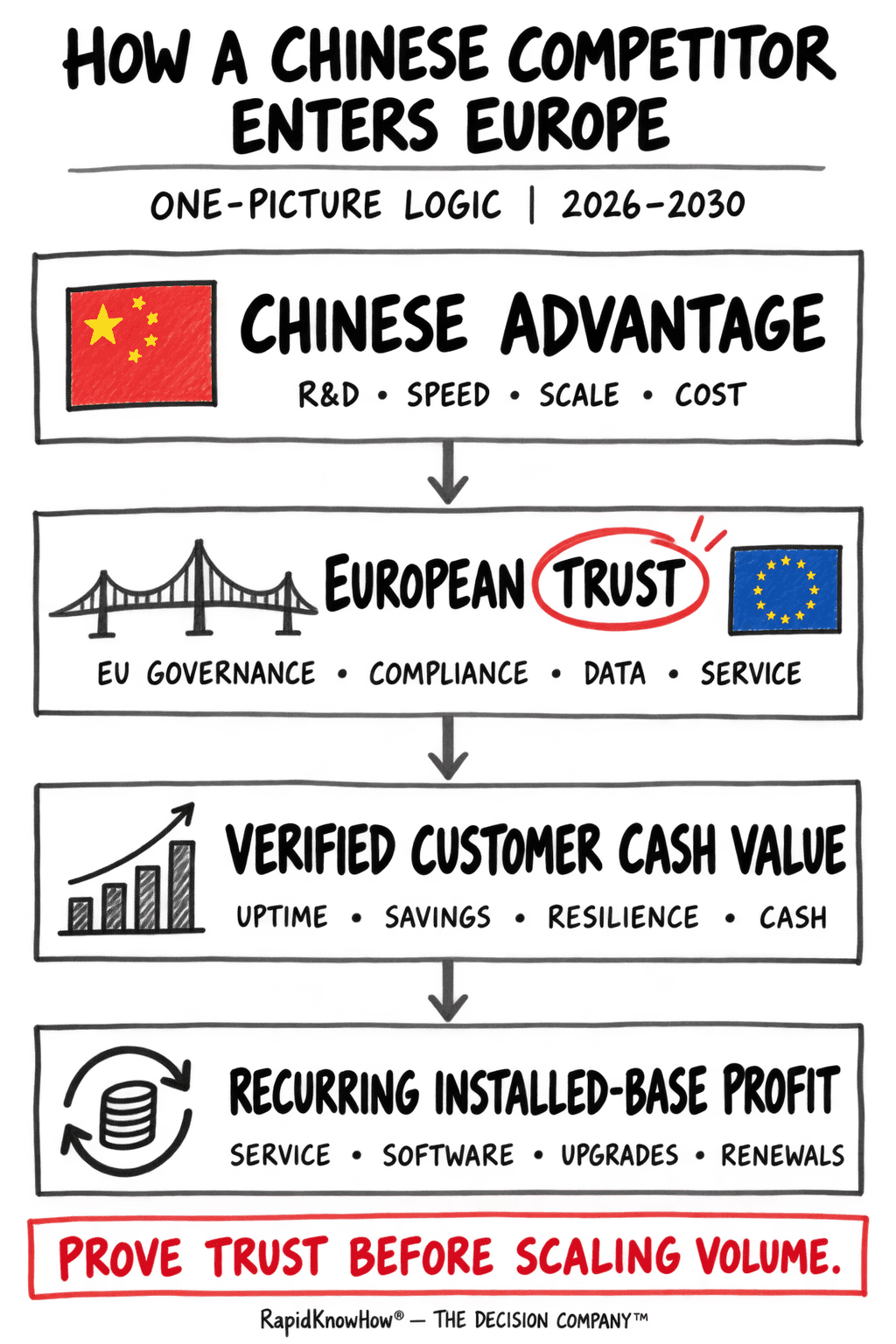
CHINESE ADVANTAGE → EUROPEAN TRUST → VERIFIED CUSTOMER CASH VALUE → RECURRING INSTALLED-BASE PROFIT
RapidKnowHow® | Report date: 24 September 2026. This strategic framework is not legal advice. Applicable requirements depend on the product, sector, transaction and country.
RapidKnowHow® Power Report
HOW TO DEFEND THE EUROPEAN B2B MARKET
Expand customer value faster than a new competitor can win the account | 2026–2030
ONE BOARD DECISION
Defend the installed customer base by expanding the value delivered to each customer.
Select one customer segment. Identify its largest operating and cash losses. Build an offer that measurably reduces those losses, connects the supplier more deeply to the customer’s operations, and creates a repeatable service and renewal business.
The governing question: If a credible Chinese competitor offered the product at a substantially lower price tomorrow, what verified value would make the customer stay?
A European company cannot assume that its origin, existing relationships or regulatory familiarity will answer that question. The EU’s stated approach to China is de-risking, not decoupling: competition remains part of the market. At the same time, EU policy emphasizes industrial competitiveness, resilience and a level playing field. policy.trade.ec.europa.eu
1. THE STRATEGIC CHOKEPOINT: THE CUSTOMER SEES A PRODUCT, NOT A SYSTEM
Many European B2B suppliers possess capabilities that a new entrant cannot quickly reproduce: application knowledge, technicians, installed equipment, regulatory experience, customer relationships and operating data.
Yet those strengths often remain unpriced and unproved. Procurement compares two product quotations because neither supplier has made the wider economic result visible.
The defence begins by changing the unit of competition:
| Weak unit of competition | Strong unit of competition |
|---|---|
| Product specification | Customer operating result |
| Unit price | Five-year total cost and cash impact |
| Delivery promise | Measured uptime and response |
| Supplier relationship | Joint improvement programme |
| Equipment sale | Installed-base service and renewal |
| Claim of local quality | Independently verifiable evidence |
Board test: Can the account team show, in one page, the annual customer cash value created beyond the product itself?
2. THE EUROPEAN B2B DEFENCE SYSTEM — TEN ACTIONS
1. SIGNAL — Detect the threat at account level
Track where competitors are winning trials, entering tenders, recruiting service partners or offering aggressive financing. Also track customers’ changing needs: energy cost, labour scarcity, uptime, cybersecurity, working capital and supply continuity.
Proof: A named account, a specific threatened application and a quantified customer problem.
2. SELECT — Choose the accounts worth defending
Rank accounts by lifetime value, reference power, switching risk and potential to expand customer value. Give the strongest teams to accounts where the supplier can build a durable economic advantage.
Proof: A prioritized list of 20–30 accounts, each with an owner and a defined decision date.
3. DIAGNOSE — Measure the customer’s avoidable loss
Establish a baseline for downtime, waste, energy use, quality failures, labour time, inventory and emergency deliveries. Ask the customer to validate both the baseline and the method of measurement.
Proof: A jointly accepted baseline; avoid presenting an internal estimate as a verified saving.
4. DESIGN — Offer a better operating result
Combine the product with application engineering, replenishment, monitoring, preventive service, training and risk controls. Include only elements that solve the selected customer problem.
Proof: One clear outcome promise, an implementation owner and a measurable acceptance test.
5. PRICE — Sell the economic difference
Show the customer both the total cost of the incumbent offer and the total cost of switching. Price part of the demonstrated advantage while leaving the customer with an attractive, credible net gain.
Proof: A customer-specific five-year value case, including implementation costs and uncertainty.
6. SERVE — Turn proximity into measurable performance
Use local technicians, spare parts, escalation authority and response commitments where they matter. Measure service performance; geographical presence alone does not prove it.
Proof: Response time, first-time resolution, uptime and customer-confirmed service outcomes.
7. CONNECT — Become part of the customer’s workflow
With the customer’s consent and clear data rights, connect planning, ordering, delivery, asset performance and review. Make the relationship useful every week, not only at contract renewal.
Proof: A functioning customer workflow that saves time or prevents loss.
8. EXPAND — Enter the adjacent value pool
Once the first result is verified, move to a related site, application, product family or operating problem. Expansion must follow customer evidence.
Proof: A second paid mandate based on the first result.
9. RENEW — Contract for continuing results
Review value delivered before renewal discussions begin. Update baselines, service commitments and the next improvement target.
Proof: Renewal supported by a jointly reviewed record of delivered value.
10. COMPOUND — Reuse what works
Convert successful cases into a standard diagnostic, offer, delivery method and proof protocol. Train account teams and partners to deliver the system without depending on one expert.
Proof: Multiple accounts achieving comparable results with positive supplier contribution and controlled working capital.
3. DEFEND BY EXPANDING THE MARKET
A defence based only on matching a lower price gives the challenger control of the contest. A stronger response creates demand the original product quotation does not address.
| Expansion move | Customer benefit | Supplier opportunity |
|---|---|---|
| Reduce downtime | More productive capacity | Service and monitoring |
| Improve energy efficiency | Lower operating cost | Engineering and optimization |
| Automate replenishment | Fewer stockouts and less inventory | Managed supply agreement |
| Improve quality or yield | Less waste and rework | Application support |
| Extend asset life | Lower replacement cost | Maintenance and refurbishment |
| Improve supply resilience | Lower interruption risk | Dual-source and continuity services |
| Connect multiple sites | Consistent performance | Multi-site agreement |
Rule: Enter an adjacent market only when the existing capability produces a measurable customer result there. Geographic coverage without proof creates complexity before it creates value.
The European Commission’s competitiveness agenda also places weight on industrial transformation, circularity, innovation and use of the single market. Those priorities may create opportunities, but a company still needs an account-level case that customers will pay for. European Commission
4. CASE: EUROPEAN INDUSTRIAL GAS SUPPLIER
Threat: A new competitor offers a lower gas price to a manufacturer.
Weak response: Discount the gas and defend the existing contract.
Stronger response: Diagnose the manufacturer’s total cost of using industrial gas, then offer:
- Reliable supply with measured interruption risk.
- Automatic replenishment and lower on-site inventory.
- Application engineering that reduces gas consumption per unit of output.
- Monitoring that identifies leaks, waste or process drift.
- A multi-site improvement programme with verified results.
Customer value equation:
Annual customer value = avoided production loss + reduced gas waste + lower inventory and handling cost + quality improvement − implementation cost − agreed risk allowance.
The supplier should seek a paid pilot, establish the baseline with the customer, verify the result and then propose a broader agreement. The aim is to make the purchasing decision about production cash performance, supported by evidence.
The same logic can be adapted to pallets, containers, tires, industrial equipment and other B2B categories. The variables and proof method must change with the application.
5. COMPETE FAIRLY ON A LEVEL PLAYING FIELD
European firms should document suspected unfair practices and use applicable trade or competition procedures where the evidence warrants it. The EU Foreign Subsidies Regulation provides a mechanism to address distortions caused by foreign subsidies while keeping the single market open to trade and investment. European Commission
Compliance can also be a customer benefit when it improves traceability, continuity or security. It should be presented precisely. For example, the Cyber Resilience Act has reporting obligations in effect from September 2026, while its principal product requirements apply from December 2027. A connected-product supplier needs a dated implementation plan, rather than a general claim that it is “EU compliant.” Shaping Europe’s digital future
Commercial rule: Use regulation to establish a fair, credible offer. Do not rely on regulation to substitute for customer value.
6. THE 2026–2030 DEFENCE ROADMAP
| Year | Mandate | Board proof |
|---|---|---|
| 2026 | Select priority accounts and measure their largest avoidable losses | Baselines and paid pilot proposals |
| 2027 | Prove integrated value in three reference accounts | Customer-confirmed cash results |
| 2028 | Standardize the offer and extend it to adjacent sites or segments | Repeatable contribution margin |
| 2029 | Build a broader service, data and partner system | Higher renewal and expansion value |
| 2030 | Operate a scalable European value platform | Recurring profit, controlled capital and evidence across accounts |
The first 90 days
Days 1–30 — Select. Rank threatened accounts. Interview customers. Choose one costly problem and agree on how to measure it.
Days 31–60 — Design. Assemble the product, service and workflow offer. Calculate the customer case and supplier economics.
Days 61–90 — Prove. Launch three paid pilots with written baselines, acceptance criteria and review dates.
90-day result: At least one customer has paid to test a measurable improvement that a product-only quotation does not provide.
7. BOARD SCORECARD
Review these measures together:
- Customer: Verified annual cash value and number of paid expansions.
- Commercial: Pilot-to-rollout conversion, renewal rate and share of the customer’s relevant spend.
- Operations: Uptime, response time, first-time resolution and quality.
- Supplier cash: Contribution after service costs, working capital, recurring gross profit and return on invested capital.
- Repeatability: Time and specialist effort required to reproduce the result in another account.
Targets should be set for the specific sector and starting position. A large claimed saving with weak verification is not a passing result.
FINAL BOARD DECISION
Choose one threatened European B2B segment. Within 90 days, prove a customer outcome that is more valuable than the challenger’s price difference. Then turn that outcome into a repeatable offer and expand account by account.
ONE-PICTURE LOGIC
CUSTOMER LOSS → VERIFIED IMPROVEMENT → PAID EXPANSION → RENEWAL → COMPOUNDING FCF
Strategic chokepoint: The customer must be able to verify the improvement.
ACTION CHECKLIST
- SETUP: Name the executive owner and select the first 20–30 accounts.
- CORE SYSTEM: Identify one recurring customer loss and agree on its baseline.
- VALUE: Build one offer with a measurable cash result.
- CUSTOMER JOURNEY: Make diagnostic, pilot, rollout and renewal easy to approve.
- DELIVERY TEST: Demonstrate service and operating performance at the customer site.
- COMMERCIAL TEST: Obtain three paid pilot mandates.
- KPI TEST: Measure customer value and supplier free cash flow.
- TRUST TEST: Substantiate performance, data and compliance claims.
- PASS / FAIL: Will a customer expand the contract because the verified result exceeds the apparent benefit of a cheaper quotation?
- FIRST REVIEW: Fix the single obstacle preventing that paid expansion.