
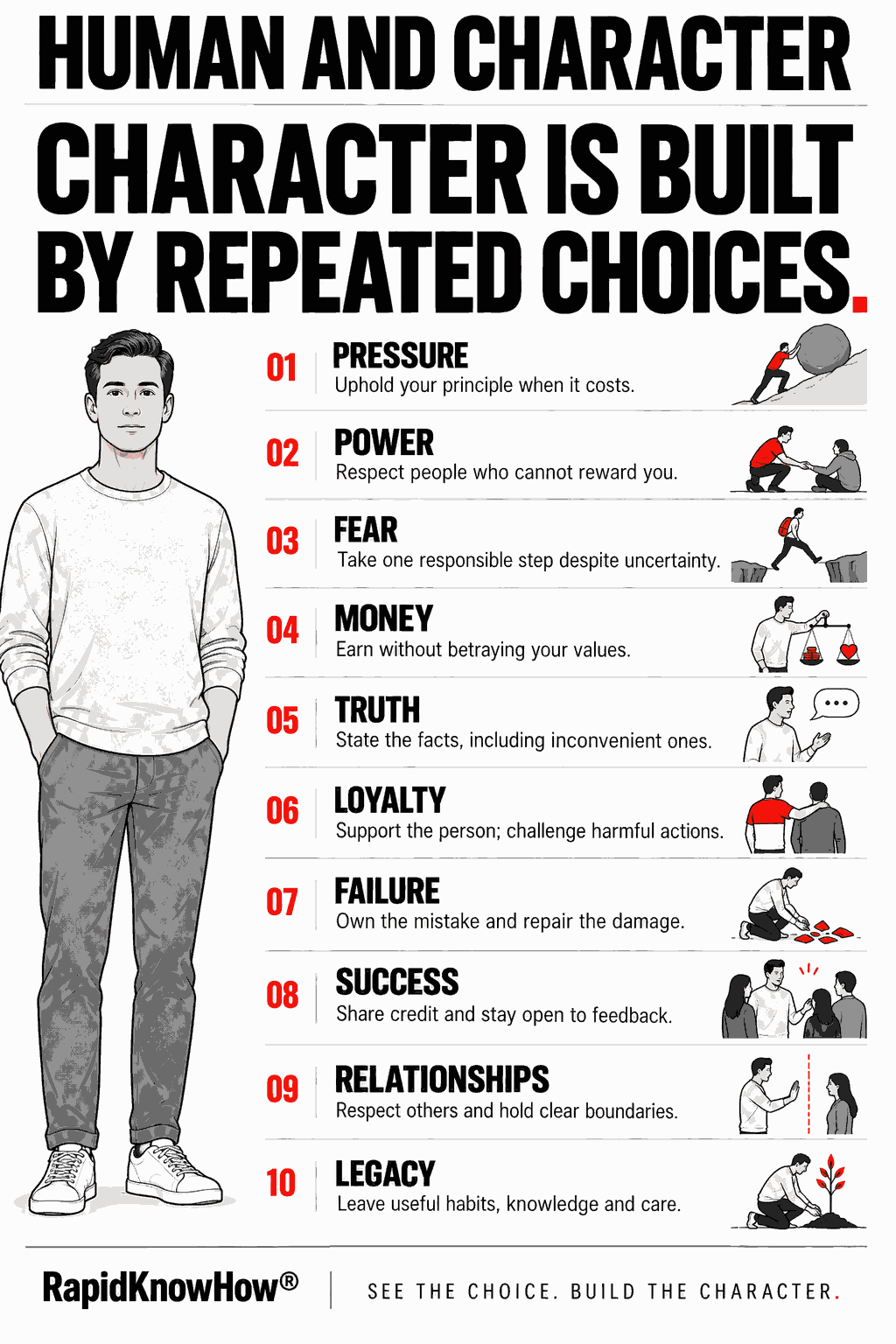
RapidKnowHow® HUMAN AND CHARACTER | Episode 09 of 10
Communicate respectfully, state your limits clearly and follow through on what you control.
The central question
Can we respect others while holding firm boundaries?
This PowerPost offers a practical reflection on behaviour and choices. The story below is illustrative, not a report of a real person or event.
1. SITUATION — See the human dilemma
A colleague repeatedly sends urgent work late at night and expects an immediate response. You want to be helpful, but the pattern is disrupting your rest and the quality of your work.
2. CHOICE — Make the decision visible
Silently comply and build resentment, respond with hostility, or agree a clear availability boundary and an urgent-contact process.
3. ACTION — Build character step by step
- Describe the pattern and its effect without guessing the other person’s motives.
- State your boundary in practical terms: availability, acceptable behaviour or what you can commit to.
- Offer a workable alternative and listen to the other person’s constraints. Negotiate where possible without abandoning essential limits.
- Follow through consistently. If the pattern continues, adjust your participation or seek appropriate support.
4. CONSEQUENCE — Check the result
Both people know what to expect and what needs a different arrangement. A boundary governs your participation; it does not guarantee that someone else will change.
5. LESSON — Preserve what you learn
Respect and boundaries can coexist. Clear limits reduce the need for repeated guessing and hidden resentment.
Measurable value delivered
Review whether the agreement is observed, disruptions decline and unresolved concerns are discussed. Evaluate the pattern rather than one difficult conversation.
ONE decision today
Write one calm boundary: ‘I can ____. I am not available for ____. For urgent situations, we can ____.’
ACTION CHECKLIST
- Name the situation and the people affected.
- Separate facts, assumptions and unknowns.
- Choose a principle and one concrete action.
- Set a completion date and a review point.
- Check the consequence, repair harm and adjust.
PASS: One responsible action completed and its consequence reviewed. FAIL: A stated intention with no action or review. At the first review, remove the one obstacle before adding more steps.
Character is shaped by temperament, experience, habits and circumstances. One action provides a signal; repeated choices provide stronger evidence. Assess behaviour carefully before labelling a person.
RapidKnowHow® — Understand the human. See the choice. Build the character.
Take the next step — RapidThrive™ PowerBook
All ten episodes in one 28-page PDF, including the PowerPicture, decision worksheet and ten-day plan. Reader edition: €19.
POWERLICENSE — Apply beyond one reader
For organisational or partner use, explore the existing RapidKnowHow® licensing options and request a License Partner Fit Check. Scope, rights and fees are agreed separately.
Separate licensing enquiry. The PowerBook purchase does not automatically grant broader licensing rights.