Applying the Two-Sided Supplier–Customer Business Model
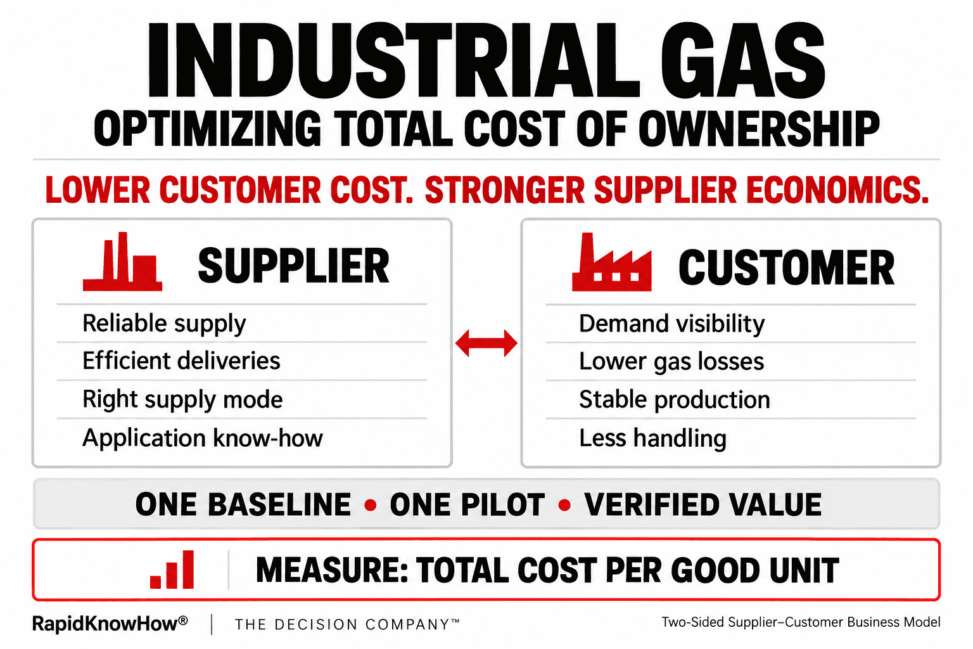
LOWER CUSTOMER COST. STRONGER SUPPLIER ECONOMICS.
The gas invoice is only one part of the customer’s total cost. Deliveries, storage, handling, energy, maintenance, gas losses and production interruptions also affect the economics.
The RapidKnowHow® Two-Sided Supplier–Customer Business Model connects the decisions on both sides around ONE shared objective:
Reduce total gas-related cost per good unit produced while maintaining safety, quality and supply reliability.
1. See the whole cost
Build the customer baseline from:
Gas purchases + delivery charges + equipment costs + energy + handling + maintenance + gas-related production losses.
Count each cost once. Include gas losses through the purchased gas bill rather than adding their purchase value again. Separate recurring operating costs from investment requirements.
Then divide the relevant period cost by good production output. This reveals whether an improvement actually makes production more economical.
2. Connect the two sides
| Improvement lever | Supplier contribution | Customer contribution |
|---|---|---|
| Demand planning | Plan supply and deliveries | Share production schedules and demand changes |
| Replenishment | Monitor stock and optimize delivery timing | Provide access and agree operating stock limits |
| Gas consumption | Provide application expertise | Measure use, repair leaks and improve operating practices |
| Supply mode | Compare cylinders, bulk and on-site options | Confirm volume, purity, pressure and reliability needs |
| Performance | Report service and delivery results | Report output, quality and gas-related downtime |
These capabilities already exist in the industry. Linde describes automatic replenishment, inventory monitoring and gas management services; Air Liquide describes connected customer storage and delivery planning. The RapidKnowHow model brings them into one joint commercial decision.
3. Make the incentives work
Reducing customer consumption can reduce supplier gas revenue. The agreement must therefore reward the supplier for delivering measurable value.
A practical structure combines:
- A gas supply agreement with clear service obligations.
- A defined fee for monitoring, maintenance or application support.
- An optional share of independently verified savings.
Agree the baseline, measurement method, responsibilities and savings allocation before starting. Adjust comparisons for production volume, product mix and energy-price changes.
Customer savings must remain positive after all additional fees. Supplier gains must remain positive after service costs and any lost contribution from lower gas sales.
4. Test the economics
Illustrative assumptions only — not verified customer results.
Assume unchanged annual production of 100,000 good units.
| Annual customer cost | Before | After |
|---|---|---|
| Gas and delivery | €200,000 | €190,000 |
| Equipment, energy, handling and maintenance | €60,000 | €50,000 |
| Gas-related downtime and quality losses | €40,000 | €20,000 |
| Additional optimization service fee | €0 | €10,000 |
| Total annual cost | €300,000 | €270,000 |
| Cost per good unit | €3.00 | €2.70 |
Customer result: €30,000 annual net savings, or 10%.
For the supplier, assume €12,000 lower operating costs, €10,000 additional service revenue, €6,000 service delivery costs and €4,000 lost gas contribution.
Supplier result: €12,000 annual incremental contribution.
This is a contribution example, not a free-cash-flow forecast. Investment, working capital, tax and implementation timing require separate assessment.
5. Apply the 30-day decision process
ONE SIGNAL
Gas-related cost per good unit is rising, or recurring supply and handling problems consume operating time.
ONE DECISION
Select ONE customer site and ONE gas application for a joint TCO pilot.
WHY NOW
A shared baseline makes the largest avoidable cost visible before either party commits to a larger investment.
TOP 3 ACTIONS
- Days 1–7: Establish the cost baseline and agree safety, quality and reliability requirements.
- Days 8–21: Test the highest-value feasible improvement, such as replenishment timing, leak reduction or cylinder handling.
- Days 22–30: Verify the measured change, calculate both parties’ economics and decide whether to scale.
ONE MEASURABLE RESULT
A jointly signed before-and-after cost per good unit, including implementation costs and service fees.
Thirty days can validate a pilot direction. Annual savings remain estimates until supported by representative operating data.
CONFIDENCE
High in the decision method. Site-specific savings remain unverified until measured.
Start with ONE application
Bring your supplier and production team together. Identify the largest avoidable gas-related cost. Agree ONE pilot and prove the value before expanding.
RapidKnowHow® — THE DECISION COMPANY™
Joint decisions → Verified savings → Repeatable value → Compounding growth