
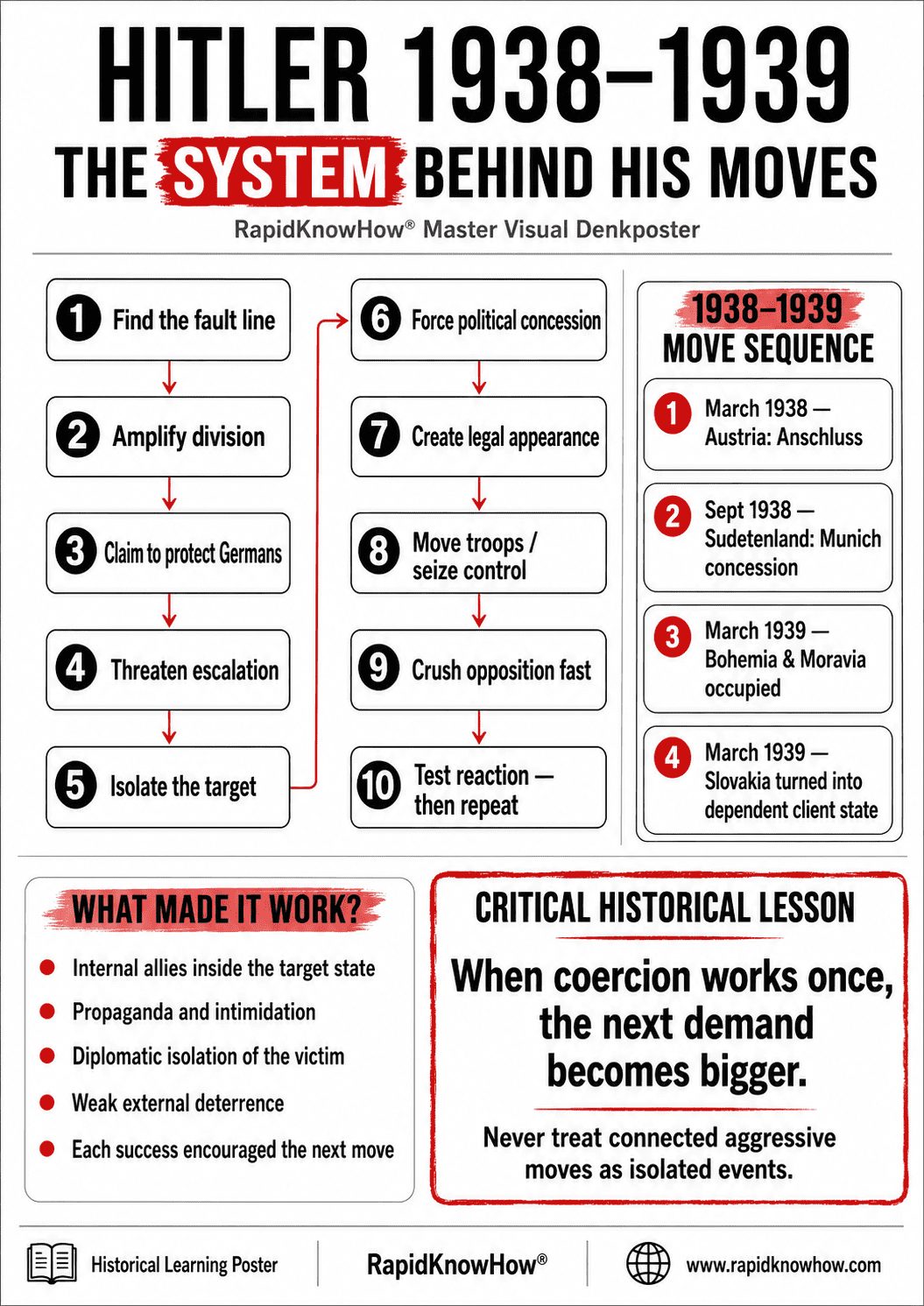
Austria → Sudetenland → Destruction of Czechoslovakia, 1938–1939
Critical Historical Analysis
Core conclusion: Hitler did not conquer Central Europe in one sudden move. He advanced through a repeatable sequence of internal destabilization, propaganda, minority claims, political pressure, military threats, diplomatic concessions, manufactured legality, and finally direct force. Each success reduced the risk of the next move.
Bohemia and Moravia were directly occupied by Nazi Germany in March 1939. Slovakia was not annexed at that moment. Under intense German pressure, Slovakia declared independence on 14 March 1939 and became a highly dependent, authoritarian German client state under Jozef Tiso. Direct German military occupation of Slovakia followed only after the Slovak National Uprising in August 1944.
1. The system started before Austria
The decisive background was not March 1938 alone.
Hitler had already discovered that repeated breaches of the European order could succeed without triggering decisive resistance:
Rearmament → Rhineland remilitarization → Austria → Sudetenland → Prague → Poland.
Britain and France tolerated several earlier treaty violations. By 1938 Hitler had increasing reason to believe that threatening escalation could produce political concessions without major military cost.
The historical danger was therefore compounding success.
Every unopposed move changed the calculation for the next one.
CASE 1 — AUSTRIA
March 1938: The Anschluss
On 11 March 1938 Chancellor Kurt Schuschnigg resigned after extreme German pressure. Austrian Nazis rapidly took control. German troops crossed into Austria on 12 March; Austria was formally incorporated into Nazi Germany on 13 March.
But describing Austria simply as an innocent country invaded by an entirely external enemy would also distort the historical record.
What made Austria vulnerable?
There were several reinforcing weaknesses.
First: Austrian democracy had already been destroyed.
The Dollfuss-Schuschnigg authoritarian system had suppressed parliamentary democracy and much of the political opposition. The Documentation Centre of Austrian Resistance notes that this authoritarian state failed to rebuild a broad democratic coalition capable of resisting National Socialism.
Second: there was an Austrian Nazi movement inside Austria.
The takeover therefore operated simultaneously:
- through German military pressure,
- through Austrian Nazis already positioned inside society and institutions,
- and through mass mobilization in the streets.
The DÖW describes the Anschluss as essentially a three-level seizure of power involving foreign military threat, indigenous Nazis and sympathizers, and street-level mobilization.
Third: propaganda and coercion reinforced one another.
There was substantial genuine enthusiasm for Hitler among many Austrians. That fact cannot responsibly be erased.
But the later 99% referendum was not a free democratic referendum. Terror, intimidation, propaganda and exclusion shaped the result, and roughly 300,000–400,000 people—particularly Jews, Roma and politically suspect citizens—were excluded from voting.
So two facts must be held together:
Austria was subjected to German aggression.
Many Austrians also actively supported, implemented and benefited from National Socialism.
That distinction is fundamental to serious historical analysis. Austrian Nazis and other Austrians participated in persecution almost immediately after the annexation.
CASE 2 — SUDETENLAND
September–October 1938: Coercion disguised as settlement
Hitler’s next target was Czechoslovakia.
The Sudetenland contained a large ethnic-German population. Nazi Germany increasingly presented their situation as an intolerable national injustice and threatened war unless the territory was transferred.
USHMM describes the crisis as one the Nazi regime deliberately helped manufacture in order to obtain the territory.
This was strategically important because the Sudeten border regions contained major elements of Czechoslovakia’s defensive system.
Munich, 29–30 September 1938
Germany, Italy, Britain and France negotiated the Munich Agreement.
Czechoslovakia itself was not a participant in the negotiations deciding the loss of its own territory.
Britain and France accepted German annexation of the Sudetenland in return for Hitler’s commitment not to make further territorial claims against Czechoslovakia.
That produced an immediate peace.
But strategically it produced something much more dangerous:
The threatened state surrendered territory and defenses while the threatening state grew stronger.
CASE 3 — BOHEMIA AND MORAVIA
March 1939: The promise is broken
Only about five and a half months after Munich, the logic changed completely.
There was no longer a credible argument that Hitler was merely seeking to incorporate German-speaking populations.
Under escalating German pressure, Slovakia declared independence on 14 March.
President Emil Hácha went to Berlin. Contemporary American diplomatic reporting describes Hitler informing him that German forces would occupy Bohemia and Moravia and warning of brutal consequences if resistance occurred. German forces entered the Czech lands on 15 March.
Bohemia and Moravia became a German-controlled Protectorate.
Czechoslovakia disappeared as an independent state.
This was the decisive destruction of the Munich assumption.
Hitler had promised:
Sudetenland is the final territorial demand.
Hitler demonstrated:
The concession had been one stage in a larger expansion strategy.
CASE 4 — SLOVAKIA
Control without immediate annexation
Slovakia illustrates another important method.
Nazi Germany did not always need to annex a territory to control it.
The Tiso regime established an authoritarian one-party state closely aligned with Nazi Germany. Germany thereby acquired substantial strategic influence while avoiding immediate formal occupation.
When Slovak resistance later threatened that system in August 1944, German forces invaded and directly occupied Slovakia.
This demonstrates an important distinction:
Formal sovereignty does not necessarily equal strategic independence.
THE NAZI EXPANSION SYSTEM
Seen together, Austria and Czechoslovakia reveal a remarkably consistent process.
1. Identify an internal division
German nationalism in Austria.
Sudeten German grievances in Czechoslovakia.
Slovak separatism.
2. Intensify the division
Political organizations, propaganda and sympathetic local actors amplify dissatisfaction.
3. Reframe expansion as protection
The aggressor claims not to be expanding but to be:
protecting Germans, restoring justice, correcting borders or preserving order.
4. Threaten a much larger cost
The choice presented becomes:
Give us the limited concession — or risk war.
5. Isolate the target
Austria found itself largely alone.
At Munich, Czechoslovakia’s future was negotiated principally by other powers.
6. Obtain apparent legality
Treaties, proclamations, invitations, plebiscites and declarations created a formal appearance of consent.
But legal form under coercion is not the same as freely given legitimacy.
7. Consolidate immediately
Police, administration, media, courts and armed forces were rapidly brought under Nazi control.
8. Persecute opponents
Jews, political opponents and other persecuted groups experienced the consequences immediately. Following the Anschluss, anti-Jewish violence spread rapidly across Austria.
9. Test international reaction
If the external cost remained low, the next demand could be larger.
10. Repeat
Austria → Sudetenland → Prague → Poland.
Why did Britain and France allow Munich?
It is too simple to explain Munich purely as cowardice.
The memory of the First World War was extraordinarily powerful. Britain and France also questioned parts of the Versailles settlement, and neither government believed itself ideally prepared for a major European war in 1938.
Chamberlain genuinely sought to prevent another catastrophic European conflict.
That explains appeasement.
It does not remove its strategic consequences.
The crucial mistake was assuming that Hitler’s demands were limited and negotiable territorial objectives, when his behavior increasingly demonstrated a broader expansionist programme.
The occupation of Prague in March 1939 finally destroyed much of that assumption. Britain and France subsequently guaranteed Poland.
Therefore the fair historical judgment is:
Appeasement was understandable as a peace strategy.
Munich was disastrous as a deterrence strategy.
Imperial War Museums describes Czechoslovakia as being fatally weakened by the territorial surrender while Hitler’s confidence increased.
What Hitler learned
This may be the most important part.
After Austria:
Pressure works.
After Munich:
Threatening war works even better.
After Prague:
Agreements can be broken after the opponent has been weakened.
The European powers were effectively teaching Hitler about their own tolerance for risk.
He was learning from their reactions as much as they were learning from his actions.
What Britain and France learned — too late
March 1939 changed the strategic interpretation.
Sudetenland could at least be presented as ethnic revisionism.
Prague could not.
Once German forces occupied overwhelmingly Czech Bohemia and Moravia, Hitler’s expansion could no longer plausibly be explained simply as national self-determination for ethnic Germans.
The fundamental problem had become unmistakable:
The objective was expanding power, not merely correcting borders.
Austria’s particularly important lesson
Austria presents a more uncomfortable historical lesson than a simple aggressor-victim story.
After 1945 Austria often emphasized the 1943 Moscow Declaration’s description of Austria as the first free country to fall victim to Hitlerite aggression.
But the same declaration also explicitly referred to Austria’s responsibility for participating in the war alongside Nazi Germany. That second part was often minimized in the post-war Austrian “victim thesis.”
A historically mature Austrian position therefore requires holding three truths simultaneously:
Austria lost its sovereignty through Nazi German aggression.
Austrians existed who resisted National Socialism and paid an enormous price.
A significant number of Austrians supported and participated in the Nazi regime and its crimes.
DÖW research explicitly emphasizes both Austrian participation and Austrian resistance.
10 LEARNING-FROM-HISTORY RULES
| # | Historical Signal | Strategic Lesson |
|---|---|---|
| 1 | Treaty violations go unanswered | Small breaches prepare larger ones. |
| 2 | Domestic polarization grows | Internal division can become external leverage. |
| 3 | Propaganda reframes aggression | Judge actions, not slogans. |
| 4 | Minorities become geopolitical instruments | Protect minorities without surrendering state sovereignty. |
| 5 | Military threat produces concessions | Rewarding coercion can increase future coercion. |
| 6 | The threatened state is excluded | Never negotiate a sovereign state’s future without it. |
| 7 | Concessions weaken defenses | Peace purchased by destroying deterrence may be temporary. |
| 8 | Agreements lack enforcement | Promises require verification and consequences. |
| 9 | Each success changes expectations | Aggression compounds when it works. |
| 10 | Warning signals are rationalized away | Act on demonstrated behaviour before the final crisis. |
RapidKnowHow® Critical Historical Conclusion
The deepest lesson of Austria → Sudetenland → Bohemia and Moravia is not simply:
“Appeasement causes war.”
That is too crude.
The stronger conclusion is:
COERCION TESTED → RESISTANCE WEAK → CONCESSION WON → TARGET WEAKENED → PROMISE BROKEN → NEXT DEMAND LARGER
And therefore:
DETECT THE PATTERN BEFORE THE FINAL MOVE.
The decisive failure of 1938 was not merely failing to predict September 1939.
It was repeatedly treating connected moves as isolated events.
Once the events are viewed as a system, the historical pattern becomes much clearer:
Austria was the proof.
Sudetenland was the strategic breakthrough.
Prague exposed the real objective.
Poland triggered the war.
That is, in my assessment, the central strategic lesson worth preserving from 1938–1939.