
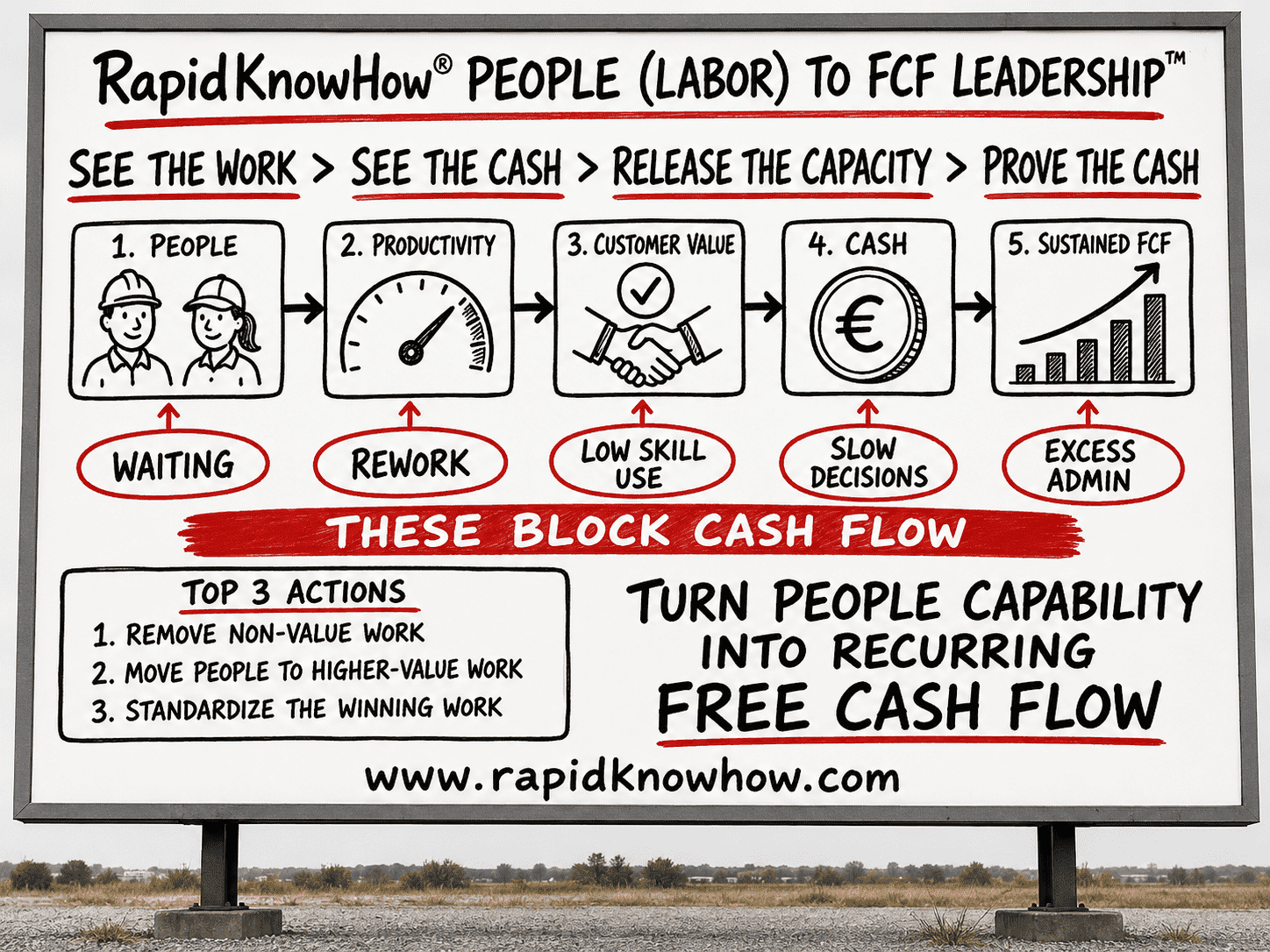
Applying the RapidKnowHow® CASH ENGINE™
CAPABILITY → PRODUCTIVITY → CUSTOMER VALUE → CASH → SUSTAINED FCF
The decisive leadership question is:
HOW DO WE HELP PEOPLE CREATE MORE CUSTOMER VALUE PER PAID HOUR — WITHOUT TURNING PRODUCTIVITY INTO SIMPLE HEADCOUNT CUTTING?
People are not inventory or machines. The FCF opportunity comes from better systems, clearer decisions, stronger skills, less waiting, less rework, and higher-value work.
1. SEE THE LABOR CASH™
Map where paid time goes:
Customer Value Work
Production / Service
Waiting
Meetings
Administration
Rework
Searching for Information
Manual Data Entry
Coordination
Problem Solving
Innovation
Then ask:
HOW MUCH PAID TIME ACTUALLY CREATES CUSTOMER VALUE?
Strategic Chokepoints
WAITING = PAID TIME WITHOUT VALUE
REWORK = PAYING TWICE FOR ONE RESULT
POOR DECISIONS = LABOR MULTIPLIED BY DELAY
LOW SKILL UTILIZATION = EXPENSIVE KNOW-HOW USED FOR CHEAP WORK
UNNECESSARY ADMINISTRATION = CASH CONSUMED WITHOUT CUSTOMER VALUE
2. SEE THE CASH™
The wrong question is:
“How many people can we remove?”
The better question is:
“HOW MUCH MORE VALUE CAN THE SAME PEOPLE CREATE?”
Measure:
Revenue / Employee
Contribution / Employee
FCF / Employee
Value-Adding Hours %
Output / Paid Hour
Rework Hours
Absence / Downtime
Decision Time
Training-to-Result Conversion
3. WIN THE CASH™
ACTION 1 — REMOVE NON-VALUE WORK
Apply Ohno logic.
Remove:
Waiting
Duplicated reporting
Repeated approvals
Manual transfers
Unnecessary meetings
Rework
Searching
Poor scheduling
Result
Same people.
More productive capacity.
LABOR PRODUCTIVITY ↑ → COST / UNIT ↓
ACTION 2 — MOVE PEOPLE TO HIGHER-VALUE WORK
Example:
A skilled engineer spends:
30% engineering
70% administration + coordination
AI, standard workflows, and clearer decision rights reduce administrative work.
New mix:
60% engineering
40% administration
No headcount reduction is required.
The organization gains much more engineering capacity from the same payroll.
CAPACITY RELEASED = CASH OPPORTUNITY
ACTION 3 — STANDARDIZE THE WINNING WORK
Convert expert knowledge into:
Decision Rules
→ Standard Work
→ Checklists
→ Digital Tools
→ AI Support
→ Training
→ Scorecards
Now productivity does not depend on one exceptional employee.
It becomes organizational capability.
4. PROVE THE CASH™
Every people-productivity initiative needs a bridge from time to money.
TIME RELEASED
Hours removed from waste
↓
CAPACITY CREATED
More productive hours available
↓
BUSINESS RESULT
**More output
- faster delivery
- higher quality
- more customer work**
↓
CASH RESULT
Revenue ↑
Cost / Unit ↓
Overtime ↓
External Spend ↓
Working Capital ↓
FCF ↑
Illustrative Industrial Case
Assume:
1,000 employees
Average total labor cost:
€70,000 / employee/year
Total labor cost:
€70 MILLION
Suppose analysis shows:
15% of paid time is structurally lost through waiting, rework, unnecessary reporting, poor scheduling, and duplicated administration.
Equivalent labor capacity:
€10.5m
Do not assume €10.5m automatically becomes cash.
Suppose management can economically convert only 30% of that capacity into:
- lower overtime
- fewer contractors
- more production
- faster projects
- additional profitable sales
Value:
€3.15 MILLION ANNUAL ECONOMIC VALUE
This is an illustrative scenario, not verified company data.
5. PEOPLE → FCF CASH BRIDGE™
CASH GENERATED
**Higher Output
- More Sales Capacity
- Faster Product Development**
CASH SAVED
Overtime ↓
Rework ↓
Contractors ↓
Administration ↓
CASH PROTECTED
Turnover ↓
Quality Failures ↓
Delayed Projects ↓
CASH COMPOUNDED
Better Skills
→ Better Standard Work
→ Higher Productivity
→ Higher FCF every year
6. THE AI OPPORTUNITY
AI should not start with:
“HOW MANY JOBS CAN WE REMOVE?”
Start with:
“WHICH LOW-VALUE TASKS CAN AI REMOVE SO PEOPLE CAN DO HIGHER-VALUE WORK?”
Example:
Manual Reporting
→ AI Preparation
→ Manager Reviews Exception
→ Faster Decision
Result:
Administration ↓
Decision Time ↓
Management Capacity ↑
The cash appears only when released capacity is deliberately redirected.
7. PEOPLE-TO-FCF LEADERSHIP SCOREBOARD™
| KPI | Direction |
|---|---|
| FCF / Employee | ↑ |
| Revenue / Employee | ↑ |
| Value-Adding Time | ↑ |
| Output / Paid Hour | ↑ |
| Rework Hours | ↓ |
| Waiting Time | ↓ |
| Decision Time | ↓ |
| Overtime | ↓ |
| External Labor Cost | ↓ |
| Quality | ↑ |
| Employee Capability | ↑ |
8. THE STRATEGIC SHIFT
OLD MODEL
Cost pressure
→ Headcount reduction
→ Work remains
→ Remaining people overloaded
→ Quality / service deteriorates
→ Cost returns
RapidKnowHow® MODEL
See Work
→ Remove Waste
→ Simplify Decisions
→ Automate Low-Value Tasks
→ Raise Skills
→ Release Capacity
→ Move Capacity to Customer Value
→
SUSTAINED FCF ↑
9. The Four Masters Applied
GUSTAF DALÉN
Design the work system better.
STEVE JOBS
Remove unnecessary complexity from the employee experience.
TAIICHI OHNO
Remove waiting, rework, excess movement, and poor flow.
WALT DISNEY
Turn expert know-how into systems that many people can use repeatedly.
10. RapidKnowHow® PEOPLE-TO-FCF MASTER FORMULA™
PEOPLE
→ CAPABILITY
→ FOCUS
→ VALUE-ADDING WORK
→ PRODUCTIVITY
→ CUSTOMER VALUE
→ MARGIN
→ CASH
→ FCF
→ REINVEST IN PEOPLE + SYSTEMS
→
SUSTAINED COMPOUNDING FCF™
ONE Leadership Rule
DON’T START BY CUTTING PEOPLE.
START BY CUTTING THE WORK THAT PREVENTS PEOPLE FROM CREATING VALUE.
Leave a Reply