
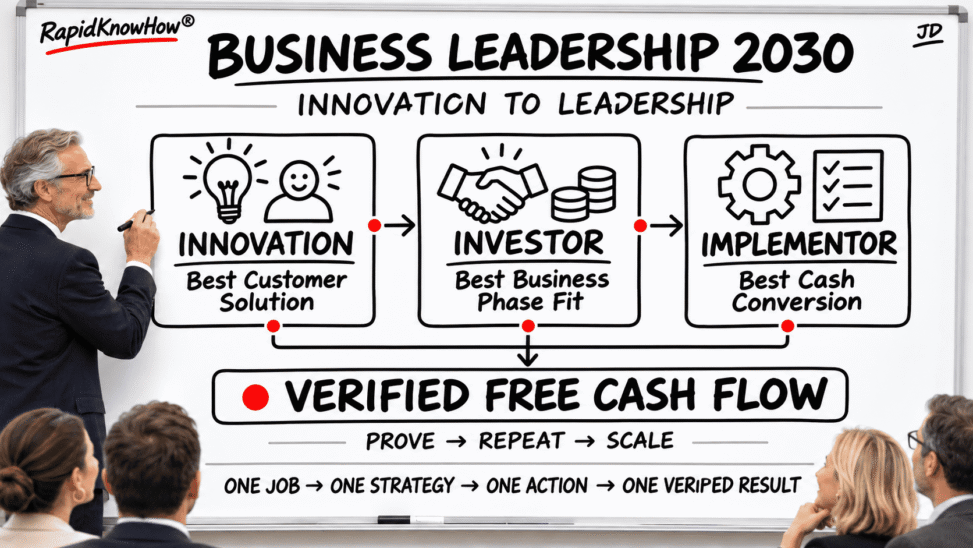
The strongest leadership model connects three decisions: which customer problem to solve, which capital partner fits the business phase, and which implementor can turn customer value into verified cash.
Innovation creates the opportunity. Investment funds the journey. Implementation determines whether the opportunity produces a sustainable business.
For RapidKnowHow®, these decisions belong within the approved journey:
Innovation → Business Model → Investor Match → Commercialization → Verified Free Cashflow → Scale.
The recommendations below are a strategic synthesis. The documented PUBLIC cases illustrate relevant practices; they do not establish one universally superior model.
1. Innovation to Leadership — Find the best Innovation Leadership Model
The leading question is:
“Which innovation solves an important customer problem with a business model that can produce attractive cash returns?”
Start by identifying the buyer, the problem and its economic consequences. Then select the innovation approach.
| Customer situation | Best-fit innovation model | Evidence required before expansion |
|---|---|---|
| A known process wastes money, time or capacity | Customer-led process innovation | Measured improvement at one customer site |
| Demand and willingness to pay remain uncertain | Experiment-led business model innovation | Paid commitment and credible delivery economics |
| A technical breakthrough requires substantial development | Technical development with milestone gates | Technical validation, customer relevance and a credible funding path |
| Value depends on several organizations working together | Ecosystem innovation | Agreed roles, interfaces, incentives and value sharing |
Recommended starting model for industrial SMEs: customer-led innovation, tested through one paid pilot.
It brings the buyer’s economic problem into the decision early. Technical breakthroughs and ecosystem solutions remain appropriate where the problem requires them.
The innovation leader must establish:
- ONE customer: Who experiences the problem and who authorizes payment?
- ONE baseline: What does the current situation cost?
- ONE differentiated solution: Why should the customer change?
- ONE commercial test: Will the customer pay under workable terms?
- ONE scaling condition: Can the result be repeated economically?
Documented PUBLIC case — Amazon. Amazon’s shareholder letters describe starting with customers and working backwards, alongside disciplined investment in differentiated opportunities and patience for emerging businesses. This supports combining customer relevance with capital discipline. It does not establish an isolated FCF contribution from the innovation method. sec.gov
RapidKnowHow® application: Before building the complete solution, write one clear customer offer:
“We will improve this specific outcome, against this agreed baseline, within this period, for this price.”
🔴 Intervention point: A promising innovation lacks paying demand.
🔴 Leverage point: Obtain one paid customer commitment with agreed success criteria.
2. Investor to Leadership — Find the best Investor for the Business Phase
The leading question is:
“Which investor can fund the next value-creating milestone on terms the business can sustain?”
The best match combines capital, relevant capabilities, time horizon and compatible governance.
The following are starting matches for evaluation, rather than automatic financing choices.
| Business phase | Main uncertainty | Investor or funding model to evaluate first | Milestone to fund |
|---|---|---|---|
| Discovery | Does the problem justify a business? | Founder funding, grants, experienced angels | Validated problem and feasible solution |
| Validation | Will customers pay? | Customer-funded pilot, seed investor, strategic partner | Paid proof and credible unit economics |
| Commercialization | Can the business deliver repeatedly? | Strategic investor or venture capital where growth economics fit | Repeat customers and reliable delivery |
| Expansion | Can profitable growth be financed? | Growth equity; debt or leasing where repayment capacity supports it | Capacity, market access and working capital |
| Established leadership | Can advantage and returns endure? | Retained cash, suitable long-term owners and disciplined financing | Resilience, reinvestment and sustained FCF |
Recommended principle: finance the next evidence milestone, with sufficient runway to reach it.
A capital-intensive industrial project may also require financing commitments covering construction and commissioning. Small funding stages should never create an avoidable funding gap.
Documented PUBLIC case — BioNTech and Pfizer. Their April 2020 collaboration combined $185 million upfront—including $113 million in equity—with Pfizer’s clinical, regulatory, manufacturing and distribution capabilities. Potential milestone payments were conditional. The case illustrates capital combined with capabilities needed for development and commercialization. biontech.com
RapidKnowHow® application: Evaluate each investor against five questions:
- Can they fund the required milestone?
- Can they help remove the principal business constraint?
- Does their investment horizon match the development cycle?
- Are control rights and economic terms workable?
- Can the partnership support the next phase?
Equity proceeds and borrowing are financing inflows. Record them separately from operating FCF.
🔴 Intervention point: Funding is available, but its conditions conflict with the business journey.
🔴 Leverage point: Match capital, capabilities and governance to the next milestone.
3. Implementor to Leadership — Find the best Implementor for Free Cashflow Conversion
The leading question is:
“Who has the authority, skills and incentives to turn the promised improvement into collected cash?”
Select the implementor according to the constraint between the solution and the cash result.
| Constraint | Best-fit implementation lead | Proof of performance |
|---|---|---|
| Technical reliability | Engineering and operations lead | Reliable operation and customer acceptance |
| Customer adoption | Commercial lead working with the customer | Paid use, repeat orders and retention |
| Inventory or receivables | Operations and finance lead | Verified release of working capital |
| Capital-intensive delivery | Project leader with finance oversight | Commissioning, controlled expenditure and operating cash |
| Repeated deployment | Process owner with trained delivery partners | Consistent results across customers or sites |
Recommended implementation model: ONE accountable result owner, supported by the necessary functions and finance verification.
That owner needs authority to resolve obstacles. Finance validates the cash result. Customer representatives confirm that the improvement preserves the required service, quality and safety.
Documented PUBLIC case — Danaher. Danaher describes its Business System as a continuous improvement system and culture. Its 2025 annual report records $6.416 billion operating cash flow and $5.293 billion FCF under its stated definition. These figures demonstrate reported cash generation; they do not isolate the causal contribution of the operating system or AI. Danaher
RapidKnowHow® application: Review implementation through a weekly cash bridge:
Customer outcome → Operational change → Financial effect → Cash movement → Verified result.
🔴 Intervention point: The solution works operationally, but the financial benefit remains unverified.
🔴 Leverage point: Connect the operating evidence to actual payments, collections, working capital and investment.
4. Connect the three models through ONE cash test
Consider an illustrative industrial gas customer pilot, with assumed figures:
| Cash effect during the 90-day pilot | Amount |
|---|---|
| Rental payments avoided after confirmed cylinder returns | +€12,000 |
| Inventory reduction converted into cash | +€18,000 |
| Implementation payments | −€8,000 |
| Equipment investment | −€5,000 |
| Illustrative incremental FCF before tax effects | +€17,000 |
The €18,000 inventory release is a one-time benefit. Future recurring benefits require separate measurement. Any tax effects, additional operating costs or service consequences must enter the final calculation.
The three leadership decisions now become concrete:
- Innovation leader: Develops a better cylinder return and replenishment process around the customer’s problem.
- Investor: Funds the limited implementation requirement on suitable terms.
- Implementor: Executes returns, changes replenishment and verifies the cash movements with finance.
A successful pilot establishes evidence for this application. Scaling requires proof that the economics remain attractive elsewhere.
5. Business Leadership 2030 — ONE integrated decision system
For this report, leadership means repeatable customer preference supported by durable cash generation and disciplined reinvestment.
AI can assist by comparing innovation options, finding documented PUBLIC cases, identifying investor candidates, analyzing operating data and flagging deviations. Named leaders remain accountable for decisions and verified results. Any claimed AI contribution needs its own baseline and measurement.
The practical sequence is:
ONE customer problem → ONE innovation model → ONE business model → ONE investor match → ONE accountable implementor → ONE verified FCF result → Repeat and scale.
ONE prioritized action: Select one industrial customer problem and prepare a 90-day paid pilot decision record containing the baseline, customer commitment, funding requirement, accountable implementor and finance-approved verification method. – Josef David
RapidKnowHow® MASTER Principle
ONE JOB → ONE STRATEGY → ONE ACTION → ONE VERIFIED RESULT.
SEE EARLIER • DECIDE BETTER • ACT FASTER.