AI-Orchestrated Decisions for Boards, CxOs and Investors
Industrial Gas companies are operating in a new value environment.
Energy cost volatility, asset intensity, pricing pressure, customer TCO demands, decarbonization, logistics complexity, working capital pressure and regional market shifts are no longer separate management issues.
They are connected value signals.
The winners will not only be the companies with the largest assets.
The winners will be the companies that can sense earlier, prioritize faster, execute smarter and scale proven value systems better.
That is the purpose of the RapidKnowHow INDUSTRIAL GAS Command Center MASTER™.
The Board-Level Problem
Most Industrial Gas organizations still manage value in functional silos:
Production optimizes plants.
Sales manages accounts.
Logistics controls deliveries.
Finance reviews numbers.
Strategy studies markets.
Sustainability prepares reports.
Digital teams build tools.
But board-level value is created when these elements are orchestrated into one decision and action system.
The critical questions are:
Where is value leaking today?
Which market signals matter most?
Which customer problems create pricing power?
Which assets are underused or overloaded?
Where is cash trapped?
Which actions improve FCF and ROICE fastest?
Which proof cases can be scaled into market value?
The Command Center answers these questions in one integrated system.
The Strategic Shift
From Functional Optimization
to
AI-Orchestrated Value Creation
Traditional Industrial Gas management asks:
“How do we improve each function?”
The RapidKnowHow Command Center asks:
“How do we orchestrate the whole value system to increase FCF, ROICE and market value?”
This shift changes the leadership game.
It moves the organization from reporting the past to shaping the future.
What the Command Center Does
The RapidKnowHow INDUSTRIAL GAS Command Center MASTER™ helps Boards, CxOs and Investors convert complexity into decision clarity.
It integrates five critical management layers:
1. Signal Radar
Detects market, customer, cost, competitor, regulatory and technology signals.
2. Insight Engine
Turns signals into structured board-level interpretation.
3. Decision Board
Prioritizes opportunities by strategic relevance, FCF impact, ROICE impact, risk and execution speed.
4. Action Sprint System
Converts priorities into 30 / 60 / 90-day implementation sprints.
5. Scaling Engine
Turns proven value cases into repeatable management systems, license models and market-value assets.
The AI-Orchestrator Role
The AI-Orchestrator is not a chatbot.
It is a leadership operating system.
Its role is to help leaders:
Sense
See earlier what is changing in markets, customers, costs, assets, regulation and competitors.
Prioritize
Rank what matters most using value, risk, timing and financial impact.
Execute
Turn selected priorities into measurable action sprints.
Scale
Convert proven actions into repeatable systems, board routines and growth assets.
The result is not more information.
The result is better decision quality, faster execution and measurable value creation.
Why This Matters to Boards
Boards need more than dashboards.
They need a disciplined way to connect external signals with internal value levers.
The Command Center helps boards ask sharper questions:
Which value levers are driving FCF?
Which actions improve ROICE?
Which market risks threaten future cash flow?
Which growth moves deserve capital?
Which management actions should be stopped, accelerated or scaled?
For Boards, the Command Center becomes a strategic oversight and value-governance system.
Why This Matters to CxOs
CxOs need speed, alignment and execution discipline.
The Command Center helps leadership teams move from scattered initiatives to focused value creation.
It supports:
Better strategic prioritization.
Clearer investment choices.
Faster operational execution.
Higher accountability.
Stronger cross-functional alignment.
Measurable FCF and ROICE improvement.
For CxOs, the Command Center becomes a decision-to-action execution system.
Why This Matters to Investors
Investors look for sustained cash-flow growth, capital discipline, pricing power, resilience and scalability.
The Command Center helps translate strategy into investor-relevant value signals:
FCF improvement.
ROICE improvement.
Asset productivity.
Margin protection.
Working capital release.
Scalable service revenue.
Strategic optionality.
For Investors, the Command Center becomes a market value acceleration system.
Priority Industrial Gas Value Levers
The Command Center focuses on seven value levers:
1. Pricing Power
Identify where value is underpriced and where customer dependency, urgency and service intensity justify stronger pricing.
2. Asset Utilization
Improve the productivity of plants, tanks, cylinders, fleet, depots and logistics networks.
3. Logistics Productivity
Reduce delivery inefficiencies, route waste, refill delays and avoidable handling costs.
4. Customer TCO
Move from product price discussions to total cost of ownership and performance improvement.
5. Working Capital
Release trapped cash from cylinders, inventories, payment cycles and inefficient asset allocation.
6. Sustainability
Convert decarbonization, energy efficiency and regulatory pressure into strategic differentiation.
7. Digital Service
Create recurring service offers from data, diagnostics, monitoring, compliance and customer performance support.
Best First Proof Case
The recommended first proof case is:
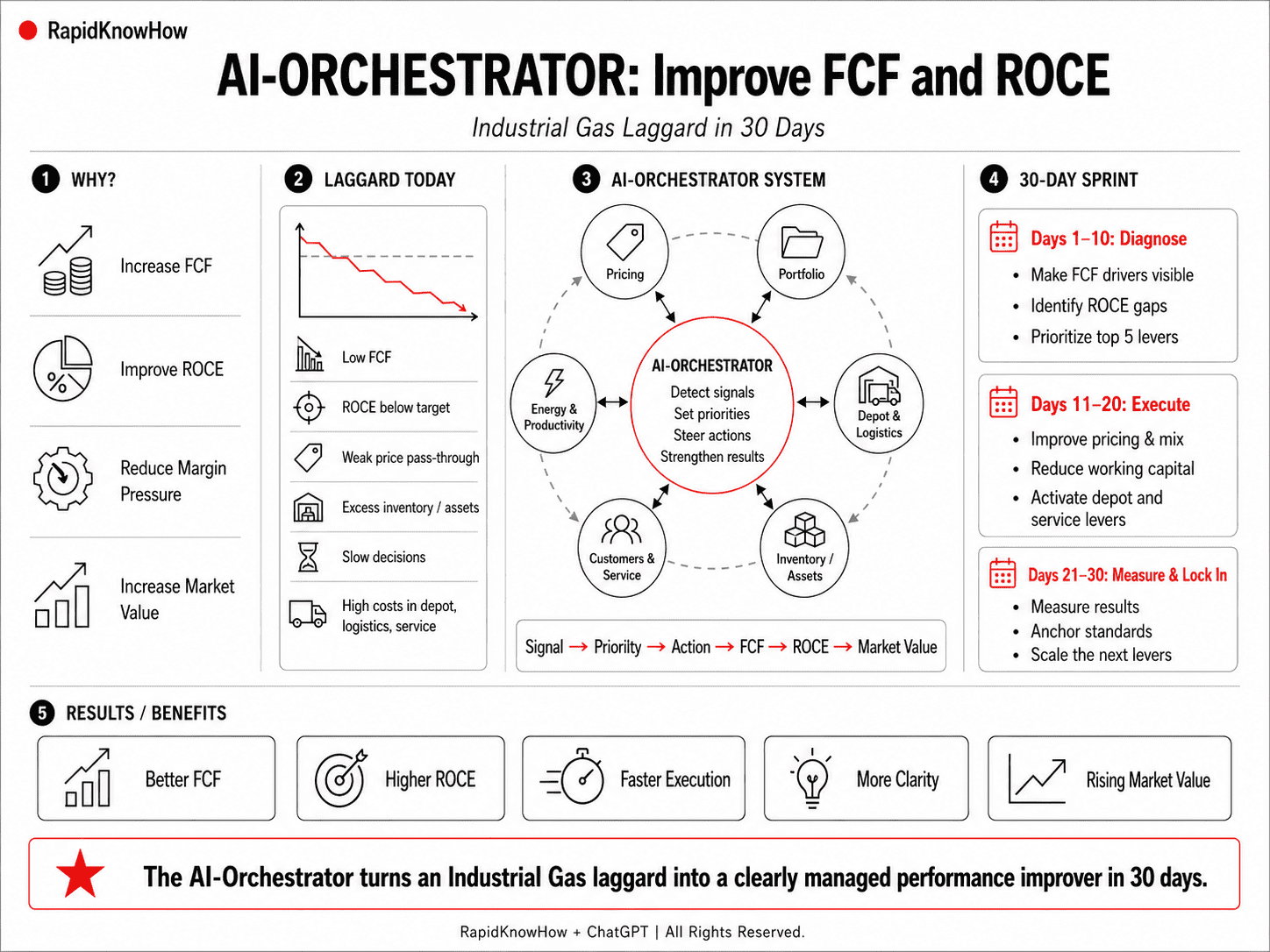
30-Day Industrial Gas FCF & ROICE Sprint
Focus
Cylinder, bulk and logistics optimization for selected DACH / CEE customer segments.
Why this first?
Because it is concrete, measurable and close to operational value.
It connects directly to:
Cost reduction.
Service performance.
Working capital.
Asset productivity.
Customer retention.
Margin protection.
FCF improvement.
ROICE improvement.
30-Day Sprint Structure
Week 1 — Sense the Game
Map the strongest signals, customer pain points, cost pressures and asset bottlenecks.
Week 2 — Prioritize the Value
Rank the top opportunities by FCF impact, ROICE impact, risk and speed of execution.
Week 3 — Build the Business Case
Create a board-ready case with current problem, root cause, financial impact, solution logic and action plan.
Week 4 — Create the Command Center Prototype
Turn the business case into a reusable decision and action module.
Command Center Outputs
At the end of the first sprint, leadership receives:
Signal Radar.
Customer Pain Map.
Value Lever Board.
FCF / ROICE Impact Estimate.
90-Day Action Sprint.
Board Decision Summary.
Command Center Prototype.
Scaling and Licensing Roadmap.
The Commercial Logic
The RapidKnowHow system converts content into strategic assets.
Power Landing Page
Attracts Boards, CxOs and Investors.
Power Posts
Translate signals into short executive insights and decisions.
Power Reports
Turn signals into structured 1000-word analyses.
PowerBooks
Package authority into breakthrough structured analysis.
Power Action Guides
Create implementation steps for measurable results.
Command Center
Orchestrates priorities, decisions, execution and scaling.
This creates a repeatable commercial system:
Insight → Authority → Action → Proof → Scale → License
The Strategic Result
The RapidKnowHow INDUSTRIAL GAS Command Center MASTER™ helps leaders move from fragmented management to orchestrated value creation.
It is designed to help Industrial Gas Boards, CxOs and Investors answer one critical question:
Where should we act now to improve FCF, ROICE and market value?
Strategic Value Statement
RapidKnowHow helps Industrial Gas leaders turn scattered market signals into structured board decisions, measurable execution and scalable value systems.
Call to Action
Start with one focused proof case.
Launch the 30-Day Industrial Gas FCF & ROICE Sprint.
Build the first Command Center prototype.
Prove measurable impact.
Then scale the system across customers, regions, business lines and license partners.
Book the Industrial Gas Command Center Discovery Session
RapidKnowHow INDUSTRIAL GAS Command Center MASTER™
Sense. Prioritize. Execute. Scale.