
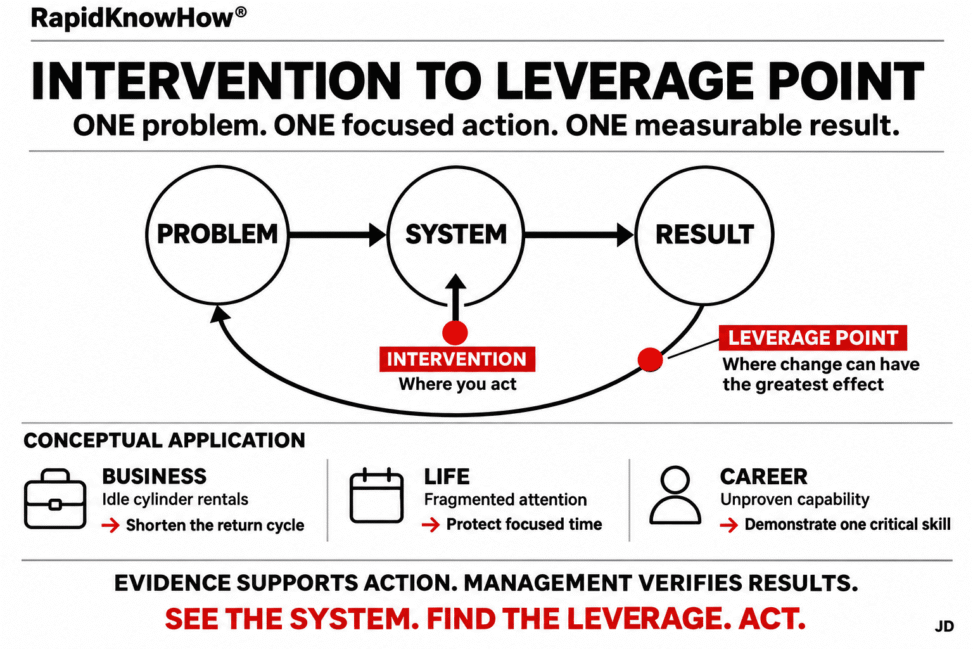
A recognized problem tells us something needs to change. It does not yet tell us where to act.
The strategic task is to understand the system producing the problem, choose an intervention, and test whether it changes the outcome.
An intervention is the action you take. A leverage point is a place in the system where a change could produce a substantial effect. The intervention acts on that point; evidence helps establish whether the expected effect occurs.
A red dot marks each location on the RapidKnowHow® System Map.
Start with the system producing the problem
Recurring problems often survive because the underlying process continues to reproduce them. Examine the flows, rules, incentives, information, delays and ownership behind the visible outcome.
For example, repeatedly asking people to return idle cylinders may produce temporary improvement. Establishing a clear return trigger, an accountable owner and a regular reconciliation cycle changes how the process operates.
The proposed leverage comes from shortening the delay between recognizing an idle cylinder and completing its return. Contract terms, collection arrangements and execution determine whether this produces a financial benefit.
Apply the principle across Business, Life and Career
The following are illustrative applications, not verified cases.
| Context | Recognized problem | ONE intervention | Proposed leverage point | Measure |
|---|---|---|---|---|
| Business | Idle cylinders continue generating rental charges | Reconcile the physical register with the invoice and arrange eligible returns | Return trigger, ownership and cycle time | Idle rental charges and confirmed billing reductions |
| Life | Fragmented attention prevents meaningful progress | Protect one daily period for a chosen priority | Rules governing access to attention | Uninterrupted time and completed priority work |
| Career | A capability is claimed but not demonstrated | Complete one relevant project with an assessable output | Evidence connecting capability to opportunity | Output quality and feedback from relevant decision-makers |
Choose the strongest intervention
Compare options against five questions:
- Causal fit: Why should this action change the outcome?
- Reach: How much of the problem could it influence?
- Durability: Will the improvement persist?
- Feasibility: What effort, authority and dependencies are involved?
- Evidence: What supports the hypothesis, and what remains uncertain?
A score structures the discussion. It does not prove which option will work. Choose ONE intervention with a credible mechanism and a result that can be observed.
Separate expected value from actual results
Before acting, record the baseline, objective, owner, measurement method and comparison period.
After acting, record the actual outcome using comparable conditions. Examine other changes that could explain the difference.
An improved outcome following an intervention is evidence worth investigating; it does not automatically establish that the intervention caused the improvement.
For Business cases, distinguish a potential saving, an invoiced reduction, collected cash and incremental free cash flow. Each requires appropriate evidence.
Use evidence at two distinct stages
Reliable research, documented experience and relevant studies can support the decision to act.
Evidence from the specific application supports the assessment of its result.
RapidKnowHow® provides the decision structure and evidence supporting action. Management owns implementation and verifies the actual result. In Life and Career cases, the individual owns that assessment, with relevant professional input where appropriate.
End with ONE decision
| Decision | When it applies |
|---|---|
| CONTINUE | The action remains justified and is progressing |
| REVISE | Assumptions, execution or measurement need correction |
| SELECT INTERVENTION | The options are ready for a choice |
| VERIFY | A reported result needs supporting evidence |
| STOP | Risks, constraints or adverse effects justify stopping |
| REUSE | The documented learning is suitable for another application |
Reusable know-how includes the conditions, limitations and unsuccessful attempts—not only the benefits.
The strategic value is cumulative: each documented case can improve the quality of the next decision.
SEE THE SYSTEM. FIND THE LEVERAGE. ACT. – Josef David