
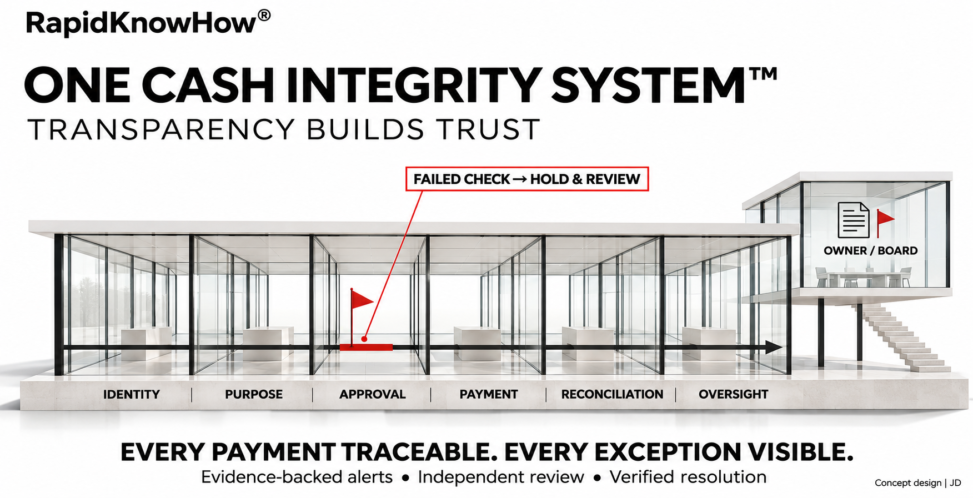
ONE TRANSACTION → ONE EVIDENCE CHAIN → ONE CONTROL DECISION → ONE VERIFIED CASH MOVEMENT
The essential rule: the system flags evidence of a discrepancy or suspected fraud. An independent investigation determines whether fraud occurred.
| Control layer | What the system checks | When it raises a red flag |
|---|---|---|
| 1. Recipient identity | Supplier identity, ownership information and independently verified bank details | Bank account changed without independent verification; unexplained account shared by unrelated recipients |
| 2. Business purpose | Contract, purchase order, delivery acceptance and invoice | Missing delivery evidence, duplicate invoice or payment exceeding agreed terms |
| 3. Authorization | Approval rights, transaction limits and separation of duties | Someone creates the supplier and releases payment; required approval bypassed; transactions split around limits |
| 4. Cash movement | Approved payment against actual bank transaction | Recipient or amount differs from approval; unauthorized payment appears |
| 5. Reconciliation and patterns | Bank records against ledger, receivables, refunds and historical transactions | Unexplained cash differences, diverted customer receipts or repeated suspicious exceptions |
| 6. Independent oversight | Changes to controls, access rights and exception handling | Controls disabled, logs altered or unresolved critical alerts repeatedly overridden |
A red flag must produce a decision—not simply another dashboard notification.
| Level | Evidence | Required response |
|---|---|---|
| AMBER — investigate | An unusual transaction with incomplete supporting evidence | Request evidence and independent review before release where appropriate |
| RED — hold | A specific failed critical control, such as an unverified bank change or missing mandatory approval | Hold the affected pending payment; notify an independent finance reviewer |
| CRITICAL — escalate | An unauthorized bank debit, altered payment instructions or evidence of deliberate control interference | Seek immediate bank intervention, preserve evidence and alert the designated owner or board contact |
An unusual amount alone should not establish fraud. Each alert must show the transaction, exact discrepancy, supporting records, potential cash exposure, responsible reviewer and resolution deadline.
For owners and boards, the first screen should answer five questions:
| Board question | Dashboard answer |
|---|---|
| How much cash is exposed? | Value of unresolved flagged transactions, with overlaps removed |
| What is the evidence? | Direct access to source records and the failed control |
| Has the money moved? | Pending, held, paid or recovery requested |
| Who is acting? | Named independent reviewer and deadline |
| Was the issue resolved? | Documented explanation, confirmed loss or verified recovery |
Three safeguards make this credible:
- Independent data: obtain bank transactions directly from the bank; an internal ledger alone cannot verify cash.
- Independent escalation: if the suspected person is the CFO or CEO, route the alert to an authorized owner, audit committee chair or other independent board contact.
- Protected evidence: retain original records and access histories in a separately controlled, tamper-evident archive. Log every override and require independent approval.
ONE recommended first build: pilot supplier payments at ONE company, covering supplier creation → bank-detail changes → invoice → approval → bank payment → reconciliation.
Prove the pilot with controlled scenarios: a duplicate invoice, an unverified account change, a split payment, an approval bypass and an altered payment recipient. Measure detection, false alarms, response time and whether legitimate payments continue smoothly.
The customer promise:
“Every payment traceable. Every critical exception visible. Every resolution independently verified.”
How Owners control their business using the Power of AI – ChatGPT
Owners can use ChatGPT to turn business records into clear questions, evidence and actions—while retaining control over decisions and cash.
The principle is simple: AI checks and explains. Authorized people decide. Independent records verify the result.
RapidKnowHow® ONE AI OWNER CONTROL SYSTEM™
| Owner’s question | What ChatGPT can help examine* | Owner’s action |
|---|---|---|
| Where is my cash? | Bank movements, cash forecasts, overdue receivables and upcoming obligations | Resolve unexplained differences and assign collection actions |
| Are we earning real money? | Profit versus operating cash flow; margins by customer and product | Investigate profits that do not convert into cash |
| Are payments legitimate? | Duplicate invoices, changed bank details, missing approvals and delivery evidence | Hold payments that fail critical checks for independent review |
| Are customers receiving value? | Delivery performance, complaints, cancellations and repeat purchases | Fix the largest recurring service failure |
| Is capital working? | Inventory, receivables, idle assets and capital expenditure against results | Release unnecessary working capital and review weak investments |
| Are managers delivering? | Commitments, deadlines, actual outcomes and supporting evidence | Assign ONE accountable person to each corrective action |
These checks require supplied files or authorized data connections. ChatGPT has no automatic visibility into the business.
Give the owner ONE daily control brief:
- CASH: available balance, near-term obligations and forecast shortfall.
- RED FLAGS: the specific discrepancy, amount exposed and supporting evidence.
- DECISION: what needs the owner’s attention today.
- ACTION: responsible person and deadline.
- RESULT: what was independently verified since yesterday.
Every finding should link to its source record. Missing data must appear as “unknown,” never as “no problem.”
For the cash-integrity system we designed, combine fixed transaction rules with AI interpretation. Rules identify duplicates, missing approvals and mismatched amounts; ChatGPT explains the exceptions and prepares questions for review. An alert indicates a discrepancy or suspected fraud, not a finding of guilt.
Keep payment release under separate human authorization. Give the analysis process read-only access, restrict confidential information to an approved business setup, and route concerns about management to an independent owner or board contact.
ONE first action: use one month of bank transactions, the corresponding ledger, unpaid customer invoices and supplier payments to produce a first control brief. Start with this instruction:
“Act as my business control analyst. Reconcile the supplied records. Identify cash differences, overdue receivables and suspicious payment exceptions. For every finding, cite the source record, distinguish facts from assumptions, state what evidence is missing, and propose ONE action with an owner and deadline. Do not treat an anomaly as proof of fraud.”
ONE JOB → ONE AI-ASSISTED CHECK → ONE OWNER DECISION → ONE VERIFIED RESULT.
Trust is good. Control is better. I Josef David
RapidKnowHow® — THE DECISION COMPANY™
Industrial Gas Leadership 2030
PROVE VALUE. THEN SCALE.
Watch the 60-second roadmap: 10 strategic actions for DACH and CEE, 2026–2030.
Start with ONE customer challenge. Use the Industrial Gas Action Guide to turn your first action into a measurable result.
RapidKnowHow® — Leading Industrial Gas Opportunity Signal Identifier in DACH & CEE