
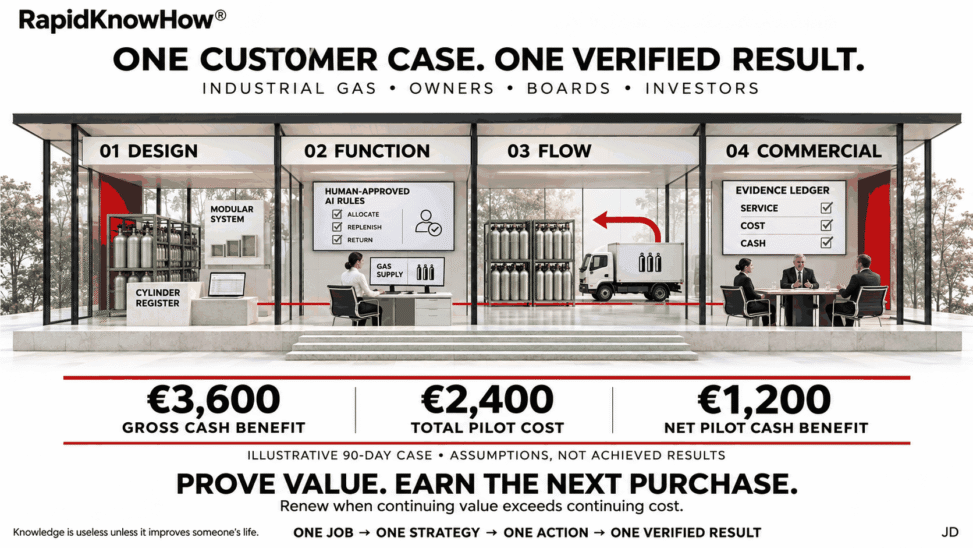
ONE Customer Case: Turn Cylinder Complexity into Verified Cash
For Business Owners, Company Boards and Key Investors—the Drivers of Change.
Illustrative customer case. All figures are assumptions showing how a pilot would work; they are not achieved customer results.
The leadership challenge
A manufacturing business operates three sites. Each site manages industrial gas independently. Management receives invoices but lacks a consolidated view of cylinder locations, usage and returns.
Production needs reliable supply. Finance wants lower avoidable expenditure. The board wants evidence before authorizing wider implementation.
ONE JOB: reduce avoidable cylinder expenditure while maintaining agreed gas availability.
ONE STRATEGY: prove the RapidKnowHow® Operating System at ONE site, then expand only where verified economics justify investment.
ONE ACTION: reconcile the physical cylinder register with rental invoices and execute approved returns.
ONE VERIFIED RESULT: demonstrate a positive net cash benefit with service maintained.
1. DESIGN — Build ONE accountable system
The pilot covers one site and runs for 90 days.
| Module | Pilot responsibility | Accountable owner |
|---|---|---|
| Customer Job | Agree service requirements and financial objective | Site director |
| Know-How | Establish cylinder status, contract terms and approved reserve requirements | Operations and procurement |
| AI Rules | Flag discrepancies and recommend actions within agreed boundaries | Customer process owner |
| Partner Execution | Collect approved cylinders and confirm receipt | Gas supplier |
| Result Evidence | Reconcile invoices, costs and cash effects | Financial controller |
The business owner sponsors the change. The site director owns execution. Finance signs off the economic result.
Design output: ONE agreed scope, baseline, responsibility map and approval protocol.
2. FUNCTION — Make each module deliver
The opening reconciliation identifies 80 potentially unnecessary rented cylinders.
Operations checks each cylinder against production needs, demand variability and supplier lead times. Procurement checks return conditions and billing rules. Only cylinders approved by both functions enter the return process.
AI assists by matching registers, highlighting discrepancies and tracking unresolved actions. Authorized people approve returns and changes to reserve levels.
Function output: an approved return list supported by operational and contractual evidence.
3. FLOW — Close every handover
Identify → Validate → Approve → Collect → Confirm → Reconcile
Each cylinder receives a traceable status. A return remains open until supplier receipt is confirmed and the relevant billing change is checked.
Exceptions—missing cylinders, rejected returns or continuing charges—go to a named owner with a resolution deadline.
Weekly service checks monitor gas-related production interruptions, emergency deliveries and compliance with approved reserve levels.
Flow output: completed returns, corrected billing and a documented service record.
4. COMMERCIAL — Prove why the customer should buy again
The customer purchases a defined pilot. The financial review includes the RapidKnowHow fee, customer effort and execution costs.
Illustrative pilot economics
Assume 80 approved returns, rental of €15 per cylinder per month and two full months of avoided rental within the pilot.
| Cash item | 90-day amount |
|---|---|
| Avoided rental payments: 80 × €15 × 2 months | €2,400 |
| Refund received for independently verified historic overbilling | €1,200 |
| Total gross cash benefit | €3,600 |
| RapidKnowHow pilot fee | −€1,500 |
| Collection and implementation expenditure | −€600 |
| Incremental customer cash expenditure | −€300 |
| Net pilot cash benefit, before tax | €1,200 |
Amounts exclude recoverable VAT. The refund is separate from future rental savings. Existing salaried staff time is recorded as an economic cost where relevant; only incremental cash expenditure enters this cash bridge.
The ongoing avoided rental would be €14,400 annually, assuming all 80 cylinders remain unnecessary and charges cease for a full year. That is a forward estimate to be tested.
The evidence required to accept the result
| Claim | Required evidence |
|---|---|
| Cylinders were returned | Approved list, collection records and supplier receipts |
| Rental expenditure fell | Reconciled invoices and payment records |
| Refund was realized | Credit documentation and bank receipt |
| Service was maintained | Production, stockout and emergency-delivery records |
| Pilot generated positive net cash | Controller-approved cash bridge including all incremental costs |
Success requires both positive net economics and maintained service. A lower invoice alone does not establish success.
Why buy again?
The customer’s next purchase should address a specific continuing job: maintaining cylinder visibility, detecting billing exceptions and coordinating replenishment and returns.
For illustration, assume annual monitoring, licence and operating costs total €4,800. Against €14,400 in sustained avoided rental, the site would retain €9,600 annually before tax.
However, the return action may produce savings that persist without a licence. Those savings alone do not justify renewal.
The renewal decision must establish whether the ongoing service protects or creates enough additional value to exceed its cost—for example, preventing cylinder accumulation, correcting new billing errors or reducing emergency deliveries. The customer should compare this with managing the process internally.
Commercial output: renew when the continuing service earns its fee; expand when another site has an evidenced opportunity.
The decision for owners, boards and investors
| Decision-maker | Why this case matters |
|---|---|
| Business owner | Converts an operational problem into accountable action and measurable cash |
| Company board | Provides a controlled investment decision with explicit expansion gates |
| Key investor | Tests execution capability, repeatability and the economics of recurring revenue |
These leaders drive change by setting priorities, assigning authority and releasing capital against evidence.
ONE decision: authorize ONE site pilot with an agreed baseline, a spending limit and a financial acceptance test.
DESIGN the accountability. FUNCTION through clear responsibilities. FLOW to completion. COMMERCIAL value earns the next purchase.
RapidKnowHow® — Knowledge is useless unless it improves someone’s life.
Josef David | JD
RapidKnowHow® — THE DECISION COMPANY™
Industrial Gas Leadership 2030
PROVE VALUE. THEN SCALE.
Watch the 60-second roadmap: 10 strategic actions for DACH and CEE, 2026–2030.
Start with ONE customer challenge. Use the Industrial Gas Action Guide to turn your first action into a measurable result.
RapidKnowHow® — Leading Industrial Gas Opportunity Signal Identifier in DACH & CEE