An attractive investment case must be supported by a business that delivers customer value, collects cash and can sustain its performance.
Scope: private equity, holding companies and investors with influence over portfolio-company operations.
A higher exit multiple, an ambitious margin forecast and an extensive list of EBITDA adjustments can make a company look attractive.
The investor’s essential question remains:
What has improved in the business—and what evidence shows that the improvement will endure?
Excel remains indispensable for valuation, scenarios and capital allocation. Its usefulness depends on the quality of the operating assumptions beneath the numbers.
1. From an Attractive Story to an Investable Business
“Dressing the bride” becomes dangerous when presentation moves ahead of economic substance.
| Attractive presentation | Evidence investors should investigate |
|---|---|
| Strong revenue growth | Retention, repeat demand, pricing and cash collection |
| Higher adjusted EBITDA | Reconciliation to reported earnings and operating cash flow |
| Lower working capital | Sustainable improvement versus delayed payments or depleted stock |
| Reduced capital expenditure | Genuine efficiency versus postponed maintenance |
| An impressive AI programme | Adoption, operational outcomes and net economic benefit |
| A higher valuation | Supportable assumptions, downside sensitivity and buyer relevance |
A projected exit valuation remains an estimate. IFRS 13 defines fair value around an orderly market-participant transaction at the measurement date; it does not turn management’s target price into an achievable sale price. IFRS 13 Fair Value Measurement
The investment narrative should explain the evidence—and expose its limits.
2. 🔴 The Leverage Point: Connect Operations to Capital Allocation
The critical intervention lies between a reported performance gap and the next allocation of money or management attention.
For each company, ask:
What is preventing this business from converting customer value into sustainable cash—and which intervention deserves resources now?
Investigate five connected areas:
| Area | Core investor question |
|---|---|
| Customers | Why do customers buy, stay and pay? |
| Operations | Where do defects, delays or idle assets consume resources? |
| Cash | Where does accounting profit fail to become available cash? |
| Management | Can the team execute, learn and report bad news promptly? |
| Resilience | Which dependencies could damage several holdings simultaneously? |
AI can help connect these observations. Investors and management remain responsible for the resulting decisions.
3. Give AI a Defined Economic Job
BCG’s January 2026 assessment argues that many private equity firms struggle to demonstrate meaningful portfolio-company AI returns. It distinguishes distributing tools from changing workflows and operating models to capture value. BCG
The practical implication: give each AI initiative a specific problem, operating owner, baseline and acceptance test.
| AI application | Useful contribution | Required check |
|---|---|---|
| Contract review | Flag renewal terms and unusual obligations | Confirm against the actual contract |
| Receivables analysis | Prioritise overdue accounts and disputed invoices | Verify balances, disputes and collections |
| Inventory analysis | Identify possible excess or obsolete stock | Confirm demand, condition and operating reserves |
| Maintenance analysis | Flag emerging equipment problems | Engineering assessment and service outcomes |
| Commercial analysis | Detect customer or margin deterioration | Validate causes with customer-facing teams |
| Portfolio monitoring | Surface exceptions across holdings | Trace each material finding to its source |
Generative AI can produce plausible but incorrect information. Its outputs need evaluation appropriate to the decision, consistent with the risk-management approach described by NIST. NIST
Use AI to accelerate investigation. Retain traceable evidence for every material conclusion.
4. Demonstration: Improve Cash Before Changing the Multiple
Consider a hypothetical industrial portfolio company. The following figures illustrate a method; they are not a forecast or verified case.
During a 90-day pilot, management documents:
| Incremental cash effect versus the agreed baseline | Amount |
|---|---|
| Reduction in overdue receivables, with no factoring | +€300,000 |
| Inventory reduction through lower purchases, preserving service | +€200,000 |
| Lower rental payments following approved equipment returns | +€30,000 |
| AI, integration and implementation cash costs | −€80,000 |
| Net incremental cash benefit during the pilot | €450,000 |
The distinction matters:
- €500,000 is working-capital release. It cannot simply recur every quarter.
- €30,000 is a realised operating saving in this period. Future savings require continued verification.
- €80,000 is a cash cost of achieving the improvement. Ongoing costs must also enter future forecasts.
Finance should reconcile the calculation to collections, purchases, inventory records, invoices and bank movements. Adjust for seasonality, volume, service changes, taxes and other material effects. Avoid counting the same benefit twice.
For reporting, define the chosen free-cash-flow measure consistently and reconcile the pilot’s effects to it.
The business improved because cash was collected and resources were released. A valuation model can then assess what those changes imply.
5. Manage the Portfolio as a Portfolio
Successful individual projects do not automatically create a resilient portfolio.
Several holdings may depend on the same customers, energy prices, lenders, technology providers or scarce skills. Apparently different businesses can share the same vulnerability.
For every holding, choose a clear stance:
| Stance | Decision basis |
|---|---|
| Invest | Evidence supports an opportunity and management can execute |
| Improve | A valuable business has a specific, addressable constraint |
| Protect | Liquidity, concentration or operational exposure needs attention |
| Exit | Ownership alternatives, future requirements and achievable proceeds favour a sale |
Compare opportunities using expected benefit, uncertainty, capital required, time to cash and execution capacity.
Shared AI tools and operating playbooks can reduce duplicated effort. Adapt them to each company’s economics, data permissions and operating requirements.
6. Build a 90-Day Evidence Cycle
Days 1–15: Establish the baseline.
Reconcile earnings to cash. Identify customer dependencies, maintenance needs, liquidity requirements and data gaps.
Days 16–30: Select ONE intervention per pilot company.
Assign an operating owner and finance reviewer. Define the expected mechanism, cost, downside limits and evidence required.
Days 31–60: Execute and study.
Use AI where it improves the workflow. Review operational exceptions weekly. Record adverse effects alongside benefits.
Days 61–90: Verify and allocate again.
Separate realised results from forecasts, one-off releases from recurring improvements, and company effects from market effects.
Scale, revise or stop based on the findings.
7. Prepare an Exit That Survives Scrutiny
A credible buyer should be able to trace:
Customer need → Operating improvement → Financial effect → Cash evidence → Sustainability assumptions.
Show the implementation costs, unresolved risks, management dependencies and conditions under which performance could deteriorate.
A well-presented data room helps buyers assess the business. Sustainable operating performance gives them something substantive to assess.
RapidKnowHow® MASTER Principle
ONE PORTFOLIO COMPANY → ONE CRITICAL CONSTRAINT → ONE ACCOUNTABLE INTERVENTION → ONE VERIFIED RESULT → ONE CAPITAL-ALLOCATION DECISION.
Your immediate action: Select ONE holding. Reconcile its investment story with its actual customer, operational and cash evidence. Fund the highest-priority gap you can test.
Make the business stronger—and let the spreadsheet explain how. Josef David
RapidKnowHow® — Match Capital to the Job It Must Do.
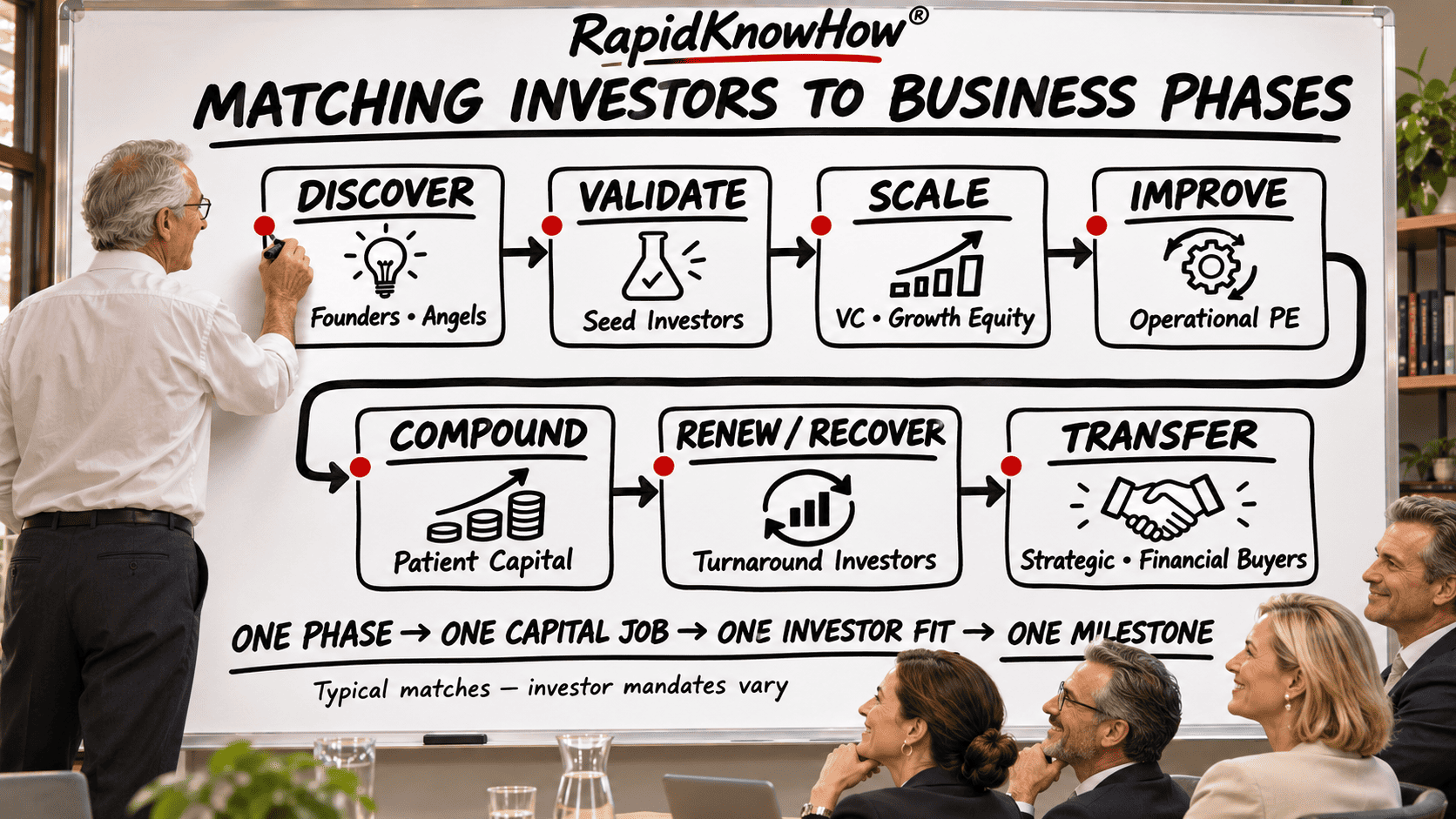
| Business phase | Main management job | Investor types to consider | Evidence for the next investment decision |
|---|---|---|---|
| 1. Discover | Confirm a customer problem worth solving | Founders, angels, specialist seed investors | Customer evidence, willingness to pay, credible team |
| 2. Validate | Deliver a solution customers buy and use | Angels, seed funds, early-stage venture capital | Paid pilots, repeat use, delivery costs and customer feedback |
| 3. Scale | Expand a repeatable commercial model | Venture capital, growth equity, strategic investors | Retention, unit economics, scalable operations and funding runway |
| 4. Improve | Convert established revenue into stronger cash generation | Buyout funds, operational private equity, family offices | Cash conversion, management capability and achievable improvement opportunities |
| 5. Compound | Reinvest sustainable cash at attractive returns | Long-term holding companies, family offices, patient public-market investors | Durable customer demand, disciplined reinvestment and resilience |
| 6. Renew or Recover | Reposition the business or restore viability | Turnaround investors, special-situations funds, strategic buyers | Liquidity, a credible recovery plan, restructuring requirements and execution capacity |
| 7. Transfer | Move ownership to the next suitable owner | Strategic buyers, financial sponsors, management buyers, public markets where suitable | Transferable earnings, reliable records, management continuity and buyer fit |
These are typical matches, not fixed boundaries. Sector, risk, ownership preferences and investor mandates change the fit.
🔴 The leverage point: define the next milestone before selecting the investor.
Ask:
What must this business achieve next, how much capital does that require, and which investor can support it on acceptable terms?
Assess five dimensions together:
- Capital: Amount, timing and follow-on capacity.
- Capability: Expertise, customer access and operating support.
- Patience: Time available before returns or an exit are required.
- Control: Decision rights, board influence and founder alignment.
- Risk: What happens if the milestone takes longer or fails?
A promising company can suffer from a capital mismatch: an investor expects distributions while the business still needs reinvestment, or management pursues expansion before the commercial model works.
Apply the MASTER principle differently at each phase
Discover value → Validate demand → Scale delivery → Improve cash conversion → Reinvest → Renew → Transfer ownership.
Early-stage businesses may deliberately consume cash while testing demand. Mature companies should explain why established earnings do—or do not—produce sustainable free cash flow.
ONE BUSINESS PHASE → ONE CAPITAL JOB → ONE SUITABLE INVESTOR → ONE AGREED MILESTONE → ONE EVIDENCE-BASED REVIEW. – Josef David