
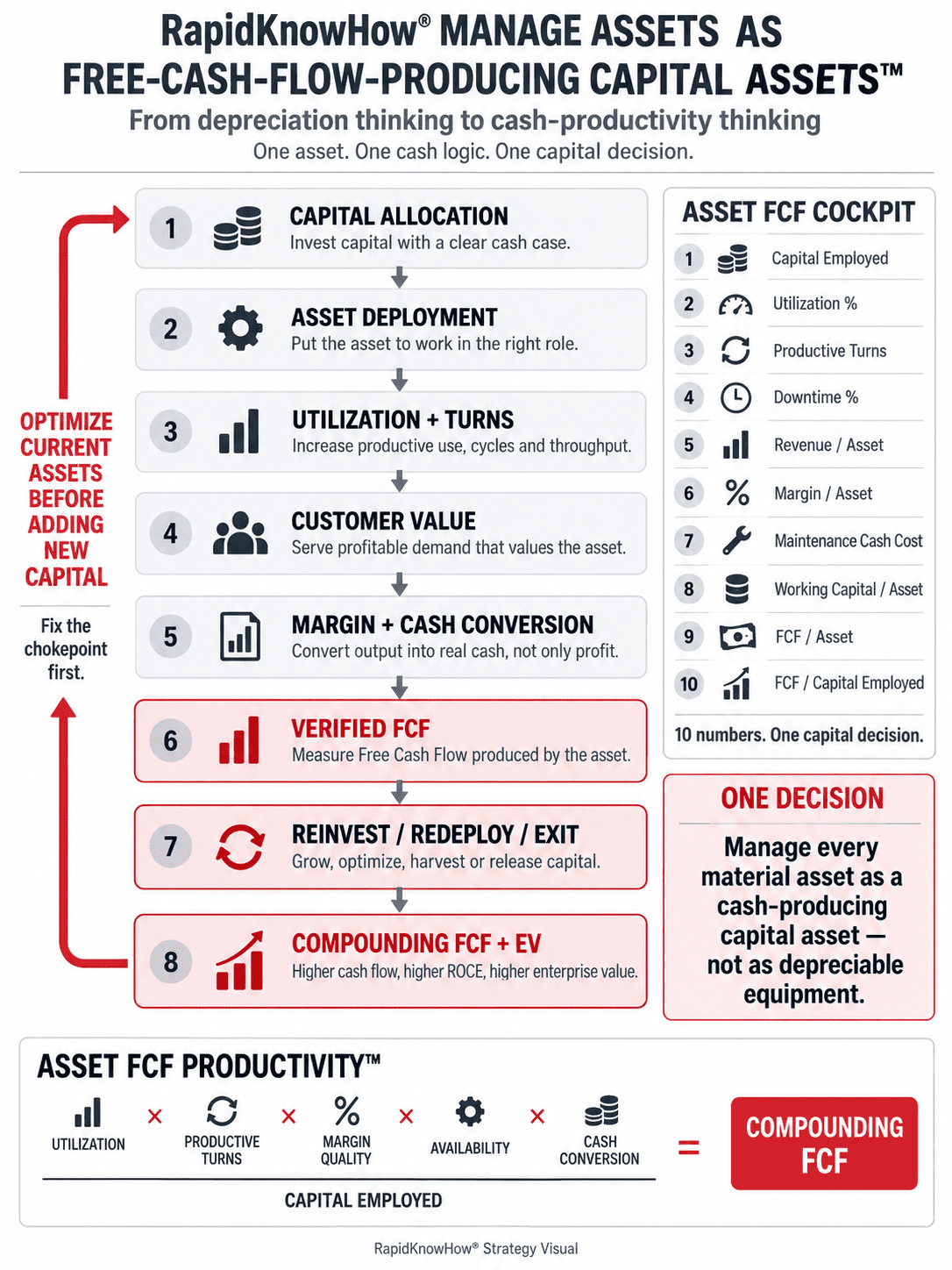
Do not manage assets as depreciating equipment. Manage them as capital that must continuously earn Free Cash Flow. – Josef David
MANAGE ASSETS AS FREE-CASH-FLOW-PRODUCING CAPITAL ASSETS™
FROM DEPRECIATION THINKING TO CASH PRODUCTIVITY THINKING
Executive Idea
Traditional asset management asks:
What did the asset cost?
How old is it?
How much has it depreciated?
When must it be replaced?
Investor-grade asset management asks:
How much Free Cash Flow does this asset produce from the capital tied up in it?
The difference is fundamental.
OLD LOGIC
BUY ASSET → USE ASSET → DEPRECIATE ASSET → REPLACE ASSET
NEW LOGIC
INVEST CAPITAL → DEPLOY ASSET → GENERATE CUSTOMER VALUE → PRODUCE FCF → REDEPLOY / REINVEST → COMPOUND
1. THE CORE PRINCIPLE™
Every physical asset is a capital-allocation decision.
Examples:
Plant
Machine
Tank
Cylinder
Cryogenic Container
Truck
Warehouse
Production Line
Data Center
Tooling
The asset should therefore be judged by:
CASH PRODUCED ÷ CAPITAL EMPLOYED
not merely by:
Age
or
Accounting book value
or
Depreciation schedule
2. THE ASSET FCF EQUATION™
For each asset calculate:
REVENUE ENABLED
minus
Direct Operating Cost
minus
Maintenance
minus
Energy
minus
Labor
minus
Logistics
minus
Working Capital
minus
Taxes / Other Cash Costs
minus
Maintenance Capex
=
ASSET FREE CASH FLOW™
Then calculate:
ASSET FCF ÷ ASSET CAPITAL EMPLOYED = ASSET CASH RETURN™
This creates one comparable language across the asset base.
3. THE FIVE QUESTIONS FOR EVERY ASSET™
1. IS IT WORKING?
Measure utilization.
An idle asset earns nothing.
2. IS IT TURNING FAST ENOUGH?
Measure:
Cycles
Turns
Hours
Loads
Deliveries
Production runs
The faster productive turns occur, the more cash one unit of capital can generate.
3. IS IT SERVING HIGH-VALUE DEMAND?
High utilization alone is not enough.
An asset can be busy while serving low-value customers.
Therefore:
UTILIZATION × MARGIN QUALITY
must be managed together.
4. IS IT CONVERTING PROFIT INTO CASH?
An apparently profitable asset may still destroy cash through:
High inventory
Slow receivables
Excess maintenance
High energy
Frequent downtime
Low yield
Unproductive logistics
5. IS IT STILL THE BEST USE OF CAPITAL?
Every asset competes with alternative uses of capital.
Ask:
Would we invest in this asset again today?
If the answer is no, management should consider:
FIX
REDEPLOY
SELL
REPLACE
CONSOLIDATE
EXIT
4. THE ASSET PRODUCTIVITY LOOP™
CAPITAL
↓
ASSET
↓
CUSTOMER VALUE
↓
REVENUE
↓
MARGIN
↓
CASH CONVERSION
↓
VERIFIED FCF
↓
REINVESTMENT
↓
MORE PRODUCTIVE CAPITAL
↺
This is how assets become a compounding system.
5. THE FOUR ASSET CATEGORIES™
Every asset should sit in one of four boxes.
A. HIGH FCF + HIGH ROCE
GROW
Protect it.
Increase utilization.
Feed it profitable demand.
Invest selectively.
B. HIGH FCF + LOW GROWTH
HARVEST
Maximize cash.
Keep maintenance disciplined.
Avoid unnecessary growth capex.
C. LOW FCF + HIGH POTENTIAL
FIX
Improve:
Utilization
Pricing
Throughput
Yield
Working capital
Customer mix
D. LOW FCF + LOW RETURN
EXIT / REDEPLOY
Do not protect an asset because:
“We already own it.”
Past capital is sunk.
Future capital must earn.
6. THE STRATEGIC CHOKEPOINT™
The most common error is:
“We need more assets.”
The real problem is often:
Low utilization
Bad scheduling
Poor network density
Wrong customer mix
Slow turnaround
Weak pricing
Too much downtime
Too much working capital
Therefore:
OPTIMIZE BEFORE YOU INVEST™
Before buying the next asset, prove why the current asset cannot produce more FCF.
7. FROM MAINTENANCE TO ECONOMIC AVAILABILITY™
Traditional maintenance asks:
Is the asset technically available?
FCF management asks:
Is the asset economically available at the moment when profitable customer demand exists?
That means maintenance decisions should optimize:
Reliability
Availability
Maintenance cost
Downtime
Asset life
Cash generation
The objective is not maximum technical life.
It is:
MAXIMUM LIFETIME FCF™
8. FROM CAPACITY TO CASH PRODUCTIVITY™
Installed capacity is not value.
Available capacity is not value.
Used capacity is not automatically value.
The sequence must be:
CAPACITY
↓
PRODUCTIVE UTILIZATION
↓
PROFITABLE OUTPUT
↓
CUSTOMER VALUE
↓
CASH
Only the final step matters to the investor.
9. THE ASSET FCF COCKPIT™
Manage every important asset class with 10 numbers:
| KPI | Management Question |
|---|---|
| 1. Capital Employed | How much capital is tied up? |
| 2. Utilization % | Is the asset working? |
| 3. Productive Turns | How often does it earn? |
| 4. Downtime % | Where is cash being lost? |
| 5. Revenue / Asset | What demand does it enable? |
| 6. Contribution Margin / Asset | Is the revenue attractive? |
| 7. Maintenance Cash Cost | What does reliability cost? |
| 8. Working Capital / Asset | How much cash is trapped? |
| 9. FCF / Asset | What cash does it produce? |
| 10. FCF / Capital Employed | Is the capital productive? |
10. THE MANAGEMENT DECISION RULE™
Every asset review should end with ONE decision:
GROW
OPTIMIZE
REDEPLOY
HARVEST
EXIT
Never end with:
“Keep monitoring.”
11. INDUSTRIAL GAS EXAMPLE™
Take a cryogenic container.
Traditional view:
Purchase cost
Age
Depreciation
Maintenance
New FCF view:
Payload
×
Turns
×
Utilization
×
Margin
×
Availability
minus
Freight
Repositioning
Maintenance
Losses
Working capital
=
FCF PER ACTIVE CONTAINER™
The question becomes:
How much annual FCF does this cryogenic container generate relative to the capital tied up in it?
That is a far more powerful management question than:
“Is the container fully depreciated?”
12. THE CAPITAL ALLOCATION TEST™
Before investing in any new asset, require:
1. CUSTOMER DEMAND
Is there proven economic demand?
2. CASH CASE
What incremental FCF will the asset produce?
3. UTILIZATION CASE
How quickly will it reach productive utilization?
4. PAYBACK
How long until invested capital is recovered?
5. ROCE
What return will the asset earn?
6. RESIDUAL OPTION
Can the asset be redeployed, resold or repurposed?
7. NETWORK EFFECT
Does it improve the productivity of other assets?
Only then approve capital.
13. THE INVESTOR VIEW™
An investor does not ultimately buy:
Factories
Machines
Containers
Vehicles
An investor buys:
FUTURE CASH FLOWS.
Therefore asset management must become:
CASH-FLOW MANAGEMENT OF CAPITAL EMPLOYED™
14. THE TRANSFORMATION™
OLD ASSET MANAGEMENT
CAPEX
↓
COMMISSION
↓
OPERATE
↓
DEPRECIATE
↓
REPLACE
FCF ASSET MANAGEMENT
CUSTOMER VALUE
↓
CAPITAL ALLOCATION
↓
ASSET DEPLOYMENT
↓
UTILIZATION
↓
CASH GENERATION
↓
VERIFIED FCF
↓
REINVEST / REDEPLOY / EXIT
↓
COMPOUND
ONE DECISION™
MANAGE EVERY MATERIAL ASSET AS A CASH-PRODUCING CAPITAL ASSET.
Replace:
BOOK VALUE THINKING
with:
FCF PRODUCTIVITY THINKING™
THE MASTER FORMULA™
UTILIZATION
× PRODUCTIVE TURNS
× MARGIN QUALITY
× AVAILABILITY
× CASH CONVERSION
divided by
CAPITAL EMPLOYED
= ASSET FCF PRODUCTIVITY™
THE STRATEGIC OUTCOME™
The organization moves from:
ASSET OWNER
to:
CAPITAL ORCHESTRATOR™
Management stops asking:
“How many assets do we own?”
and begins asking:
“Which assets are producing the highest sustainable FCF from every euro of capital employed?”
That is the basis for:
HIGHER FCF
↓
HIGHER ROCE
↓
BETTER CAPITAL ALLOCATION
↓
LOWER CAPITAL INTENSITY
↓
HIGHER ENTERPRISE VALUE
ACTION CHECKLIST™
☐ List all material assets
☐ Calculate capital employed by asset
☐ Measure utilization
☐ Measure productive turns
☐ Measure downtime
☐ Calculate revenue enabled
☐ Calculate contribution margin
☐ Allocate maintenance cash cost
☐ Allocate working capital
☐ Calculate FCF per asset
☐ Calculate FCF / capital employed
☐ Rank assets from highest to lowest productivity
☐ Classify each asset: GROW / OPTIMIZE / REDEPLOY / HARVEST / EXIT
☐ Challenge all new capex against current asset productivity
☐ Identify ONE asset chokepoint
☐ Fix it before adding capital
FINAL PASS / FAIL™
Ask:
Can we increase FCF from the current asset base before investing another euro of capital?
YES
OPTIMIZE → PROVE → SCALE.
NO
Find the chokepoint:
UTILIZATION?
DEMAND?
PRICE?
MARGIN?
DOWNTIME?
WORKING CAPITAL?
MAINTENANCE?
CAPITAL STRUCTURE?
Fix that ONE constraint first.
Leave a Reply