
Translating BCG, Deloitte, Gartner & McKinsey Findings into Results
END OF Q3 2026 | Evidence cutoff: 30 September 2026 | Board • CEO • Owner • Investor
Updated 24 November 2026. Research published after the cutoff is excluded; the current commercial offer appears separately below.
EXECUTIVE CONCLUSION
The four research streams increasingly point in the same direction:
AI access is no longer the scarce resource. Converting AI into verified economic value is.
BCG reports broader AI value capture alongside a control gap; Deloitte identifies limited process readiness; Gartner emphasizes governance for agent autonomy and warns about project economics; McKinsey finds that individual productivity gains have not translated into a comparable increase in reported enterprise financial impact.
That makes the End-of-Q3 2026 RapidKnowHow® translation:
DON’T SELL AI. DON’T SELL REPORTS. DELIVER VERIFIED BUSINESS RESULTS.
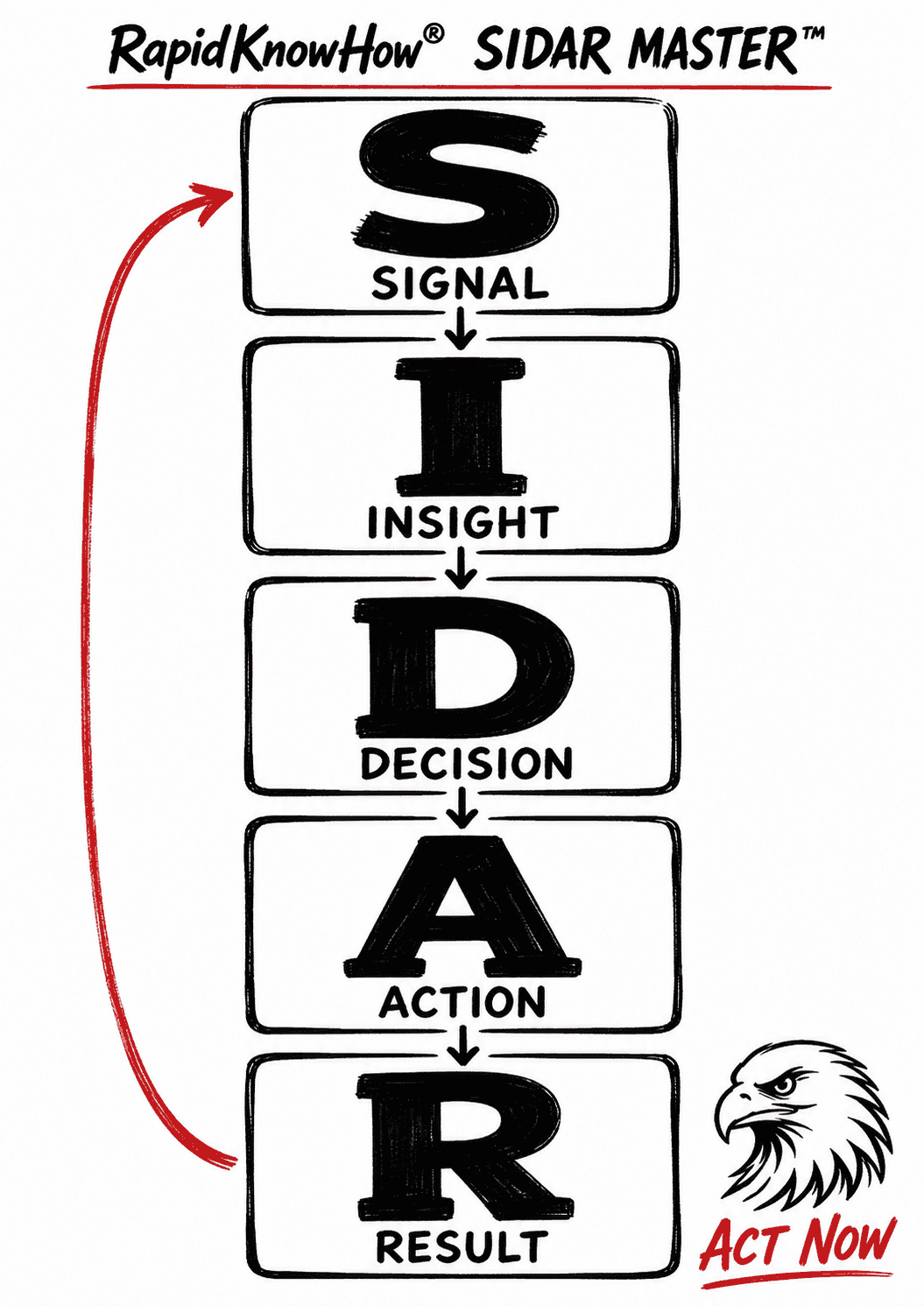
SIDAR — FROM RESEARCH TO RESULT
| SIDAR | What the research says | RapidKnowHow® translation |
|---|---|---|
| S — SIGNAL | AI adoption is accelerating, but enterprise value is lagging. | Find the ONE business problem where money is being lost or opportunity missed. |
| I — INTERPRET | Workflow, governance, people and economics determine value—not the model alone. | Translate AI capability into FCF, margin, ROCE, growth, risk or decision-speed impact. |
| D — DECIDE | Too many pilots and poorly selected agent use cases destroy value. | Choose ONE Decision with ONE accountable owner and ONE measurable result. |
| A — ACT | Leaders redesign work rather than adding another AI tool. | Execute a 30-day Result Sprint around the decision. |
| R — REVIEW | Productivity claims mean little without financial verification. | Measure → Verify → Preserve → Compound. |
THE FOUR SIGNALS
1. BCG — VALUE IS SPREADING; CONTROL MUST CATCH UP
Reported evidence — 30 September 2026: BCG’s Applied AI Index surveyed more than 1,300 CxOs and senior leaders across over 20 sectors. Nearly half of the companies in its sample were generating AI value: 7.5% were classified as future-built and 41% as scaling. Only 5% had the full set of critical agent controls. These are survey findings, not verified free cash flow at a prospective customer.
RapidKnowHow® interpretation: Select a valuable workflow, define decision authority and track its economics. The quarter-end opportunity is to combine broader value capture with effective control.
2. DELOITTE — REDESIGN THE WORK BEFORE SCALING AGENTS
Reported evidence — 12 August 2026: Deloitte surveyed 501 US leaders involved in agentic AI, at organizations at least piloting it, between April and June 2026. While 74% expected nearly half their business processes to be redesigned or rebuilt around agents within four years, only 5% said their processes were highly prepared; 15% reported scaled, orchestrated cross-functional multi-agent adoption. Expectations and current readiness are different measures.
RapidKnowHow® interpretation: Define ownership, exception handling and decision rights before expanding automation. Test ONE workflow and measure the operating consequences.
3. GARTNER — GOVERN AUTONOMY AND TEST THE ECONOMICS
Published analysis — 22 September 2026: Gartner’s public abstract for AI Agents Raise Minimum Viable Governance Requirements warns that agent autonomy creates operational and legal risks requiring adapted governance and an agent control plane. This summary uses the public abstract, not the subscriber-only report.
Earlier forecast — 25 June 2025: Gartner predicted that over 40% of agentic AI projects would be cancelled by the end of 2027 because of costs, unclear business value or inadequate risk controls. This is a forecast available at the Q3 cutoff, not an observed cancellation rate.
RapidKnowHow® interpretation: OWNER → PURPOSE → ECONOMICS → BOUNDARY → KPI → VERIFICATION. Set spending limits, human escalation and stop conditions.
4. McKINSEY — BRIDGE PRODUCTIVITY TO FINANCIAL IMPACT
Reported evidence — 25 August 2026: McKinsey’s State of AI survey found that 80% of respondents reported improved individual productivity, while 37% attributed some enterprise EBIT impact to AI, essentially unchanged from the prior year. About one in five reported AI operating costs constraining usage. These measures describe different outcomes; EBIT impact is not free cash flow.
RapidKnowHow® interpretation: Convert a productivity improvement into a specific collection, cost, throughput or working-capital action. Record implementation costs and the baseline; management verifies the actual cash effect.
AI VALUE = BETTER DECISION × FASTER ACTION × VERIFIED RESULT is the RapidKnowHow® decision heuristic, not a formula established by these studies.
ONE DECISION — END OF Q3 2026
Position RapidKnowHow® as the system that converts external intelligence + AI capability into ONE verified economic result.
Not another research publisher.
Not another AI consultancy.
Not another dashboard.
The operating chain becomes:
SIGNAL → INSIGHT → DECISION → ACT → RESULT → VALUE → COMPOUND
TOP 3 ACTIONS
1 — SELECT ONE MONEY PROBLEM
RAPIDKNOWHOW® | THE DECISION COMPANY™
Which ONE cash opportunity will you act on today?
Turn the insight into ONE practical action. Use the 9-page PowerBook to record your baseline, identify a collection, cost or working-capital opportunity, and start within ONE hour. Management verifies the cash when realized.
GET MY FCF ACTION POWERBOOK — €29 →
One-time purchase · PDF download after confirmed payment.
Start with an executive problem that already has an economic baseline:
FCF leakage • margin erosion • working capital • lost sales • asset utilization • customer loss • supply reliability.
2 — RUN THE 30-DAY RESULT SPRINT
Establish:
Baseline → ONE Decision → Owner → Top 3 Actions → KPI → €Value → Verification.
3 — TURN THE RESULT INTO REUSABLE IP
Successful case:
Result → Proof Case → Action Guide → Licensed System → Renewal → Expansion.
That is where consulting knowledge becomes a compounding asset.
THE RUBBER HITS THE ROAD
Consider an industrial-gas replenishment case.
SIGNAL
Stockouts + emergency deliveries + excess cylinder inventory.
DECISION
Move selected customers to predictive automatic replenishment.
ACT
Connect consumption signals → prioritize accounts → automate replenishment recommendations → manage exceptions.
RESULT
Measure actual changes in:
OTIF ↑ | Stockouts ↓ | Emergency Deliveries ↓ | Inventory ↓ | FCF ↑
Only then calculate:
ONEValue™
Verified annual customer value = €1.0M (illustrative example, not a claimed result)
Apply the protected GIVE + GET Calculation MASTER™:
| Trigger | Illustrative GIVE | |
|---|---|---|
| Tranche 1 — START | Mandate + baseline established | 30% |
| Tranche 2 — PROVE | Verified KPI/cash improvement | 40% |
| Tranche 3 — COMPOUND | Sustained verified value + system transfer | 30% |
The commercial principle is:
CLIENT GETS VERIFIED VALUE → RAPIDKNOWHOW® GETS FAIR VALUE → BOTH GROW VALUE.
The percentages are a commercial architecture, not fixed pricing.
END OF Q3 2026 ONE RESULT
The strongest synthesis from all four firms is remarkably simple:
THE WINNER WILL NOT BE THE COMPANY WITH THE MOST AI.
THE WINNER WILL BE THE COMPANY THAT SYSTEMATICALLY TURNS AI INTO BETTER DECISIONS AND VERIFIED CASH RESULTS.
That creates a very clean RapidKnowHow® position:
SEE THE SIGNAL → MAKE ONE DECISION → ACT → PROVE THE CASH → COMPOUND THE SYSTEM™
SIDAR is the intelligence engine.
ONE Decision™ is the decision engine.
ONEValue™ is the proof engine.
GIVE + GET is the commercial engine.
ONEGrow™ is the compounding engine.
My End-of-Q3 2026 assessment: this is the strongest bridge yet between the external AI research and the RapidKnowHow® IP architecture. It shifts the conversation from “What can AI do?” to the board-level question that actually matters:
“WHAT VERIFIED VALUE DID WE CREATE?”
RAPIDKNOWHOW® | DOCUMENTED PUBLIC EVIDENCE
Traditional Management versus AI Orchestrator Leadership — What Is Proven?
Evidence position: The public sources reviewed do not directly test RapidKnowHow® AI Orchestrator Leadership against traditional management and isolate its incremental free cash flow. Comparative research supports an association between advanced AI adoption and stronger performance. A company case documents reported cash growth. Neither establishes a universal AI leadership FCF premium.
| Source | Documented finding | Evidence limit |
|---|---|---|
| BCG — AI Talk Is Cheap. Value Creation Is Rare., 9 July 2026 | Outside-in analysis of 600+ US public companies: AI adoption leaders achieved industry-adjusted three-year shareholder returns approximately 9 percentage points above the median. | Observational company analysis; shareholder return is not FCF. Adoption categories do not directly identify the RapidKnowHow leadership model. |
| BCG — How Leaders Build an AI-First Cost Advantage, 26 March 2026 | IBM case: more than $4.5 billion in annual operating-cost reductions from a comprehensive transformation involving AI, process simplification and other measures. | Combined transformation effects; cost reductions cannot be treated as an equivalent AI-attributable FCF increase. |
| IBM — FY2025 results, 28 January 2026 | Company-defined FCF was approximately $14.7 billion in FY2025, up approximately $2.0 billion year over year. | Reported company FCF growth; the release does not isolate the amount caused by AI orchestration. IBM’s FCF definition must be retained when comparing periods. |
RapidKnowHow® conclusion: Use documented PUBLIC research to select a credible intervention. Management establishes the additional cash delivered in its own operating context.
ONE Proposed Industrial-Gas Pilot — Cylinder Rental Cash Leakage
Status: proposed measurement protocol; no participating sites selected, no pilot launched and no results claimed. This is a present-day application proposal based on evidence available by 30 September 2026.
ONE objective: Determine whether an AI-orchestrated cylinder-return workflow produces greater net cash benefit than the existing management workflow over the same 90-day observation period.
Traditional workflow: The comparison site continues its existing register checks, supplier contacts and authorized returns. Document the actual practice before starting.
AI-orchestrated workflow: At the pilot site, reconcile the cylinder register and rental invoices; flag potentially unnecessary rentals; draft return requests; route exceptions and approvals to an accountable manager; track receipts, supplier confirmation, invoice changes and cash payments. Management authorizes every return and checks operational and safety requirements.
- Establish the comparison. Select one pilot site and one comparable site with similar cylinder mix, rental terms, demand and existing return performance. Record at least 30 days of pre-pilot data, plus earlier invoices needed to understand billing cycles and seasonality. If sites are not sufficiently comparable, report that limitation before proceeding.
- Freeze the measurement rules. Record the FCF definition, baseline, exclusions, owner, approval limits and agreed decision threshold. Finance validates invoice-payment timing, credits, return charges and all incremental costs.
- Observe for 90 days. Review operating and cash records at days 30, 60 and 90. Track comparable outcomes at both sites. Record changes in production, demand, prices, contract terms and staffing that could affect the comparison.
- Reconcile and decide. Finance reviews invoices, return receipts, credits, payment records and implementation spending. Management chooses scale, revise or stop against the pre-agreed threshold and service requirements.
Primary operating measures: eligible cylinders returned; days from identification to confirmed rental stop; invoiced rental charges; cash paid; supplier credits received; staff effort; stockouts and emergency deliveries.
Net cash benefit per site: rental payments avoided against the agreed baseline + cash refunds received − incremental return, transport, labour, AI, integration and implementation cash outflows. Recognize a credit only when it reduces an actual payment or produces a refund. Do not count the same saving twice.
Estimated incremental cash effect of the orchestration package: the pilot site’s change in comparable net cash performance minus the comparison site’s change over the same periods, adjusted for documented differences. Report baseline amounts and uncertainty alongside the estimate.
Reconcile that cash bridge to operating cash flow less capital expenditure under the agreed FCF definition, including actual tax and working-capital effects. Keep recurring savings, one-time refunds, implementation investment and payment-timing effects separate. Do not extrapolate a temporary working-capital release into recurring annual FCF.
Attribution boundary: A two-site comparison can strengthen an estimate, but does not establish a general causal leadership premium. Because the intervention combines AI, process changes and management accountability, describe results as effects of the orchestration package; isolating AI alone requires a further comparison.
ONE next action: The customer’s management nominates the pilot owner and proposes two comparable sites, then supplies cylinder registers, rental terms, invoices, return records and payment data for baseline validation.
SOURCE REGISTER — AVAILABLE BY 30 SEPTEMBER 2026
Primary sources: BCG, The Formula for Agentic AI Value — 30 September 2026; Deloitte, AI Readiness Gap — 12 August 2026; Gartner, AI Agents Raise Minimum Viable Governance Requirements — public abstract, 22 September 2026; Gartner, agentic-project cancellation forecast — 25 June 2025; McKinsey, The State of AI in 2026 — 25 August 2026.
Evidence boundary: These sources use different samples, definitions and methods; their percentages are not a common performance ranking. Survey findings, forecasts and RapidKnowHow® interpretations are identified separately. They inform decisions and do not establish a customer’s realized results. Management owns implementation and verification.
RapidKnowHow® MASTER Principle
BUSINESS • LIFE • CAREER LEADERSHIP
Own the outcome—and prove the value.
Help ONE person solve ONE problem worth solving.
Use reliable evidence and documented PUBLIC cases to understand the system, identify a leverage point and choose ONE practical intervention.
ONE OBJECTIVE → ONE STRATEGY → ONE ACTION → ONE VERIFIED RESULT
| Leadership area | The value to create | The result to verify |
|---|---|---|
| Business | Better customer outcomes and sustainable cash generation | Incremental free cash flow after implementation costs and investment |
| Life | Better health, relationships, independence and balance | Observable improvement against a personal baseline |
| Career | Greater capability, useful contribution and opportunity | Demonstrated skills, stakeholder value and earned opportunities |
AI supports research, comparison, coordination and monitoring. The responsible person owns the decision, action and verification.
Evidence establishes why an action is worth evaluating. Measurement establishes whether it worked in your circumstances.
Knowledge is useless unless it improves someone’s life.
SEE EARLIER • DECIDE BETTER • ACT FASTER