
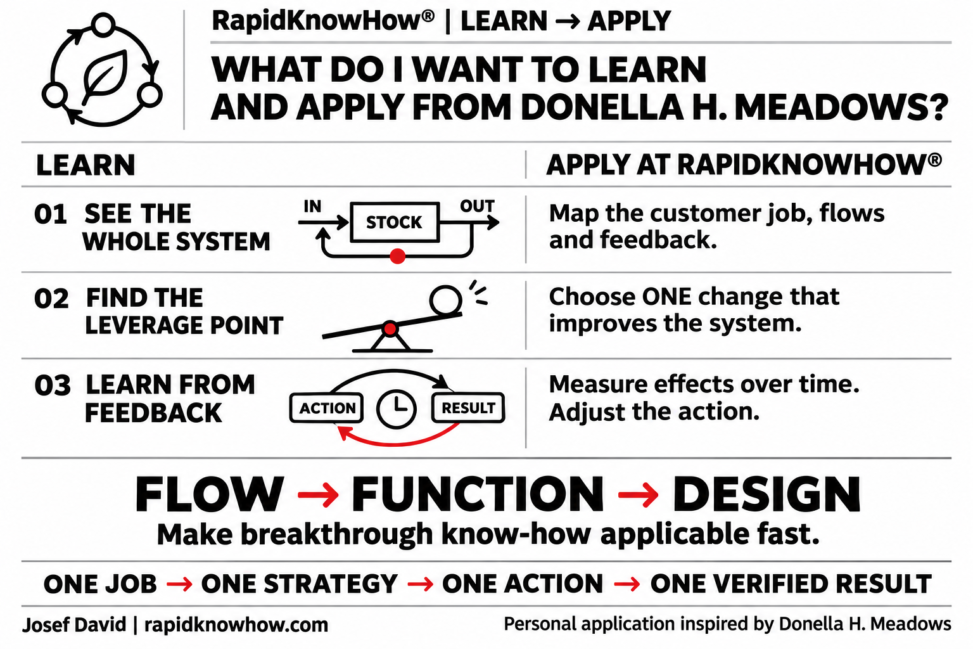
Applying Donella H. Meadows’ thinking to Business, Life and Career Leadership
The purpose of leadership is to create conditions in which useful results can be repeated and sustained.
Donella Meadows’ systems thinking helps us understand those conditions. It directs attention to what accumulates, what changes it, how decisions influence those changes and why consequences often arrive later than expected.
RapidKnowHow® turns this understanding into a practical operating principle:
ONE JOB → ONE STRATEGY → ONE ACTION → ONE VERIFIED RESULT
The verified result informs the next decision. This feedback transforms a sequence of actions into a learning system.
The ten systems below demonstrate this approach. All numerical examples are illustrative.
Understanding the system
A stock is something that accumulates: cylinders, unpaid invoices, unfinished commitments, financial reserves or demonstrated skills.
Inflows increase the stock. Outflows reduce it.
Closing stock = Opening stock + Additions − Reductions
Feedback connects the current situation with the next action. A balancing loop corrects a gap. A reinforcing loop amplifies an existing direction. Delays separate an action from its visible consequences.
The leadership task is to identify a useful intervention point, make a deliberate change and observe whether the whole system improves.
BUSINESS LEADERSHIP
1. The Cylinder Return System
Objective: Reduce unnecessary cylinder rental while maintaining reliable gas supply.
Idle cylinders accumulate when deliveries, consumption, physical returns and rental records are poorly connected.
The buying organization establishes a common register showing cylinder identity, location, operational need and rental status. A responsible person reviews idle units and arranges appropriate returns.
Suppose a site begins with 100 idle cylinders. During one month, another 20 become idle and 60 are returned.
100 + 20 − 60 = 60 idle cylinders remaining.
The feedback loop connects the idle-cylinder count with return activity. More idle units trigger more review and return tasks. Accepted returns reduce the stock.
The intervention point is the connection between physical assets, contractual conditions and invoices.
Assume the net reduction of 40 cylinders avoids rental of €8 per cylinder each month. The potential recurring gross avoidance is €320 monthly. An assumed one-time collection cost of €80 reduces the first full month’s benefit to €240 before tax, provided the rental charges actually stop.
ONE action: Reconcile 20 cylinder identities at ONE customer site.
Verified result: Accepted returns, confirmed rental-stop dates and lower subsequent charges, with supply continuity maintained.
The buying organization leads. RapidKnowHow® provides neutral know-how and practical support.
2. The Cash Collection System
Objective: Convert accepted customer value into collected cash.
Receivables accumulate when invoices are issued faster than customers pay them. Delays may arise from missing acceptance records, disputed charges or unclear responsibility.
The system makes these obstacles visible and assigns each unresolved invoice to someone able to resolve it.
Suppose opening receivables are €50,000. During the month, €20,000 is invoiced and €30,000 is collected.
€50,000 + €20,000 − €30,000 = €40,000 closing receivables.
The feedback loop connects overdue balances with timely resolution. Resolving a dispute enables payment, which reduces the outstanding balance.
The intervention point is reliable information reaching the person who can act.
ONE action: Resolve ONE overdue invoice and confirm a payment date.
Verified result: The payment appears in the bank account and is reconciled with the invoice.
The €10,000 reduction can represent a one-time working-capital release. It does not establish €10,000 of recurring monthly profit.
3. The Verified Solution System
Objective: Build reusable evidence of customer value.
RapidKnowHow® accumulates useful knowledge when completed customer improvements are documented and checked.
A case enters the system when its starting position, action, costs and outcome are supported by evidence. Cases leave when their information becomes obsolete or their conclusions can no longer be supported.
Suppose there are five usable cases. Three new cases are validated and one existing case becomes obsolete.
5 + 3 − 1 = 7 usable cases.
The reinforcing loop connects credible evidence with buyer confidence. Greater confidence can support more completed pilots, which can produce further verified cases.
The intervention point is the standard for admitting a case into the evidence base.
ONE action: Document ONE completed customer improvement with the customer’s consent.
Verified result: A usable case containing the baseline, action, implementation cost, outcome and supporting records.
The system must also retain lessons from unsuccessful interventions. Otherwise, the evidence becomes selective and weakens future decisions.
4. The Pilot Capacity System
Objective: Deliver customer pilots reliably within available capacity.
Active pilots accumulate when new work starts faster than existing work finishes. Excessive simultaneous work can increase delays, rework and delivery costs.
The system establishes a limit on active pilots and reviews new commitments against actual capacity.
Suppose six pilots are active. Two begin and three finish during the month.
6 + 2 − 3 = 5 active pilots.
The balancing loop connects workload with admission decisions. When active work approaches the capacity limit, fewer new pilots start.
The intervention point is the rule governing new commitments.
ONE action: Agree a maximum number of simultaneous pilots and assign responsibility for enforcing it.
Verified result: Shorter completion times, maintained quality and customer acceptance within the agreed resource limit.
The financial effect requires separate verification through costs, invoicing and collections.
LIFE LEADERSHIP
5. The Time Freedom System
Objective: Create usable time by controlling commitments.
Unfinished commitments accumulate when new obligations are accepted faster than existing ones are completed or deliberately removed.
The system introduces a simple acceptance rule: a new commitment needs a clear purpose and an available place in the calendar.
Suppose there are 12 unfinished commitments. Four are accepted and seven are completed or cancelled during the week.
12 + 4 − 7 = 9 unfinished commitments.
The balancing loop connects a growing backlog with a stronger acceptance filter.
The intervention point is the decision to accept another obligation.
ONE action: Remove or simplify ONE recurring commitment that contributes little value.
Verified result: Time becomes available in the calendar and remains usable.
Removing a 30-minute weekly obligation releases two hours over four weeks. Changes should be agreed with anyone affected so the workload is not simply transferred.
6. The Household Resilience System
Objective: Maintain a practical reserve for unexpected expenses.
A household reserve grows through affordable transfers and declines through withdrawals.
The system compares the reserve with a household-defined target, taking essential expenses and upcoming bills into account.
Suppose the reserve begins at €3,000. During the month, €400 is transferred into it and €150 is withdrawn.
€3,000 + €400 − €150 = €3,250 closing reserve.
The balancing loop connects the gap below the target with future affordable transfers.
The intervention point is an agreed funding rule.
ONE action: Review upcoming expenses and agree ONE affordable transfer.
Verified result: The reserve increases without causing unpaid essential bills.
At assumed essential spending of €2,000 monthly, coverage rises from 1.50 to approximately 1.63 months. Moving money between accounts changes its allocation; it does not itself create wealth.
7. The Shared Commitment System
Objective: Improve reliability in family or community relationships.
Unresolved agreements accumulate when expectations, responsibilities or dates remain unclear.
The system creates a brief, respectful review of shared commitments. Participants clarify what will happen, who will act and when the agreement will be reviewed.
Suppose eight agreements remain unresolved. Three new agreements are made and five are fulfilled or explicitly renegotiated.
8 + 3 − 5 = 6 unresolved agreements.
The balancing loop connects unresolved commitments with earlier joint review and resolution.
The intervention point is shared understanding.
ONE action: Hold ONE 15-minute conversation about outstanding agreements.
Verified result: Responsibilities become clearer, agreements are fulfilled and the people involved experience greater reliability and fairness.
Trust may improve more slowly than the task list. Relationship quality therefore needs conversation and judgement as well as records.
CAREER LEADERSHIP
8. The Applied Skill System
Objective: Convert learning into demonstrated capability.
Capability develops when knowledge is applied, assessed and improved through feedback.
The system counts competencies only when they meet an agreed practical standard. It also recognises that skills can become outdated.
Suppose four competencies are current. Two additional competencies are demonstrated and one becomes obsolete.
4 + 2 − 1 = 5 current competencies.
The reinforcing loop connects demonstrated capability with access to more challenging work. That work provides further practice and feedback, supporting additional capability.
The intervention point is the definition of successful learning.
ONE action: Apply ONE selected skill to a real task and obtain independent feedback.
Verified result: A work sample meets an agreed standard.
Career value depends on whether the capability is useful in actual work. Promotion and higher earnings require separate evidence.
9. The Professional Relationship System
Objective: Build useful, reciprocal professional relationships.
Active relationships develop through meaningful exchanges. They can become inactive when contact or mutual relevance declines.
The system encourages relevant contributions and respectful follow-up. An agreed definition of “active” keeps the count consistent.
Suppose there are 20 active relationships. Five are activated and two become inactive during the month.
20 + 5 − 2 = 23 active relationships.
The reinforcing loop connects useful exchanges with greater willingness to reconnect, collaborate and exchange further knowledge.
The intervention point is the quality and relevance of the contribution.
ONE action: Offer ONE useful insight to a relevant professional contact.
Verified result: A meaningful reciprocal exchange occurs.
A larger network can improve access to knowledge and opportunities. The quality of those relationships cannot be established by contact counts alone.
10. The Career Opportunity System
Objective: Select work that fits capability, purpose and available capacity.
Qualified opportunities accumulate when suitable options enter the pipeline. They leave when accepted, declined or allowed to expire.
The system establishes selection criteria before pursuing opportunities. These include purpose, capability, terms and workload.
Suppose six qualified opportunities are open. Four enter the pipeline and three close.
6 + 4 − 3 = 7 open opportunities.
The balancing loop connects a growing pipeline with stronger qualification and timely decisions.
The intervention point is the rule defining a worthwhile opportunity.
ONE action: Assess ONE opportunity against the agreed criteria and make a clear decision.
Verified result: Suitable work is accepted on understood terms and within sustainable capacity.
The number of options measures available choice. Value emerges through selecting and completing appropriate work.
CONNECTING THE TEN SYSTEMS
Business, Life and Career Leadership influence one another.
Business activity consumes time and professional capacity. Better skills can improve customer delivery. Reliable relationships can support cooperation. Household resilience can provide room for considered decisions.
A local improvement can therefore weaken the wider system. Accepting more customer pilots may increase commercial activity while creating delivery delays and reducing family time.
The leadership responsibility is to examine these connections before expanding an intervention.
| Leadership area | Intended value | Evidence |
|---|---|---|
| Business | Customer outcomes and collected cash | Operating records, accepted results and payments |
| Life | Usable time, resilience and reliable relationships | Calendars, reserves and shared experience |
| Career | Demonstrated capability and suitable work | Assessed work, reciprocal exchanges and agreed opportunities |
APPLYING ONE SYSTEM
Begin by observing the current situation. Define the boundary, record the starting position and identify the people affected.
Choose ONE intervention. State why it should influence the system, who owns it and when its effects should become visible.
Allow for the delay. Monitor the stock, additions, reductions, costs and unintended effects. Avoid repeatedly changing the intervention before its consequences can be assessed.
Verify the result. Compare it with the baseline and consider other explanations for the change.
Then decide whether to continue, adapt or stop.
THE RAPIDKNOWHOW® LEADERSHIP APPLICATION
The user owns the objective and leads the action.
RapidKnowHow® supplies the know-how, decision support and practical method.
Records and evidence establish the result.
For the first Business Leadership application, select the Cylinder Return System at ONE industrial gas customer site. Reconcile the assets, confirm accepted returns, establish when rental charges stop and verify the net cash effect.
Expand only after the evidence supports the decision.
ONE JOB → ONE STRATEGY → ONE ACTION → ONE VERIFIED RESULT
RapidKnowHow® — THE DECISION COMPANY™
Industrial Gas Leadership 2030
PROVE VALUE. THEN SCALE.
Watch the 60-second roadmap: 10 strategic actions for DACH and CEE, 2026–2030.
Start with ONE customer challenge. Use the Industrial Gas Action Guide to turn your first action into a measurable result.
RapidKnowHow® — Leading Industrial Gas Opportunity Signal Identifier in DACH & CEE