
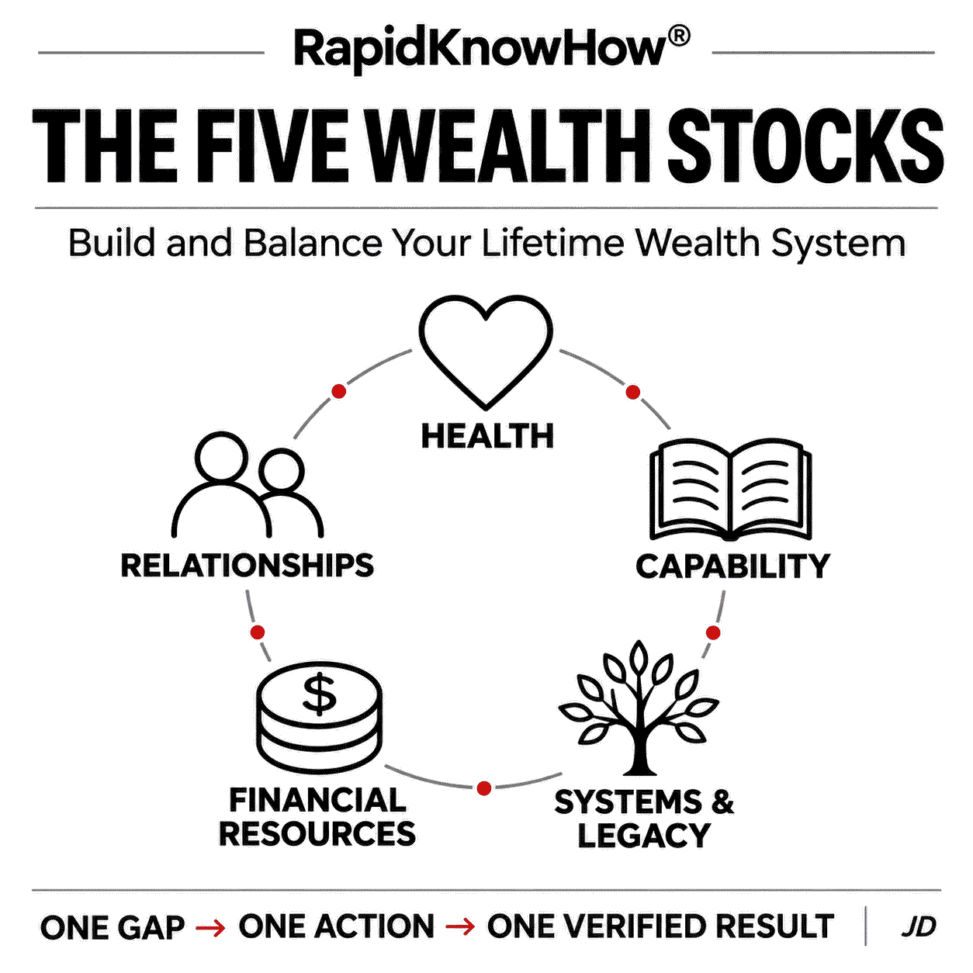
Build wealth by strengthening the whole system. Check whether progress in one area is quietly exhausting another.
Business, Life and Career draw on the same resources: your capacity, capability, relationships, money and working systems. The RapidKnowHow® FIVE Wealth Stocks framework makes those connections visible.
A stock accumulates over time. Inflows build it; outflows drain it. An intervention changes those flows or the rules governing them. It becomes a demonstrated leverage point when evidence shows that the change produces a substantial, lasting improvement.
The FIVE stocks and where to intervene
| Wealth stock | What builds it | What drains it | 🔴 Candidate intervention | Evidence to review |
|---|---|---|---|---|
| Health and functional capacity | Recovery, supportive routines and appropriate care | Illness, sustained overload and neglect | Redesign ONE recurring source of overload. | Workload, recovery time and daily functioning. |
| Knowledge and capability | Learning, practice and feedback | Obsolescence and unused skills | Apply ONE useful skill to a real problem. | Quality of the result and external feedback. |
| Relationships and trust | Attention, reliability and reciprocity | Neglect and broken promises | Renegotiate ONE unreliable commitment and keep the revised agreement. | Commitments fulfilled and feedback from those affected. |
| Financial resources | Retained surplus and net asset gains | Spending, losses and obligations | Remove ONE documented cash bottleneck. | Actual net cash retained after associated costs. |
| Useful systems and legacy | Documented methods and capable successors | Complexity and dependence on one person | Transfer ONE repeatable process. | Independent completion, quality and time released. |
These stocks have different units. Keep their measures separate. Balance means maintaining viable levels for your purpose and circumstances—not giving every stock an equal score.
Connect Business, Life and Career
| Domain | Its contribution to the system | Its balancing question |
|---|---|---|
| Business | Creates customer value and resources to sustain operations. | Does growth retain cash while preserving delivery capacity and trust? |
| Life | Provides purpose, relationships, recovery and enjoyment. | Does the way I work support the life I want? |
| Career | Develops useful capability, credible results and future choices. | Am I building opportunities without creating unsustainable commitments? |
An attractive business opportunity can still weaken the overall system if it requires permanent personal availability. A training programme can consume time without building capability if nothing is applied. Higher earnings may create little financial resilience if commitments rise just as quickly.
Demonstration: intervene in the overload loop
Consider an illustrative owner-led business:
More orders → more owner involvement → less available attention → errors and rework → more owner involvement
The visible symptom is a busy owner. The candidate leverage point is a rule: every routine customer decision requires the owner’s approval.
🔴 Intervention: Define clear decision limits, document ONE recurring process and train a colleague to complete it.
This could affect all five stocks:
| Stock | Potential effect | What must be checked |
|---|---|---|
| Health and function | Less work spilling into recovery time. | Whether hours and overload actually fall. |
| Capability | A colleague develops practical competence. | Whether the process is completed correctly. |
| Trust | Responsibilities become clearer. | Whether customers and colleagues experience reliable delivery. |
| Financial resources | Less rework or owner time required. | Net benefit after training, supervision and correction costs. |
| Systems and legacy | Less dependence on one person. | Whether the process works during the owner’s absence. |
The change succeeds only if the wider evidence supports it. Moving excessive workload to a colleague would transfer the problem rather than resolve it.
Operate the balancing feedback loop
OBSERVE → COMPARE → INTERVENE → VERIFY → REVIEW
- Observe: Record the current condition of each stock.
- Compare: Identify the gap against a personally meaningful target or minimum.
- Intervene: Change ONE rule, connection or recurring process causing the gap.
- Verify: Measure the intended effect and consequences for the other stocks.
- Review: Retain, adjust or reverse the change after allowing for relevant delays.
Your ONE action for the next 30 days
Complete this statement:
“My system is constrained by ________. I will change ________. I expect ________. I will verify it using ________, while checking that ________ does not deteriorate.”
Choose the constraint that most threatens the system’s purpose. Establish the baseline before acting.
ONE OBJECTIVE → ONE LEVER → ONE ACTION → ONE VERIFIED RESULT
Create value. Protect the balance. Build freedom. Pass it on. – Josef David