
Evolving resilient, self-organizing systems from the bottom up through AI orchestration.
The central idea: enable people closest to a problem to solve it, verify the result, and help the whole system learn.
Donella Meadows identified the ability to change and self-organize a system’s structure as a powerful intervention point. Information flows, rules and shared goals shape that ability. The model below applies her systems thinking to AI orchestration; it is a proposed RapidKnowHow® approach. The Donella Meadows Project
ONE repeatable learning algorithm
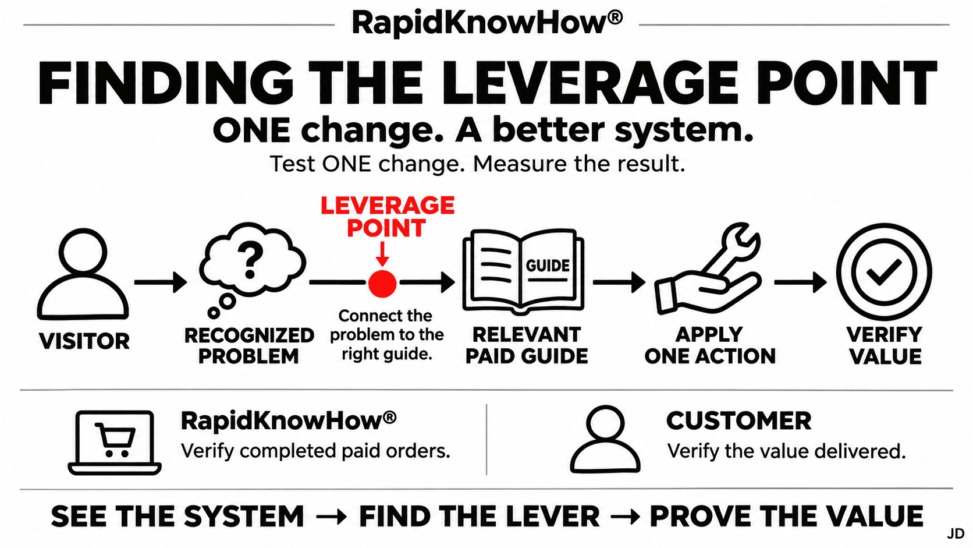
Recognize ONE problem → Set ONE objective → Find ONE leverage point → Apply ONE action → Verify ONE result → Adapt and reuse.
Each cycle begins with an observable problem. It ends with evidence that informs the next decision. A failed action also produces useful learning when its causes and limits are recorded honestly.
Three properties make the system work
| Property | How to build it | AI orchestration’s supporting role |
|---|---|---|
| Resilience | Preserve essential capacity, alternatives and the ability to recover when an action fails. | Monitor deviations, compare responses and flag emerging dependencies. |
| Self-organization | Give local teams authority to change their methods within agreed boundaries. | Bring relevant knowledge, evidence and options to the people doing the work. |
| Hierarchy | Connect local decisions through shared objectives, coordination and clear escalation. | Connect learning across levels and surface conflicts between local and overall results. |
Bottom-up learning needs a shared direction. Leadership establishes purpose, constraints and accountability. Local teams discover workable solutions. Coordination connects their decisions where resources, risks or outcomes overlap.
The hierarchy earns its place by helping its contributing teams perform better.
How the levels connect
| Level | Responsibility | Evidence passed onward |
|---|---|---|
| Individual or site | Recognize the problem and test an action. | Baseline, action, observed result and exceptions. |
| Team or cluster | Resolve dependencies and test reuse. | Where the solution works, where it fails and what must change. |
| Enterprise or ecosystem | Align objectives, allocate resources and revise shared rules. | Overall value, system risks and conditions for further adoption. |
Evidence travels upward. Purpose, resources and support flow back toward the work.
Example: industrial gas cylinder returns
At ONE customer site, the team identifies cylinders that appear unnecessary.
The buying organization sets the objective: reduce avoidable rental payments while maintaining supply reliability.
AI can assist with reconciling records, identifying discrepancies and organizing contract information. The responsible team confirms physical stock, required reserves and return conditions before acting.
The team returns eligible cylinders, checks supplier acceptance and verifies subsequent invoices and payments.
The result becomes reusable knowledge only when the record explains:
- What changed against the baseline.
- Which costs and effort were required.
- Whether supply reliability was maintained.
- Under which conditions another site could repeat the action.
A rental reduction becomes verified incremental FCF only after the relevant cash effects, implementation costs and timing are reconciled. A projected saving remains a hypothesis until supported by evidence.
The crucial intervention
🔴 Connect verified local results to the authority to improve shared rules.
If teams discover better methods but cannot change replenishment rules, contracts or information flows, learning stops at the site boundary. If successful methods become compulsory everywhere without checking local conditions, adaptation stops.
AI orchestration should help people judge what to reuse, what to adapt and what to retire. Decision owners remain accountable for those choices.
The same algorithm can guide Business, Life and Career systems. The evidence changes: collected cash in business, time recovered in daily life, or demonstrated capability in a career.
ONE ALGORITHM DELIVERED means a working cycle of action, proof and adaptation.
Start locally. Verify the value. Connect the learning. Evolve the system. -Josef David