
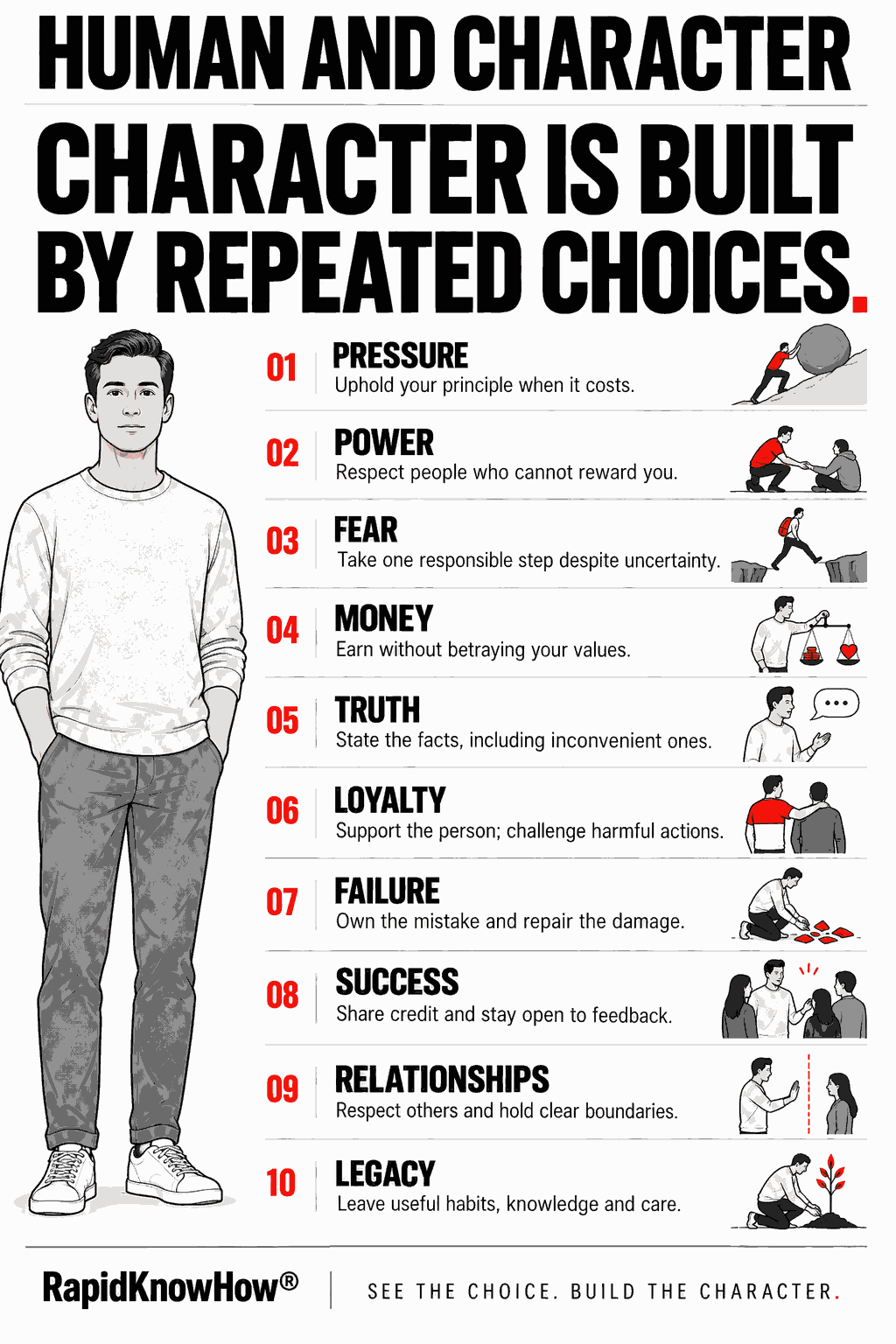
RapidKnowHow® HUMAN AND CHARACTER | Episode 02 of 10
Treat people with dignity regardless of their ability to reward or influence you.
The central question
How do we treat people who cannot help us?
This PowerPost offers a practical reflection on behaviour and choices. The story below is illustrative, not a report of a real person or event.
1. SITUATION — See the human dilemma
A director speaks warmly to an investor, then dismisses a cleaner who reports a blocked emergency exit. The cleaner has little organisational influence, but the observation matters.
2. CHOICE — Make the decision visible
Judge the message by the messenger’s status, or give the person a fair hearing and act on the evidence.
3. ACTION — Build character step by step
- Notice the power difference. Ask whether the other person can safely disagree or say no.
- Listen without humiliation. Ask what happened and what help is needed.
- Apply the same standards of courtesy and evidence to everyone. Explain decisions rather than relying on rank.
- Make it safe to raise concerns. Follow through and check for retaliation or repeated dismissal.
4. CONSEQUENCE — Check the result
A relevant concern is heard and addressed. Respect makes cooperation possible, although trust must be earned through repeated behaviour.
5. LESSON — Preserve what you learn
Authority gives us greater capacity to affect other people’s lives. That increases our responsibility for how we use it.
Measurable value delivered
Track concerns acknowledged, actions completed and whether people feel able to speak up. Do not interpret silence as proof that everything is fine.
ONE decision today
Invite one overlooked colleague to share a practical concern. Listen, agree a next step and close the loop.
ACTION CHECKLIST
- Name the situation and the people affected.
- Separate facts, assumptions and unknowns.
- Choose a principle and one concrete action.
- Set a completion date and a review point.
- Check the consequence, repair harm and adjust.
PASS: One responsible action completed and its consequence reviewed. FAIL: A stated intention with no action or review. At the first review, remove the one obstacle before adding more steps.
Character is shaped by temperament, experience, habits and circumstances. One action provides a signal; repeated choices provide stronger evidence. Assess behaviour carefully before labelling a person.
RapidKnowHow® — Understand the human. See the choice. Build the character.
Take the next step — RapidThrive™ PowerBook
All ten episodes in one 28-page PDF, including the PowerPicture, decision worksheet and ten-day plan. Reader edition: €19.
POWERLICENSE — Apply beyond one reader
For organisational or partner use, explore the existing RapidKnowHow® licensing options and request a License Partner Fit Check. Scope, rights and fees are agreed separately.
Separate licensing enquiry. The PowerBook purchase does not automatically grant broader licensing rights.