
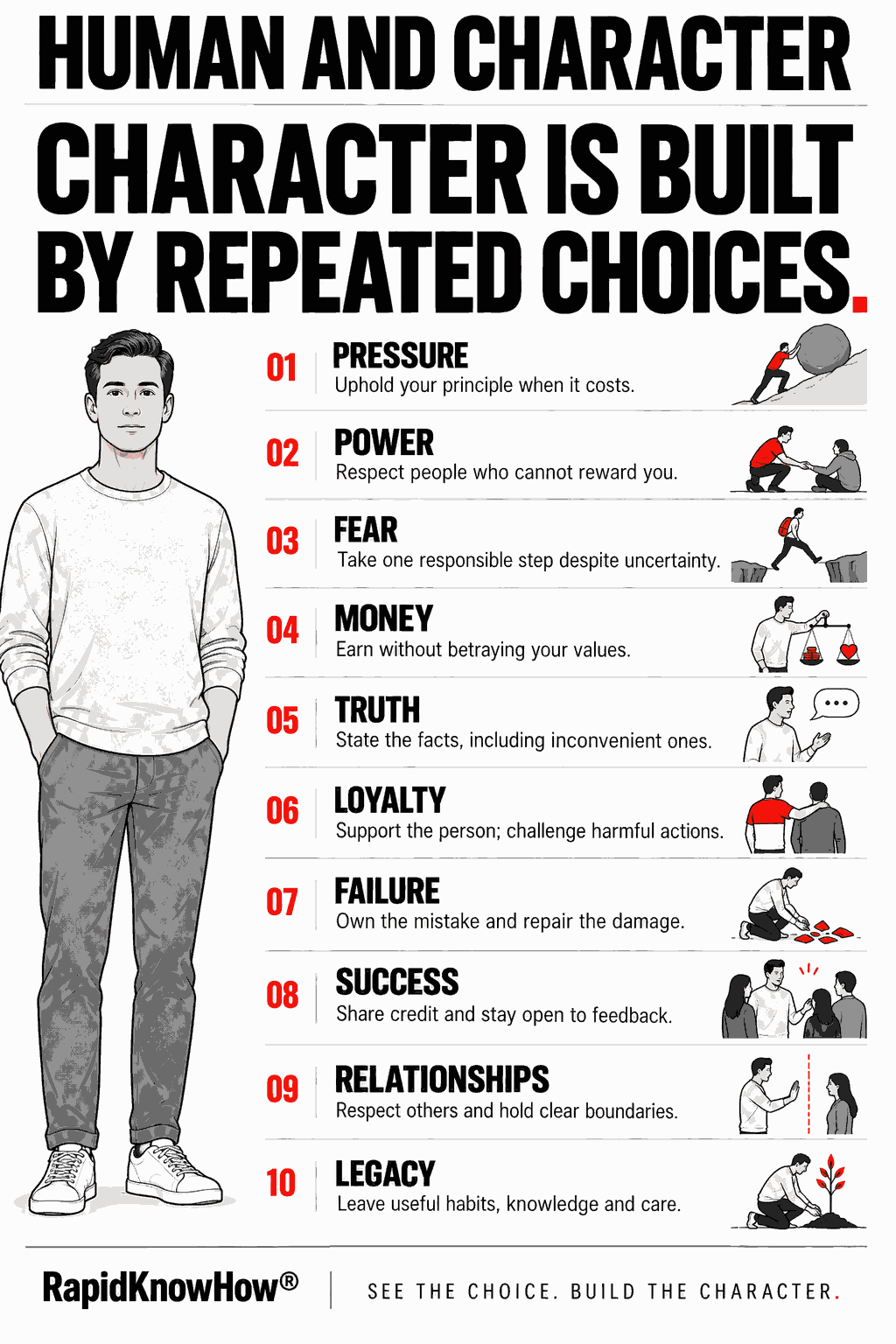
RapidKnowHow® HUMAN AND CHARACTER | Episode 06 of 10
Support the person while challenging conduct that causes harm or violates a clear commitment.
The central question
When should we support—and when should we challenge?
This PowerPost offers a practical reflection on behaviour and choices. The story below is illustrative, not a report of a real person or event.
1. SITUATION — See the human dilemma
A trusted colleague asks you to conceal an expense error. You value the relationship and do not want to embarrass them. Concealment would turn a repairable mistake into a shared deception.
2. CHOICE — Make the decision visible
Equate loyalty with silence, or help the colleague correct the error while refusing to conceal it.
3. ACTION — Build character step by step
- Clarify what happened before judging. Distinguish a mistake, a disagreement and repeated misconduct.
- Speak directly and respectfully when appropriate. Describe the action and its effect rather than attacking identity.
- Offer a repair: correct the record, reimburse the amount or seek appropriate guidance.
- Hold the boundary. If the issue persists or creates serious harm, use an appropriate escalation route.
4. CONSEQUENCE — Check the result
The person has a fair chance to repair the mistake, and you avoid endorsing the harmful action. The relationship may become stronger or strained; neither outcome alone determines whether the decision was right.
5. LESSON — Preserve what you learn
Loyalty is compatible with honest disagreement. Supporting someone can mean helping them stop making a damaging choice.
Measurable value delivered
Verify that the record was corrected, the consequence addressed and the behaviour reviewed. Protect confidentiality where appropriate.
ONE decision today
Prepare one sentence: ‘I support you, and I cannot support this action. Here is how we can repair it.’
ACTION CHECKLIST
- Name the situation and the people affected.
- Separate facts, assumptions and unknowns.
- Choose a principle and one concrete action.
- Set a completion date and a review point.
- Check the consequence, repair harm and adjust.
PASS: One responsible action completed and its consequence reviewed. FAIL: A stated intention with no action or review. At the first review, remove the one obstacle before adding more steps.
Character is shaped by temperament, experience, habits and circumstances. One action provides a signal; repeated choices provide stronger evidence. Assess behaviour carefully before labelling a person.
RapidKnowHow® — Understand the human. See the choice. Build the character.
Take the next step — RapidThrive™ PowerBook
All ten episodes in one 28-page PDF, including the PowerPicture, decision worksheet and ten-day plan. Reader edition: €19.
POWERLICENSE — Apply beyond one reader
For organisational or partner use, explore the existing RapidKnowHow® licensing options and request a License Partner Fit Check. Scope, rights and fees are agreed separately.
Separate licensing enquiry. The PowerBook purchase does not automatically grant broader licensing rights.