
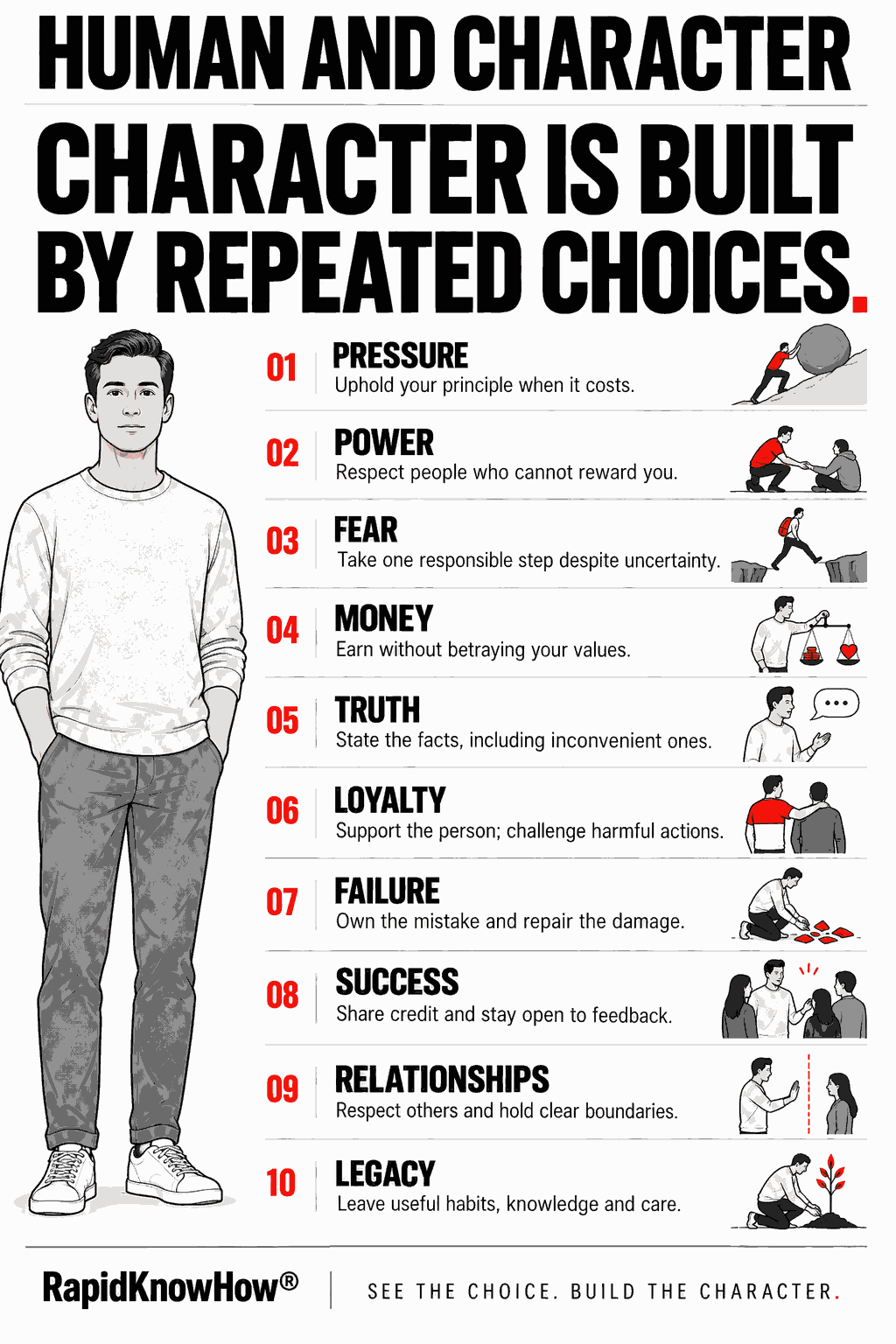
RapidKnowHow® HUMAN AND CHARACTER | Episode 05 of 10
State the relevant facts, distinguish uncertainty and correct errors even when inconvenient.
The central question
Do we tell the truth when it threatens our interests?
This PowerPost offers a practical reflection on behaviour and choices. The story below is illustrative, not a report of a real person or event.
1. SITUATION — See the human dilemma
A manager notices that a favourable performance report excludes a failed pilot. Including it could weaken the case for a promotion. Leaving it out could cause the board to approve an investment on misleading evidence.
2. CHOICE — Make the decision visible
Present a selectively positive story, or give decision-makers an accurate account of both performance and its limits.
3. ACTION — Build character step by step
- Check the evidence. Confirm definitions, time period, exclusions and the origin of the numbers.
- Separate facts from interpretation. Label estimates, unknowns and contrary evidence.
- Disclose material information to the people entitled to receive it. Be accurate while respecting legitimate confidentiality.
- Correct errors promptly. Explain what changed and whether earlier decisions need to be reviewed.
4. CONSEQUENCE — Check the result
The decision can be based on a more accurate picture. The correction may hurt the manager’s immediate interests, but it reduces the risk of compounding a misleading conclusion.
5. LESSON — Preserve what you learn
Truthfulness includes what we say, what we omit and how we correct ourselves.
Measurable value delivered
Track material corrections, disclosed assumptions and decisions revisited after new evidence. Avoid turning truthfulness into an unsupported numerical character score.
ONE decision today
Take one important claim you are using today. Add its evidence, one limitation and any fact that materially changes its meaning.
ACTION CHECKLIST
- Name the situation and the people affected.
- Separate facts, assumptions and unknowns.
- Choose a principle and one concrete action.
- Set a completion date and a review point.
- Check the consequence, repair harm and adjust.
PASS: One responsible action completed and its consequence reviewed. FAIL: A stated intention with no action or review. At the first review, remove the one obstacle before adding more steps.
Character is shaped by temperament, experience, habits and circumstances. One action provides a signal; repeated choices provide stronger evidence. Assess behaviour carefully before labelling a person.
RapidKnowHow® — Understand the human. See the choice. Build the character.
Take the next step — RapidThrive™ PowerBook
All ten episodes in one 28-page PDF, including the PowerPicture, decision worksheet and ten-day plan. Reader edition: €19.
POWERLICENSE — Apply beyond one reader
For organisational or partner use, explore the existing RapidKnowHow® licensing options and request a License Partner Fit Check. Scope, rights and fees are agreed separately.
Separate licensing enquiry. The PowerBook purchase does not automatically grant broader licensing rights.