
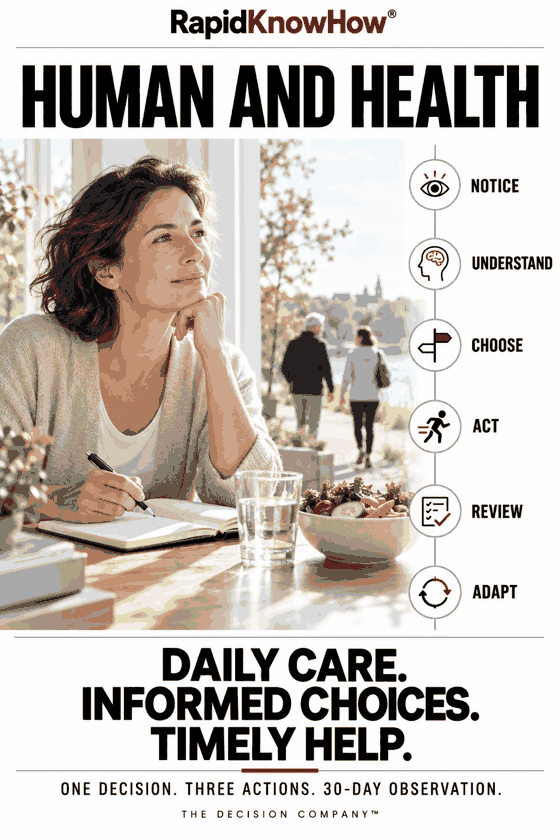
HEALTH GROWS THROUGH DAILY CARE, INFORMED DECISIONS AND TIMELY HELP.
How can movement support everyday capabilities?
WHO guidance recognizes benefits from regular movement, including walking, wheeling and everyday activity. Strength and balance also matter, especially with ageing. Population recommendations provide context; a person’s condition, abilities and care plan determine an appropriate starting point.
THE SIGNAL / PROBLEM
The signal is prolonged sitting or a valued task becoming harder. Sudden deterioration should not be treated as a fitness challenge.
THE SYSTEM
Choose movement suited to your present ability and surroundings. Start modestly if inactive and build gradually when appropriate. For chronic conditions, recent surgery, falls or symptoms, agree limits with your clinician or physiotherapist rather than copying another person’s programme.
ONE DECISION
Make one safe, suitable movement opportunity easier to repeat.
TOP 3 ACTIONS
- Identify a movement you can do comfortably within existing advice.
- Remove one practical barrier such as access, timing or support.
- Record participation and how you felt without chasing a target.
30-DAY OBSERVATION
A record of suitable activity opportunities completed and any difficulties to discuss with your care team.
ILLUSTRATIVE CASE
A desk worker puts a short comfortable walk into an existing break. A person who cannot walk chooses a suitable seated or wheeling activity with appropriate guidance.
CARE CHECK
Stop activity and seek urgent help for severe symptoms such as chest pain or severe breathlessness. Do not train through them.
ACTION CHECKLIST
Choose one relevant need → record observations → choose a suitable action or care contact → act → review → adapt. Seek care sooner whenever symptoms or your care plan require it.
WHO: physical activity. Sources checked 7 October 2026. The decision framework and cases are RapidKnowHow editorial work, not clinical protocols.
← Previous episode · Start the series · Next episode →
Apply the complete system
For organisational health-literacy education, explore PowerLicense →. Scope, rights and fees are separate. Licensing does not authorize diagnosis or treatment.
General education for adults. Not a diagnosis, treatment plan or individualized exercise or diet prescription. Cases are illustrative; no medical outcome is promised.
RapidKnowHow® — THE DECISION COMPANY™