
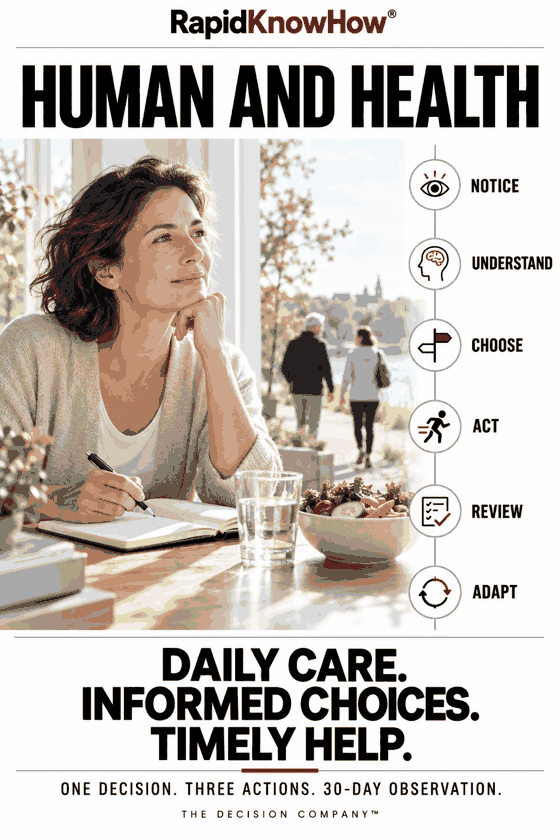
HEALTH GROWS THROUGH DAILY CARE, INFORMED DECISIONS AND TIMELY HELP.
Which changes deserve attention and timely medical help?
Prevention includes informed use of appropriate services and timely responses to symptoms. Screening is for people without the relevant symptoms and has benefits and limitations. A screening result does not replace assessment of a new concern.
THE SIGNAL / PROBLEM
The signal is a new, unexplained or worsening change, or uncertainty about a recommended preventive service. Urgent symptoms belong outside a 30-day experiment.
THE SYSTEM
Record what changed, when it began and how it affects you. Ask your clinician about vaccination and screening suited to your age, history and local programme. Seek immediate help for sudden persistent chest pain, severe breathing difficulty or stroke signs such as facial droop, arm weakness or speech difficulty, even if stroke symptoms improve.
ONE DECISION
Match the next step to urgency rather than postponing all concerns to the review date.
TOP 3 ACTIONS
- Identify the service to contact for routine, urgent and emergency help.
- Discuss one relevant preventive service with your clinician.
- Bring new or persistent symptoms for assessment at the appropriate time.
30-DAY OBSERVATION
A documented preventive-care decision and clear contact plan; urgent assessment happens immediately when needed.
ILLUSTRATIVE CASE
A reader receives a screening invitation and asks about its purpose, possible harms and follow-up. Another reader develops a new symptom and seeks assessment instead of waiting for screening.
CARE CHECK
In the EU, call 112 for a medical emergency. These examples are not an exhaustive symptom checklist.
ACTION CHECKLIST
Choose one relevant need → record observations → choose a suitable action or care contact → act → review → adapt. Seek care sooner whenever symptoms or your care plan require it.
WHO: screening; NHS: chest pain and stroke; EU: 112. Sources checked 7 October 2026. The decision framework and cases are RapidKnowHow editorial work, not clinical protocols.
Additional sources: NHS: chest pain · NHS: stroke · EU emergency number 112.
← Previous episode · Start the series · Next episode →
Apply the complete system
For organisational health-literacy education, explore PowerLicense →. Scope, rights and fees are separate. Licensing does not authorize diagnosis or treatment.
General education for adults. Not a diagnosis, treatment plan or individualized exercise or diet prescription. Cases are illustrative; no medical outcome is promised.
RapidKnowHow® — THE DECISION COMPANY™