
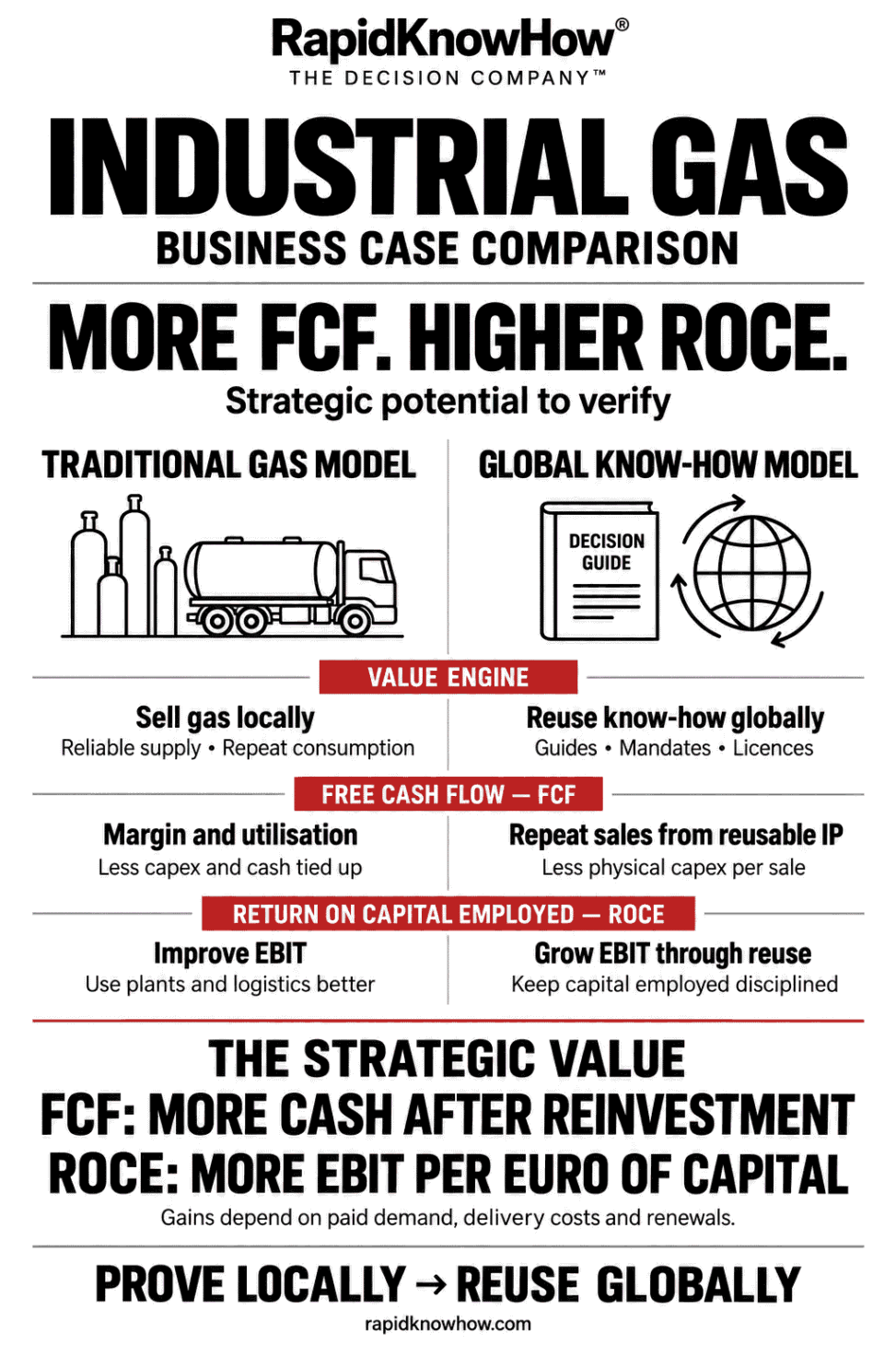
PROVE VALUE LOCALLY. SCALE KNOW-HOW GLOBALLY. IMPROVE FCF AND ROCE THROUGH REPEATABLE CUSTOMER VALUE.
RapidKnowHow® — THE DECISION COMPANY™
PowerReport | Business Case | 15 October 2026
1. THE STRATEGIC DECISION
Industrial gas companies create value by supplying essential gases reliably. A know-how business creates value by helping customers make and execute better decisions.
Both models can generate recurring income. Their growth constraints, investment requirements and cash-flow characteristics differ.
ONE decision for RapidKnowHow: Build a focused know-how business around industrial gas expertise. Start with ONE repeatable customer problem, prove the method through paid mandates, then offer clearly defined annual licences.
The value-development process:
Local experience → Paid mandate → Verified customer value → Reusable case → Annual licence → Renewal and expansion → Transferable free cash flow.
All financial figures below are illustrative planning assumptions. They are not industry benchmarks, forecasts or achieved RapidKnowHow results.
2. COMPARING THE BUSINESS MODELS
| Dimension | Traditional local gas business | Global know-how business |
|---|---|---|
| Customer buys | Gas availability, purity, reliability and application performance | A clearer decision and a method to execute and verify it |
| Delivery | Plants, pipelines, tankers, cylinders and distributors | Reports, decision tools, remote reviews and licences |
| Growth constraint | Capacity, route density, utilisation and customer proximity | Credibility, acquisition, adaptation, delivery capacity and renewal |
| Capital requirements | Equipment, facilities, inventory and working capital; requirements vary by supply model | Product development, evidence, software, marketing, expert time and updates |
| Recurring revenue | Repeat consumption and supply contracts | Annual access, reuse rights, updates and support |
| Competitive advantage | Infrastructure, local service and customer integration | Proven methods, trusted expertise, reusable intellectual property and execution |
| Main risks | Energy costs, underutilisation, logistics, reliability and credit losses | Weak willingness to pay, copying, churn and founder dependence |
The models can reinforce each other. A gas supplier can attach know-how to its supply relationships. An independent expert can sell decision systems without owning gas-production assets.
3. STRATEGIC VALUE: FREE CASH FLOW
Free cash flow improves when a business generates more operating cash while controlling reinvestment and working-capital requirements.
For a local gas business, the main improvement opportunities include:
- Protecting margins through appropriate pricing.
- Improving plant, cylinder and fleet utilisation.
- Increasing delivery-route efficiency.
- Reducing overdue receivables.
- Matching investment to profitable demand.
For a know-how business, the opportunities include:
- Selling a reusable method to several customers.
- Reducing repeated development work.
- Standardising delivery and support.
- Collecting payment before digital delivery.
- Building renewals around continued usefulness.
Digital delivery has low physical distribution requirements. Customer acquisition, expert time, localisation and updates still consume cash.
The strategic advantage comes from profitable reuse.
4. ILLUSTRATIVE BUSINESS CASE: EQUAL REVENUE, DIFFERENT CASH DEMANDS
The following comparison assumes €1 million annual revenue in each business.
Cash operating costs include market-rate management or founder compensation. The model uses a simplified 25% cash-tax assumption on positive operating cash surplus.
Figures exclude VAT, interest and financing.
| Annual cash bridge | Local gas business | Know-how business |
|---|---|---|
| Revenue | €1,000,000 | €1,000,000 |
| Direct cash costs | −€600,000 | −€150,000 |
| Sales, staff, administration and updates | −€200,000 | −€500,000 |
| Operating cash surplus before tax | €200,000 | €350,000 |
| Assumed cash tax | −€50,000 | −€87,500 |
| Maintenance or platform reinvestment | −€60,000 | −€20,000 |
| Increase in working capital | −€20,000 | €0 |
| Illustrative annual free cash flow | €70,000 | €242,500 |
| FCF margin | 7.0% | 24.25% |
| Opening capital committed | €600,000 | €150,000 |
Under these assumptions, the know-how business generates €172,500 more annual free cash flow.
This difference is a scenario result, not evidence that know-how businesses always outperform gas businesses.
The local case represents a small distribution and service operation—not a new air separation plant. Its opening capital comprises €450,000 of equipment and €150,000 of working capital.
The know-how case assumes €100,000 for product and intellectual-property development and a €50,000 launch reserve.
This is a simplified cash-planning model. Actual tax calculations require depreciation, amortisation and the applicable tax treatment.
5. STRATEGIC VALUE: RETURN ON CAPITAL EMPLOYED
ROCE measures operating profit generated per euro of capital employed.
ROCE = EBIT ÷ Average capital employed × 100
EBIT means earnings before interest and tax.
A local gas business can improve ROCE by increasing profitable throughput, improving asset utilisation and controlling working capital.
A know-how business can potentially improve ROCE by reusing intellectual property across customers while keeping additional capital requirements disciplined.
However, lower physical investment alone does not establish higher ROCE. The business must earn sufficient operating profit after including the real cost of expertise, acquisition, support and updates.
The cash model above does not establish accounting EBIT or average capital employed. It therefore does not support a defensible numerical ROCE comparison.
The strategic objective: more sustainable EBIT from each euro of capital employed, alongside stronger free cash flow.
6. TEST THE LICENCE ECONOMICS
Assume:
- Annual licence revenue: €5,000 per customer.
- Direct onboarding, support and payment costs: €1,000 per licence.
- Contribution toward fixed costs: €4,000 per licence.
- Fully loaded annual fixed costs: €180,000.
Fixed costs include management, marketing, product updates, administration and systems.
Break-even: €180,000 ÷ €4,000 = 45 active licences.
| Scenario | Active licences | Annual revenue | Cash surplus before tax and reinvestment |
|---|---|---|---|
| Downside | 20 | €100,000 | −€100,000 |
| Break-even | 45 | €225,000 | €0 |
| Base illustration | 60 | €300,000 | €60,000 |
| Scale illustration | 100 | €500,000 | €220,000 |
This standalone licence model is separate from the €1 million revenue comparison. The results must not be added together.
Renewal determines the replacement burden
With 60 opening licences and an 80% renewal rate, 48 customers renew. Twelve new customers are needed to maintain 60.
At an assumed €2,000 acquisition cost per new customer, replacement demand consumes €24,000 of the marketing budget.
At 60% renewal, 24 replacement customers are needed, costing €48,000.
These acquisition costs must fit within the fixed-cost budget or be added to it.
Delivery capacity also matters
At 100 licences and six support hours per customer annually, support alone requires 600 hours.
A scalable licence business therefore needs documented methods, defined support limits and sufficient delivery capacity.
7. THE RAPIDKNOWHOW APPLICATION
Start with ONE customer problem: improve cash conversion without weakening supply reliability.
Build initial evidence in DACH and CEE. Extend to additional markets after checking customer needs, language and local operating conditions.
| Offer to test | Customer receives | Commercial purpose |
|---|---|---|
| Cash & Liquidity Action Guide | Decision framework, cash baseline and 30-day worksheet | Paid entry and self-directed application |
| Scoped paid mandate | Baseline review, prioritised decision, action plan, owner and evidence review | Prove useful customer value |
| Annual team licence | Defined internal reuse rights, current toolkit, updates and scoped reviews | Recurring access and application |
| Partner licence | Controlled delivery rights, facilitator standards and quality review | Expand through qualified partners |
Illustrative test prices are €99 for the separate Action Guide, €3,000 for a scoped mandate and €5,000 annually for a team licence.
These are proposed test offers, not current shop listings or approved commercial terms. They are separate from the selling price of this PowerReport.
The customer journey remains:
Enter challenge → See three relevant solutions → Choose ONE → Buy the matching guide → Pay → Download PDF and receive email.
A mandate supports application. A licence supports repeated use after value has been demonstrated.
8. THE 30-DAY ACTION PLAN
ONE measurable target: three paid pilots with documented baselines.
| Timing | Action | Evidence required |
|---|---|---|
| Days 1–7 | Package ONE Cash & Liquidity guide and mandate scope | Clear deliverables, defined founder hours and a working purchase-to-PDF route |
| Days 8–14 | Attract qualified inbound enquiries through sector PowerPosts and the website | Enquiry source, paid orders, conversion and reasons for declining |
| Days 15–30 | Deliver up to three paid pilots | Baseline, decision, responsible owner, delivery effort and evidence |
A proposed maximum external cash budget for this test is €3,000. Founder time must also be recorded and costed.
TOP 3 ACTIONS
- PRODUCTISE: Define one cash problem with a repeatable baseline and worksheet.
- PROVE: Sell and deliver tightly scoped pilots; measure fully loaded delivery costs.
- PRESERVE: Convert useful results into permissioned cases and a defined licence proposal.
Track customer outcomes beyond day 30. Renewal evidence will take longer.
9. EXAMPLE: RELEASING CASH FROM RECEIVABLES
Assume annual credit sales of €2 million and average receivable days of 45.
Receivables = €2,000,000 × 45 ÷ 365 = approximately €246,575.
A sustained five-day reduction would release:
€2,000,000 × 5 ÷ 365 = approximately €27,397.
This is a one-time working-capital release at the assumed sales level. It is not recurring annual profit.
Verify sales mix, ageing, bad debt and seasonality before attributing the change to the method.
10. BUILD TRANSFERABLE ENTERPRISE VALUE
A local gas business can compound through utilisation, route density, customer retention and service quality.
A know-how business can compound through reusable intellectual property, customer evidence, lower repeated delivery effort, renewals and qualified partners.
Neither model automatically deserves a higher valuation.
For RapidKnowHow, the priorities are to:
- Document the method so another qualified person can deliver it.
- Clarify intellectual-property ownership and licence rights.
- Standardise delivery, support and evidence.
- Develop customer relationships beyond the founder.
- Measure recurring revenue, contribution and renewal.
- Reinvest selectively in methods customers actually use.
Enterprise value depends on sustainable, transferable cash flow.
ONE FINAL DECISION
PROVE ONE CUSTOMER RESULT LOCALLY. TURN IT INTO A REUSABLE METHOD. SCALE THROUGH PAID APPLICATION AND RENEWING LICENCES.
Expand when paid pilots demonstrate useful decisions and positive delivery contribution.
Revise the offer when customers require extensive custom work.
Pause expansion when demand remains unproven or the agreed test budget is exhausted.
RapidKnowHow® — THE DECISION COMPANY™
ONE challenge. ONE decision. ONE measurable result.
Sources and evidence
Industry sources reviewed on 15 October 2026:
- Air Liquide — Industrial Merchant: physical distribution, application expertise and digital services.
- Air Liquide — On-site production contracts announcement, 26 January 2023: historical explanation of customer-site production and long-term supply contracts.
- Linde Engineering — Air Separation Plants: proprietary technology, engineering, operating experience and international delivery.
Financial figures and proposed offers are illustrative business-case assumptions. Customer demand, acquisition costs, measured outcomes, renewals and company valuation remain to be verified.