
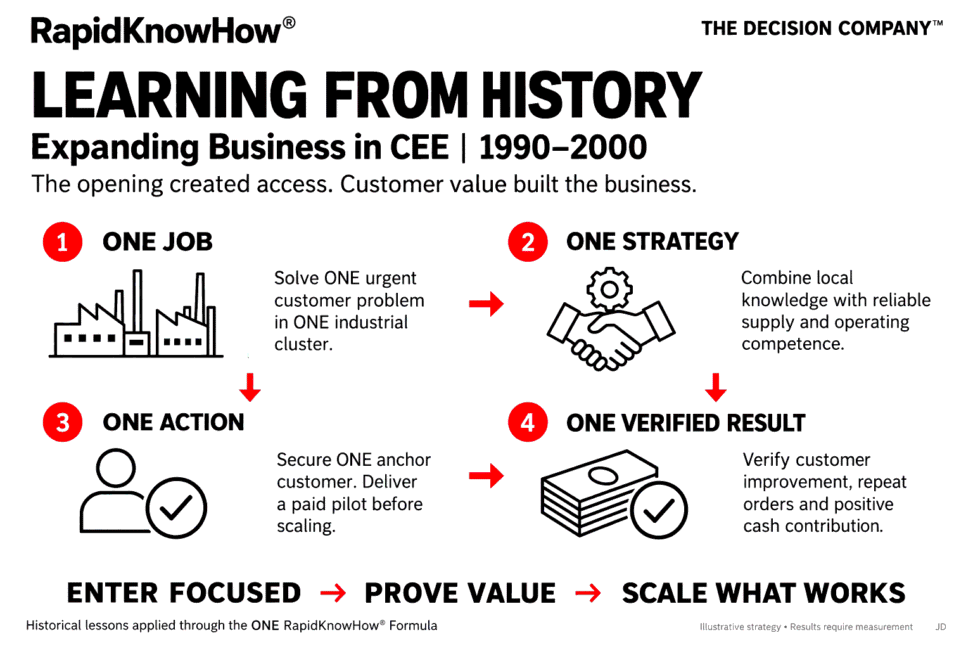
The strongest expansion strategy was to enter a carefully selected market, solve an urgent customer problem with capable local people, and expand after proving the business could generate cash.
The opening of the Iron Curtain in 1989 created extraordinary opportunities. But market opening, privatization and functioning commercial institutions progressed at different speeds. An attractive industrial market could still have weak payment systems, uncertain ownership and difficult contract enforcement. CEE required country-by-country judgment. imf.org
The following business lessons are a practical interpretation of the historical evidence, rather than a claim that one strategy worked everywhere.
1. Select ONE industrial cluster
“Expand into Eastern Europe” was too broad an objective. A more actionable objective was: serve a defined group of customers in one industrial region.
For an industrial supplier, that meant assessing customer concentration, transport distances, infrastructure, competitive supply and customers’ ability to pay.
| Decision | Strong expansion approach | Common mistake |
|---|---|---|
| Where to enter | One country and a reachable customer cluster | Several countries simultaneously |
| Whom to serve | Customers with urgent needs and credible payment capacity | Every former state enterprise |
| What to offer | A measurable improvement in reliability, quality or productivity | An unchanged Western product catalogue |
| How to establish | Export, distribute, partner or acquire according to the business need | Buy assets simply because they look cheap |
| When to expand | After proving customer retention and cash collection | After reporting initial sales growth |
2. Bring operating competence with the capital
Privatization transferred ownership, but ownership alone did not create a competitive business. Governance, management incentives, investment and restructuring also mattered. Historical research found substantial differences in privatization outcomes, including stronger performance in some businesses sold to foreign investors. elibrary.imf.org
The practical lesson: an acquisition needed a clear operating plan—customers to retain, equipment to improve, managers to develop and working capital to control.
3. Combine local knowledge with clear accountability
A capable local team could explain customer relationships, language, procurement practices and operating realities. The incoming business could contribute technology, service standards, training and financial discipline.
Trust required transparent accounts, clear decision rights and agreed responsibilities. Personal access alone was an insufficient foundation for expansion.
This follows from a central historical finding: the quality of institutions and the business environment influenced transition outcomes. ebrd.com
4. Serve the emerging economy as well as existing industry
The opportunity extended beyond purchasing established factories. New private enterprises became important sources of growth and employment during the transition. ideas.repec.org
A useful customer portfolio therefore combined:
- Established industrial customers with credible restructuring prospects.
- New private businesses requiring dependable suppliers.
- Incoming international manufacturers needing local service.
5. Make cash collection part of the entry strategy
A signed contract was only the beginning. A practical expansion plan needed customer credit checks, disciplined payment terms, inventory control and investment tied to demonstrated demand.
Measure cash collected, contribution after delivery costs, working capital and capital employed alongside revenue. These are recommended business controls, rather than historical results established by the cited studies.
Applying the RapidKnowHow® Formula
| Step | CEE expansion example |
|---|---|
| ONE JOB | Help manufacturers in one selected cluster reduce production interruptions. |
| ONE STRATEGY | Combine dependable supply, local technical service and measurable customer savings. |
| ONE ACTION | Secure one anchor customer and deliver a paid pilot before committing major capital. |
| ONE VERIFIED RESULT | Confirm fewer interruptions, repeat orders and positive cash contribution after service and delivery costs. |
For industrial gases, this could mean first establishing contracted demand and reliable delivery within an economical service radius, then adding storage, filling or production capacity when the customer base supports it. This is an illustrative application, not a documented company case.
The lasting lesson: political opening creates access. Customer value, local competence and disciplined execution turn access into a sustainable business. – Josef David
RapidKnowHow® — Learning from History
Business Case: Entering the CEE Industrial Gas Market | 1990–2000
ONE JOB — Enter the CEE Market
Establish a profitable industrial gas business serving international joint ventures in selected CEE industrial clusters.
ONE STRATEGY — Target International Joint Ventures
Become their trusted local industrial gas partner by meeting international quality, safety and supply standards. Use each successful customer relationship as a reference to win nearby customers.
ONE ACTION — Best Quality Products. No Stock Outs.
Deliver gases to agreed purity specifications, supported by dependable logistics, monitored inventory, timely replenishment and backup supply.
ONE VERIFIED RESULT — Top KPIs within Four Years
Verify performance against the starting baseline, agreed customer standards and credible competitor benchmarks:
| KPI | Evidence of success |
|---|---|
| Product quality | Deliveries consistently meet agreed specifications |
| Supply continuity | Zero supplier-caused stock outs |
| Delivery reliability | Agreed on-time, in-full target achieved |
| Customer retention | Anchor customers renew and expand |
| Market position | Leading supplier to the selected JV customer cluster |
| Capital productivity | ROCE meets the agreed investment hurdle |
| Free cash flow | Positive FCF after working capital and capital expenditure |
Four-year execution:
Year 1: Win anchor JVs → Year 2: Prove reliable supply → Year 3: Build cluster density → Year 4: Verify leadership and financial performance.
These are proposed success criteria. “Verified” requires actual four-year results.
The business logic: International standards win entry. Reliable supply earns trust. Customer density improves capital productivity and cash generation.
– HAND PICKED, ENTREPRENEURIAL PEOPLE THRIVE -Josef David
RapidKnowHow® — THE DECISION COMPANY™
Industrial Gas Leadership 2030
PROVE VALUE. THEN SCALE.
Watch the 60-second roadmap: 10 strategic actions for DACH and CEE, 2026–2030.
Start with ONE customer challenge. Use the Industrial Gas Action Guide to turn your first action into a measurable result.
RapidKnowHow® — Leading Industrial Gas Opportunity Signal Identifier in DACH & CEE