
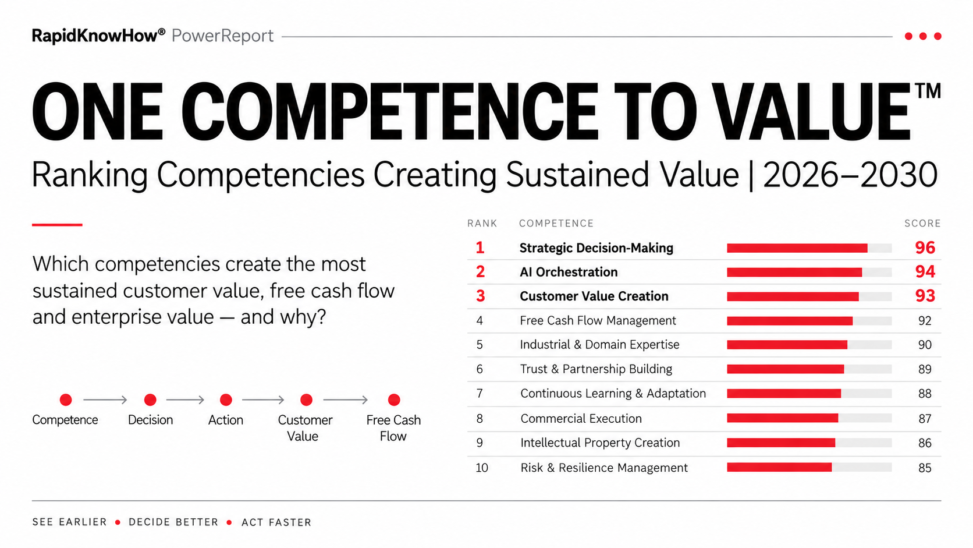
ONE COMPETENCE TO VALUE™
Ranking the 10 Competencies Creating Sustained Value | 2026–2030
Strategic Question: Which competencies will create the greatest sustainable customer value, free cash flow and shareholder value through 2030?
Published: 30 October 2026
Perspective: Business Owners · CEOs · Investors · Market Leaders
RapidKnowHow® — THE DECISION COMPANY™
SEE EARLIER • DECIDE BETTER • ACT FASTER
1. EXECUTIVE CONCLUSION
The most valuable competency in 2030 will not be knowing more. It will be converting knowledge into measurable results, repeatedly.
Five developments support this conclusion:
- The World Economic Forum expects 39% of workers’ existing skills to change or become outdated between 2025 and 2030. Weltwirtschaftsforum
- PwC’s June 2026 research reports an average 62% wage premium for jobs requiring AI skills. PwC
- McKinsey’s August 2026 survey finds that high-performing AI organizations fundamentally redesign workflows substantially more often than other organizations. McKinsey & Company
- OECD research emphasizes adaptive problem-solving and continuous learning as foundations for sustained productivity. OECD
- IBM’s September 2026 research identifies human judgment and the ability to supervise AI as increasingly critical competencies. IBM Newsroom
RapidKnowHow conclusion:
Knowledge creates potential.
Competence turns potential into action.
Verified customer outcomes convert action into economic value.
Repeatability makes that value sustainable.
2. TOP 10 COMPETENCIES — RANKING 2026–2030
This is RapidKnowHow’s strategic ranking, not a published labor-market ranking.
The assessment considers four criteria:
Customer Value 35% | Cash Conversion 25% | Sustainability 20% | Scalability 20%.
Scores represent strategic assessments, not independently measured performance.
| Rank | Competence | Value Score |
|---|---|---|
| 1 | Strategic Decision-Making | 96 |
| 2 | AI Orchestration | 94 |
| 3 | Customer Value Creation | 93 |
| 4 | Free Cash Flow Management | 92 |
| 5 | Industrial & Domain Expertise | 90 |
| 6 | Trust & Partnership Building | 89 |
| 7 | Continuous Learning & Adaptation | 88 |
| 8 | Commercial Execution | 87 |
| 9 | Intellectual Property Creation | 86 |
| 10 | Risk & Resilience Management | 85 |
WHY THESE COMPETENCIES?
1. STRATEGIC DECISION-MAKING — 96/100
The competence to identify the most valuable opportunities, evaluate alternatives and select ONE action.
Why sustained value?
Better decisions prevent capital misallocation and focus limited resources on opportunities with the highest expected return.
Value created: Higher ROCE, better investment decisions and fewer strategic failures.
2. AI ORCHESTRATION — 94/100
The ability to integrate AI, human judgment and operational processes into a reliable business system.
Why sustained value?
AI tools become widely available. The competitive advantage increasingly comes from redesigning workflows, controlling quality and delivering superior outcomes.
Value created: Productivity, speed, scalable operations and lower operating costs.
3. CUSTOMER VALUE CREATION — 93/100
Understanding customers’ jobs to be done and solving them better than competing alternatives.
Why sustained value?
Customers continue purchasing when solutions deliver measurable benefits.
Value created: Revenue growth, retention and recurring business.
4. FREE CASH FLOW MANAGEMENT — 92/100
Converting operational performance into cash available after necessary investments.
Why sustained value?
Revenue growth alone does not guarantee shareholder value. Cash generation supports reinvestment, resilience and distributions.
Value created: Sustainable FCF and increased financial flexibility.
5. INDUSTRIAL & DOMAIN EXPERTISE — 90/100
Deep understanding of specialized markets, technologies, customers and operating systems.
Why sustained value?
Domain expertise helps distinguish workable solutions from attractive but impractical proposals.
Value created: Better reliability, differentiated solutions and fewer operational mistakes.
6. TRUST & PARTNERSHIP BUILDING — 89/100
The ability to build lasting relationships through transparency, competence and fair value sharing.
Why sustained value?
Trust lowers coordination costs and supports long-term customer and partner relationships.
Value created: Repeat business, renewals and partnership growth.
7. CONTINUOUS LEARNING — 88/100
Learning quickly, questioning assumptions and adapting successfully.
Why sustained value?
Technologies change. Customer needs evolve. Established methods become obsolete.
Value created: Sustained relevance and faster innovation.
8. COMMERCIAL EXECUTION — 87/100
Converting valuable solutions into signed contracts, paying customers and profitable sales.
Why sustained value?
An excellent solution without effective commercialization creates little realized economic value.
Value created: Paying customers, stronger pricing and improved cash conversion.
9. INTELLECTUAL PROPERTY CREATION — 86/100
Turning repeatable knowledge into protected and commercially useful methods, products and licensing systems.
Why sustained value?
Reusable intellectual property can enable recurring revenues without rebuilding the underlying solution for every customer.
Value created: Licensing income, scalability and stronger differentiation.
10. RISK & RESILIENCE MANAGEMENT — 85/100
Anticipating technological, operational, financial and cybersecurity threats.
Why sustained value?
Companies must protect the value they create.
IBM’s 2026 research estimates the global average data-breach cost at approximately $4.99 million. IBM Newsroom
Value created: Business continuity and protection against avoidable losses.
3. ONE COMPETENCE-TO-VALUE MODEL™
THE RAPIDKNOWHOW® VALUE CONVERSION FLOW
COMPETENCE
↓
ONE BETTER DECISION
↓
ONE EXECUTED ACTION
↓
VERIFIED CUSTOMER VALUE
↓
FREE CASH FLOW
↓
REINVESTMENT + REPEAT BUSINESS
↓
SUSTAINED ENTERPRISE VALUE
The essential principle:
A competence becomes economically valuable when it produces a demonstrable result.
A growing enterprise value follows only when those results are repeatable, economically attractive and durable.
4. INDUSTRIAL APPLICATION: ONE BUSINESS CASE
Industrial Gas Growth — DACH + CEE 2027
ONE JOB
Help industrial gas buyers reduce their total cost of ownership while maintaining supply reliability.
ONE STRATEGY
Combine industrial gas expertise, AI-supported demand analysis and improved supplier coordination.
ONE ACTION
Implement a verified 90-day pilot for a selected industrial customer.
Illustrative Value Delivery
| Indicator | Before | Target |
|---|---|---|
| Annual relevant costs | €1,000,000 | €920,000 |
| Annual customer savings | — | €80,000 |
| Supply reliability | 97% | 99% |
| Customer annual value | Baseline | +€80,000 |
These are hypothetical pilot targets, not observed customer results.
The €80,000 cost reduction is a potential customer benefit, not automatically RapidKnowHow revenue or free cash flow.
RapidKnowHow creates its own economic value through an agreed commercial arrangement, such as a fixed fee, performance-based fee or recurring IP licence.
The outcome must be measured before the solution is scaled.
5. COMPETENCE DEVELOPMENT ROADMAP 2026–2030
| Year | Strategic Priority | Required Result |
|---|---|---|
| 2026 | Identify and rank competencies | ONE Value Baseline |
| 2027 | Apply competencies to customer problems | Verified Customer Results |
| 2028 | Standardize repeatable solutions | Scalable Operating Models |
| 2029 | Commercialize and license proven solutions | Recurring Profitable Revenue |
| 2030 | Build a compounding value ecosystem | Sustained FCF Growth |
Strategic transition:
2026 — KNOW
2027 — APPLY
2028 — STANDARDIZE
2029 — LICENSE
2030 — COMPOUND
6. THE COMPETENCE-TO-VALUE SCORECARD
Five measures connect competence development to actual business outcomes.
| KPI | What We Measure |
|---|---|
| 1. Decision Quality | Percentage of strategic decisions meeting predefined success criteria |
| 2. Customer Value | Verified annual customer financial benefit |
| 3. Commercial Conversion | Paying customers ÷ qualified solution opportunities |
| 4. FCF Conversion | Free cash flow ÷ operating profit, using a consistent definition |
| 5. Value Durability | Customer renewals and recurring contribution |
ONE MANAGEMENT RULE
Never rank a competence only by how fashionable or technically advanced it is.
Rank it by the value it creates and how reliably that value can be repeated.
7. RAPIDKNOWHOW® STRATEGIC ACTION
ONE OBJECTIVE
Establish a commercially useful Competence-to-Value Model for business leaders and investors.
ONE STRATEGY
Connect the ten competencies to specific business opportunities, customer benefits and measurable financial outcomes.
TOP 3 ACTIONS
ACTION 1 — RANK
Select the three competencies creating the greatest opportunity for a specific company.
ACTION 2 — PROVE
Demonstrate ONE measurable customer or business outcome within 90 days.
ACTION 3 — SCALE
Convert the verified solution into a repeatable PowerActionGuide, Operating System or licensed intellectual property offering.
8. ONE BOARD DECISION
Where should we invest in competence development between 2026 and 2030 to create the greatest sustainable free cash flow?
RapidKnowHow® Recommendation
Prioritize the combination of:
1. Strategic Decision-Making
2. AI Orchestration
3. Customer Value Creation
Support these three competencies with strong financial discipline, specialized expertise and commercial execution.
Together, they offer a promising foundation for converting knowledge into measurable business results.
Actual investment priorities should be validated against each company’s existing capabilities, market position and economics.
ONE POWER CONCLUSION
KNOWLEDGE IS NOT THE VALUE.
COMPETENCE CREATES THE POSSIBILITY.
EXECUTION CREATES THE RESULT.
FREE CASH FLOW DEMONSTRATES THE ECONOMIC VALUE.
REPEATABILITY MAKES IT SUSTAINABLE.
RapidKnowHow® — THE DECISION COMPANY™
Knowledge is useless unless it improves someone’s life.
POWERREPORT | 2026–2030 | Josef David
RapidKnowHow® — THE DECISION COMPANY™
Industrial Gas Leadership 2030
PROVE VALUE. THEN SCALE.
Watch the 60-second roadmap: 10 strategic actions for DACH and CEE, 2026–2030.
Start with ONE customer challenge. Use the Industrial Gas Action Guide to turn your first action into a measurable result.
RapidKnowHow® — Leading Industrial Gas Opportunity Signal Identifier in DACH & CEE