
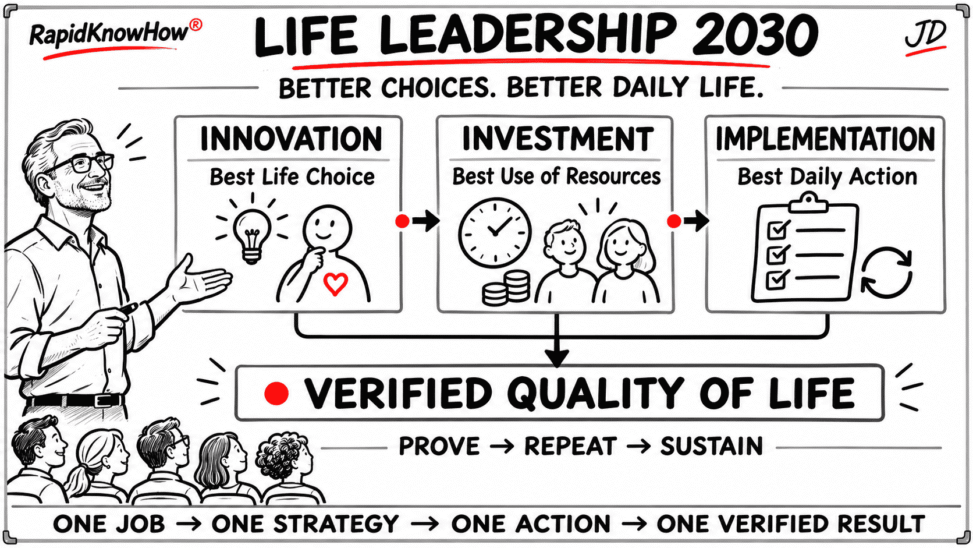
Life leadership means directing your choices, resources and daily actions toward a life you value—and checking whether those actions actually help.
The MASTER follows the same three-part logic as Business Leadership 2030:
INNOVATION → INVESTMENT → IMPLEMENTATION → VERIFIED QUALITY OF LIFE
| Leadership decision | Leading question | Required result |
|---|---|---|
| Innovation | What should I change to improve my life? | ONE worthwhile life choice |
| Investment | Where should I commit my time, energy, money and attention? | Resources matched to my priority |
| Implementation | Which action can I repeat consistently? | ONE observable improvement |
Financial security matters alongside health, relationships, autonomy and meaningful activity. The OECD similarly assesses well-being across multiple dimensions rather than income alone. OECD
1. Innovation to Life Leadership — Find the best Life Improvement Model
The leading question is:
“Which recurring problem, if improved, would make the greatest practical difference to my daily life?”
For this report, examine five areas:
| Life area | Recognize the problem | Identify a useful improvement |
|---|---|---|
| Health and energy | Daily demands exceed available energy | A more manageable routine |
| Time and autonomy | Commitments crowd out personal priorities | Protected time for what matters |
| Relationships | Important connections receive little attention | Regular, meaningful contact |
| Financial resilience | Recurring commitments create pressure | Better visibility and control of household cash |
| Purpose and contribution | Days feel busy but unrewarding | A meaningful activity or contribution |
Recommended model: start with the most important recurring constraint and test ONE manageable change.
A useful change might be simplifying an obligation, arranging regular contact with a friend, removing an unwanted expense or making space for a personally meaningful project.
Judge the choice by its likely benefit, effort, affordability and effect on other people.
🔴 Intervention point: You recognize dissatisfaction but have too many possible improvements.
🔴 Leverage point: Select ONE recurring problem that you can influence.
Documented PUBLIC case — Harvard Study of Adult Development. Harvard reports long-term associations between relationship quality, well-being and health. This supports giving relationships explicit attention. The observational findings do not guarantee that any particular social activity will produce a specific health outcome. Harvard Gazette
RapidKnowHow® application: Put one valued relationship into your weekly calendar and review whether the contact feels worthwhile to both people.
2. Investment to Life Leadership — Find the best Resource Allocation for Your Life Phase
The leading question is:
“What deserves more of my limited resources at this stage of life?”
Life investment includes time, energy, attention, money and mutual support. The right allocation changes with circumstances.
| Life situation | Priority to evaluate | Practical allocation |
|---|---|---|
| Building independence | Capability and stability | Time for useful skills and essential routines |
| Managing work and family responsibilities | Capacity and coordination | Shared responsibilities and protected personal time |
| Navigating a transition | Adaptation and support | Time to explore options before taking on major commitments |
| Later life and retirement | Autonomy, connection and meaning | Accessible activities, valued relationships and purposeful contribution |
Recommended model: fund your priority with resources released from a lower-value commitment.
Before adding something new, identify what can be stopped, simplified, shared or reduced.
For example, reclaiming 30 minutes on five days creates 2½ hours per week. That time becomes useful when it is deliberately assigned to something you value.
🔴 Intervention point: You want improvement but have no spare capacity.
🔴 Leverage point: Release ONE resource drain before adding ONE commitment.
Decision rule: An improvement should remain worthwhile after accounting for its cost, effort and effects on other life areas.
3. Implementor to Life Leadership — Find the best Daily Action and Support Model
The leading question is:
“Which small action can I reliably carry out in my actual circumstances?”
Choose support according to the obstacle.
| Implementation obstacle | Model to use | Evidence to review |
|---|---|---|
| Forgetting | Attach the action to an existing routine | Whether it happens consistently |
| Too much effort | Reduce preparation and simplify the action | Whether starting becomes easier |
| Lack of confidence or knowledge | Learn with an appropriate guide or professional | Whether understanding and capability improve |
| Isolation | Agree an activity with a willing partner or group | Whether participation and connection improve |
| Competing commitments | Protect a specific calendar slot | Whether the time remains available |
Recommended model: ONE simple action, a clear cue, suitable support and a weekly review.
Documented PUBLIC case — habit formation research. Lally and colleagues studied repeated behaviours in everyday settings. Habit development varied substantially between participants; repeating a behaviour in a consistent context supported increasing automaticity. There is no universal deadline by which a new habit must become established. onlinelibrary.wiley.com
RapidKnowHow® application: Define the action precisely:
“After this existing routine, I will carry out this manageable action and record whether it helped.”
🔴 Intervention point: A good intention repeatedly fails to become action.
🔴 Leverage point: Make the action easier to start in a consistent situation.
4. Verify Life Value — Check Actions and Outcomes Separately
Completing an activity shows implementation. Its effect on your life requires a separate check.
| Example action | Implementation evidence | Life-value evidence |
|---|---|---|
| Protect time for a meaningful activity | Sessions completed | Whether the time feels worthwhile |
| Arrange regular personal contact | Meetings or calls completed | Perceived quality of connection |
| Remove unwanted recurring expenses | Cancellations confirmed | Actual reduction in payments |
| Simplify a recurring obligation | Time released | Whether pressure decreases without creating another problem |
Personal ratings can help reveal patterns, but remain subjective. Keep their wording and timing consistent.
Illustrative example: Removing €150 of unwanted monthly charges releases €150 per month once the payments stop. Reclaiming 2½ hours each week creates additional personal time. Record these separately; do not invent a monetary value for the time or combine them into a single “life return.”
5. ONE 30-Day Life Leadership Experiment
- Days 1–7: Observe ONE problem and record a simple baseline.
- Day 8: Choose ONE change and allocate the necessary resources.
- Days 8–30: Apply the action and review it weekly.
- Day 30: Compare the experience with the baseline.
- Decide: CONTINUE, REVISE or STOP.
Thirty days provides an initial learning period. Longer observation may be necessary to judge lasting improvement.
ONE prioritized action: Complete this sentence today:
“Over the next 30 days, I will improve ______ by doing ______, using ______, and checking ______.”
RapidKnowHow® MASTER Principle
ONE JOB → ONE STRATEGY → ONE ACTION → ONE VERIFIED RESULT
PROVE → REPEAT → SUSTAIN
Knowledge is useless unless it improves someone’s life.