
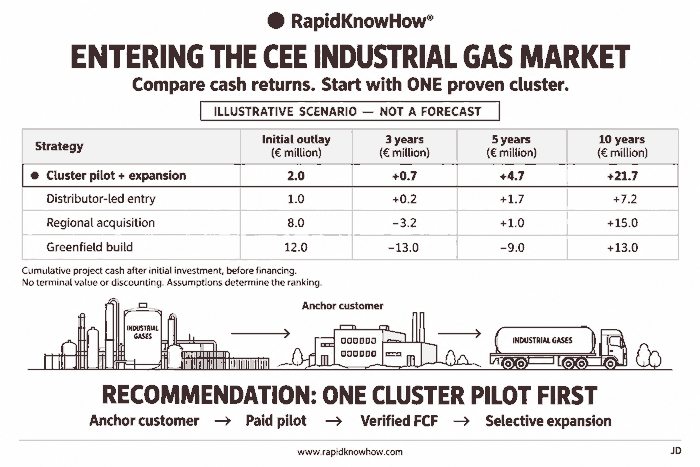
Recommend ONE cluster pilot first, then expand using verified cash returns. For a regional entrant, this offers a practical balance between early cash generation, capital exposure and long-term growth.
The comparison below is an illustrative scenario—not a forecast or verified CEE business case. Figures represent cumulative project cash after initial investment, before financing, in € million.
| CEE entry strategy | Initial Outlay | 3-year cash | 5-year cash | 10-year cash | Assessment |
|---|---|---|---|---|---|
| ONE cluster pilot → selective expansion | 2.0 | +0.7 | +4.7 | +21.7 | Best modeled balance of capital discipline and growth |
| Distributor-led entry | 1.0 | +0.2 | +1.7 | +7.2 | Low initial exposure; less control over service and margins |
| Acquire regional operator | 8.0 | −3.2 | +1.0 | +15.0 | Immediate customer access; purchase price and integration determine returns |
| Build production and logistics | 12.0 | −13.0 | −9.0 | +13.0 | Strong infrastructure control; substantial capital and demand risk |
Model assumptions: annual operating FCF after tax, working capital and ongoing capex averages, respectively, €0.9m / €0.4m / €1.6m / −€0.3m during years 1–3; €2.0m / €0.75m / €2.1m / €2.0m during years 4–5; and €3.4m / €1.1m / €2.8m / €4.4m during years 6–10. No terminal value or discounting is included. These assumptions drive the ranking; actual quotations and customer commitments could change it.
Industrial gas strategy should connect supply modes and increase network density. Linde explicitly describes this approach across onsite, merchant and packaged gases; its onsite arrangements also commonly use long-term contracts and minimum purchase requirements. This supports the operating logic, not the illustrative figures above. Linde
Conclusion by horizon
- 3 years: prioritize contracted demand, reliable delivery and limited capital commitment.
- 5 years: deepen the winning cluster; add customers that improve delivery density and asset utilization.
- 10 years: connect proven clusters; consider acquisitions or production assets where contracted demand justifies them.
ONE recommendation:
ONE cluster → ONE anchor customer → ONE paid pilot → Verified FCF → Selective replication.
Use AI orchestration to support demand visibility, replenishment and delivery planning; use stakeholder management to agree responsibilities and service standards.
ONE first action: build a customer-backed pilot case with signed demand, supply quotations, full TCO, investment requirements and downside cash flow. Expand only after reliability and net cash gains are demonstrated.
RapidKnowHow® — THE DECISION COMPANY™
Industrial Gas Leadership 2030
PROVE VALUE. THEN SCALE.
Watch the 60-second roadmap: 10 strategic actions for DACH and CEE, 2026–2030.
Start with ONE customer challenge. Use the Industrial Gas Action Guide to turn your first action into a measurable result.
RapidKnowHow® — Leading Industrial Gas Opportunity Signal Identifier in DACH & CEE