
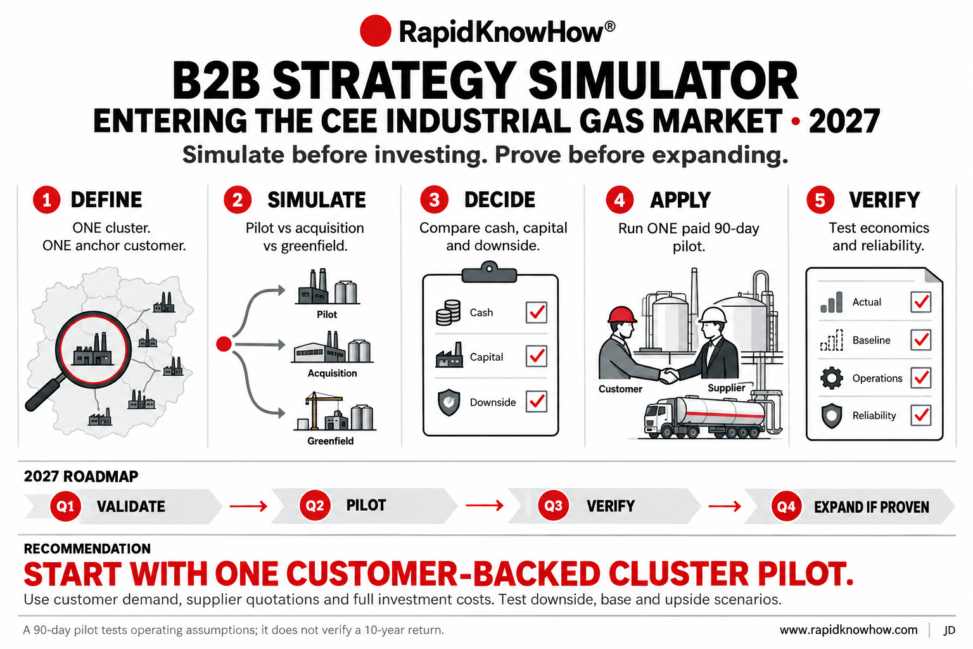
ONE decision: Which entry strategy can generate sustainable free cash flow while limiting capital at risk?
| Simulator step | Application |
|---|---|
| DEFINE | Select ONE industrial cluster, customer segment and gas application. Establish demand, current supply problems and available capital. |
| SIMULATE | Compare cluster pilot, regional acquisition and greenfield entry over 3, 5 and 10 years. |
| DECIDE | Assess cumulative cash, funding required, payback and downside exposure alongside supply reliability. |
| APPLY | Secure ONE anchor customer, qualified supply partners and a paid 90-day pilot. |
| VERIFY | Compare actual demand, delivery cost, working capital and service performance against the model. |
Build the simulation from customer evidence.
| Required input | What to establish |
|---|---|
| Demand | Gas, purity, volume, variability and customer commitments |
| Revenue | Contract prices, rental and service income |
| Operating costs | Gas sourcing, energy, transport, people, maintenance and losses |
| Capital | Tanks, cylinders, vehicles, equipment and installation |
| Working capital | Inventory, customer payment periods and supplier terms |
| Downside | Slower customer uptake, lower volumes, higher costs and supply disruption |
Use the same scope and assumptions across strategies:
Project FCF = operating cash after tax − capital expenditure − increase in working capital.
Deduct acquisition and initial entry outlays when comparing cumulative project cash. Show downside, base and upside scenarios; the earlier illustrative figures remain assumptions until supported by quotations and customer commitments.
My recommendation: enter through ONE customer-backed cluster pilot. Use qualified existing supply capacity initially, then add assets when demonstrated demand and delivery economics justify them. Acquisition becomes attractive when its purchase price and integration costs outperform that route; greenfield requires sufficient contracted demand.
2027 execution
| Period | Decision and action |
|---|---|
| Q1 | Validate ONE cluster, obtain supply quotations and secure an anchor customer. |
| Q2 | Run the paid pilot with agreed safety, quality and reliability requirements. |
| Q3 | Verify unit economics and cash impact; correct the main constraint. |
| Q4 | Expand within the cluster if the evidence supports it. |
A 90-day pilot can test operating assumptions; it cannot verify a 10-year return.
ONE next action: complete ONE cluster input sheet and replace assumptions with customer demand, supplier quotations and investment costs.
Simulate before investing. Prove before expanding.
ONE B2B Strategy Simulator 2030
Test ONE strategy before committing capital.
DEFINE → SIMULATE → DECIDE → APPLY → VERIFY
Start with the Industrial Gas CEE example or enter your own assumptions. The example figures are illustrative—not forecasts. This calculator does not send your inputs to a server.
● ONE Job
● ONE Comparison
All amounts are in € million. Enter annual cash after tax, working-capital changes and ongoing capital expenditure, before financing. Initial investment is deducted separately: do not count the same cost twice.
Strategy 1
Strategy 2
Strategy 3
Separate the 10 annual values with commas. Use a decimal point for fractions. Negative cash values are allowed.
Stress: positive annual cash falls by 25%; negative annual cash costs increase by 25%. Upside reverses these changes. Initial investment remains unchanged. These are simple sensitivities, not probability estimates.
● ONE Result
| Strategy | Initial investment | 3-year cash | 5-year cash | 10-year cash | Payback |
|---|
Bars show the magnitude of cumulative cash at your selected horizon. Red indicates positive cash; grey indicates negative cash. Read the signed figures beside each bar.
Ranking uses cumulative undiscounted project cash after initial investment. It does not include terminal value, financing, discounting, probability weighting or a ROCE calculation. Different investment scales affect the comparison.
Payback is the first year-end when cumulative cash becomes non-negative. Later cash flows can make it negative again.
● ONE Next Action
Validate ONE strategy with customer commitments, supplier quotations and full investment costs. Agree ONE pilot with a named owner, baseline, safety and service requirements, and measurable success criteria.
Simulate before investing. Prove before expanding.
“2030” is the simulator name. A 2027 start produces a 10-year horizon ending in 2036. A 90-day pilot tests operating assumptions; it cannot verify a 10-year return.
RapidKnowHow® — THE DECISION COMPANY™
Industrial Gas Leadership 2030
PROVE VALUE. THEN SCALE.
Watch the 60-second roadmap: 10 strategic actions for DACH and CEE, 2026–2030.
Start with ONE customer challenge. Use the Industrial Gas Action Guide to turn your first action into a measurable result.
RapidKnowHow® — Leading Industrial Gas Opportunity Signal Identifier in DACH & CEE